

8.3 IBL ∞ -algebras
209
One sometimes considers versions of Definition 8.2 with ¯
h having degree
different from 0. The convention when | ¯
h| = 2 is implicit in [6] and explicit in
[2], an arbitrary even degree is allowed in [3, 4]. Our convention that ¯
h has degree
zero follows [13] and, of course, [12]. When | ¯
h| = 0, the operator Δ k in (8.43)
has degree
1 + (1 − k)| ¯
h|
and the operators ω s
k,t,g in (8.47) degree
1 + (1 − k − g)| ¯
h|.
Example 8.2 Suppose that | ¯
h| = 2 and consider IBL ∞ -algebras for which the only
nontrivial operations are ω 1
2,2,0 : S 2 (U ) → U of degree −1 and ω 2
1,1,0 : U →
S 2 (U ) of degree 1. This in particular means that Δ in (8.43) is of the form
Δ = Δ 1 + ¯
hΔ 2 ,
(8.48)
where Δ 1 , Δ 2 : S(U ) → S(U ). It turns out that such IBL ∞ -algebras are the same
as involutive Lie bialgebras whose definition we recall below, on the desuspension
V :=↓ U of U .
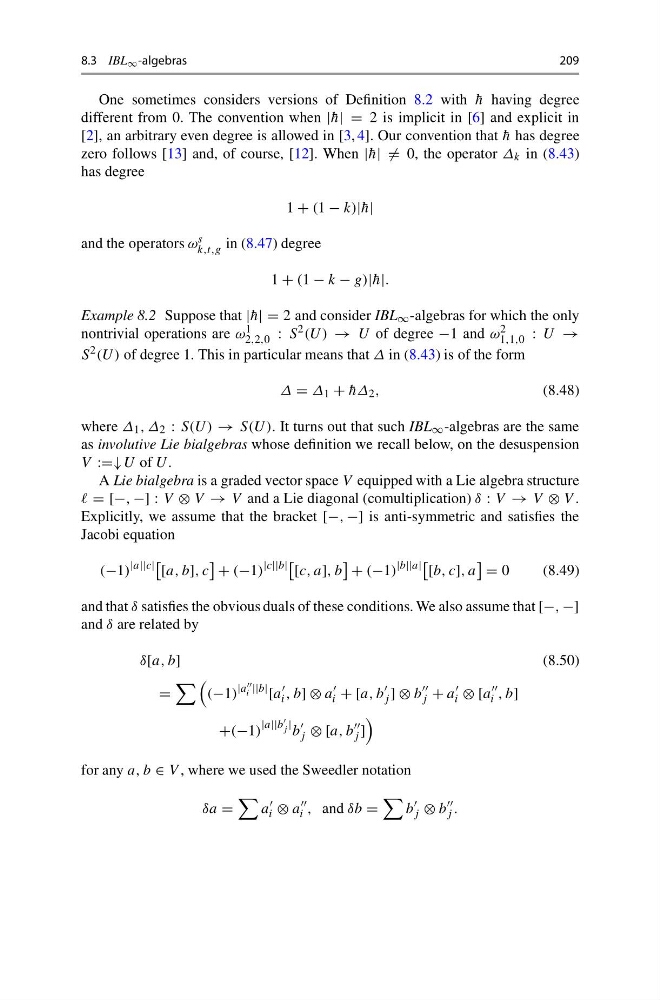
A Lie bialgebra is a graded vector space V equipped with a Lie algebra structure
= [−, −] : V ⊗ V → V and a Lie diagonal (comultiplication) δ : V → V ⊗ V .
Explicitly, we assume that the bracket [−, −] is anti-symmetric and satisfies the
Jacobi equation
(−1)
|a||c|
[a, b], c
+ (−1)
|c||b|
[c, a], b
+ (−1)
|b||a|
[b, c], a
= 0
(8.49)
and that δ satisfies the obvious duals of these conditions. We also assume that [−, −]
and δ are related by
δ[a, b]
(8.50)
=
(−1)
|a
i ||b|
[a
i , b] ⊗ a
i + [a, b
j ] ⊗ b
j + a
i ⊗ [a
i , b]
+(−1)
|a||b
j | b
j ⊗ [a, b
j ]
for any a, b ∈ V , where we used the Sweedler notation
δa =
a
i ⊗ a
i , and δb =
b
j ⊗ b
j .
209
One sometimes considers versions of Definition 8.2 with ¯
h having degree
different from 0. The convention when | ¯
h| = 2 is implicit in [6] and explicit in
[2], an arbitrary even degree is allowed in [3, 4]. Our convention that ¯
h has degree
zero follows [13] and, of course, [12]. When | ¯
h| = 0, the operator Δ k in (8.43)
has degree
1 + (1 − k)| ¯
h|
and the operators ω s
k,t,g in (8.47) degree
1 + (1 − k − g)| ¯
h|.
Example 8.2 Suppose that | ¯
h| = 2 and consider IBL ∞ -algebras for which the only
nontrivial operations are ω 1
2,2,0 : S 2 (U ) → U of degree −1 and ω 2
1,1,0 : U →
S 2 (U ) of degree 1. This in particular means that Δ in (8.43) is of the form
Δ = Δ 1 + ¯
hΔ 2 ,
(8.48)
where Δ 1 , Δ 2 : S(U ) → S(U ). It turns out that such IBL ∞ -algebras are the same
as involutive Lie bialgebras whose definition we recall below, on the desuspension
V :=↓ U of U .
A Lie bialgebra is a graded vector space V equipped with a Lie algebra structure
= [−, −] : V ⊗ V → V and a Lie diagonal (comultiplication) δ : V → V ⊗ V .
Explicitly, we assume that the bracket [−, −] is anti-symmetric and satisfies the
Jacobi equation
(−1)
|a||c|
[a, b], c
+ (−1)
|c||b|
[c, a], b
+ (−1)
|b||a|
[b, c], a
= 0
(8.49)
and that δ satisfies the obvious duals of these conditions. We also assume that [−, −]
and δ are related by
δ[a, b]
(8.50)
=
(−1)
|a
i ||b|
[a
i , b] ⊗ a
i + [a, b
j ] ⊗ b
j + a
i ⊗ [a
i , b]
+(−1)
|a||b
j | b
j ⊗ [a, b
j ]
for any a, b ∈ V , where we used the Sweedler notation
δa =
a
i ⊗ a
i , and δb =
b
j ⊗ b
j .