

202
8 Structures Relevant to Physics
where the second sum is taken over all n 1 + n 2 = n, g 1 + g 2 = g, and unshuffles
σ ∈ uSh(n 1 , n 2 ). 6
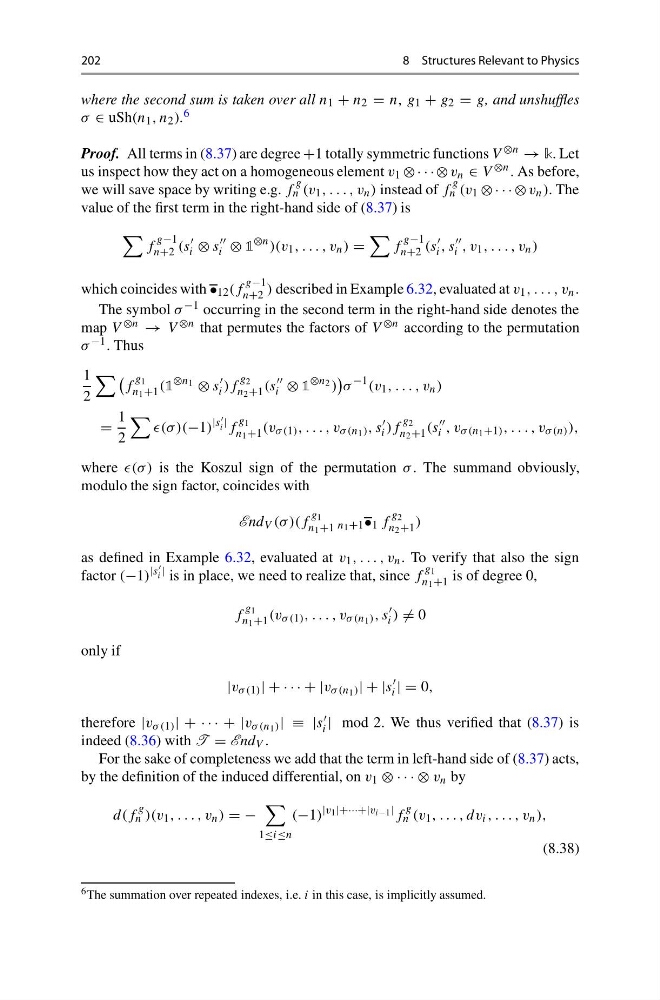
Proof. All terms in (8.37) are degree +1 totally symmetric functions V ⊗n → k. Let
us inspect how they act on a homogeneous element v 1 ⊗ · · · ⊗ v n ∈ V ⊗n . As before,
we will save space by writing e.g. f
g
n (v 1 , . . . , v n ) instead of f
g
n (v 1 ⊗ · · · ⊗ v n ). The
value of the first term in the right-hand side of (8.37) is
f
g−1
n+2 (s
i ⊗ s
i ⊗ 1
⊗n )(v 1 , . . . , v n ) =
f
g−1
n+2 (s
i , s
i , v 1 , . . . , v n )
which coincides with • 12 (f
g−1
n+2 ) described in Example 6.32, evaluated at v 1 , . . . , v n .
The symbol σ −1 occurring in the second term in the right-hand side denotes the
map V ⊗n → V ⊗n that permutes the factors of V ⊗n according to the permutation
σ −1 . Thus
1
2
f
g 1
n 1 +1 (1
⊗n 1 ⊗ s
i )f
g 2
n 2 +1 (s
i ⊗ 1
⊗n 2 )
σ
−1 (v 1 , . . . , v n )
=
1
2
)(−1)
|s
i | f
g 1
n 1 +1 (v σ (1) , . . . , v σ (n 1 ) , s
i )f
g 2
n 2 +1 (s
i , v σ (n 1 +1) , . . . , v σ (n) ),
where (σ ) is the Koszul sign of the permutation σ . The summand obviously,
modulo the sign factor, coincides with
End V (σ )(f
g 1
n 1 +1 n 1 +1 • 1 f
g 2
n 2 +1 )
as defined in Example 6.32, evaluated at v 1 , . . . , v n . To verify that also the sign
factor (−1)
|s
i | is in place, we need to realize that, since f
g 1
n 1 +1 is of degree 0,
f
g 1
n 1 +1 (v σ (1) , . . . , v σ (n 1 ) , s
i ) = 0
only if
|v σ (1) | + · · · + |v σ (n 1 ) | + |s
i | = 0,
therefore |v σ (1) | + · · · + |v σ (n 1 ) | ≡ |s
i | mod 2. We thus verified that (8.37) is
indeed (8.36) with T = End V .
For the sake of completeness we add that the term in left-hand side of (8.37) acts,
by the definition of the induced differential, on v 1 ⊗ · · · ⊗ v n by
d(f
g
n )(v 1 , . . . , v n ) = −
1≤i≤n
(−1)
|v 1 |+···+|v i−1 | f
g
n (v 1 , . . . , dv i , . . . , v n ),
(8.38)
6 The summation over repeated indexes, i.e. i in this case, is implicitly assumed.
8 Structures Relevant to Physics
where the second sum is taken over all n 1 + n 2 = n, g 1 + g 2 = g, and unshuffles
σ ∈ uSh(n 1 , n 2 ). 6
Proof. All terms in (8.37) are degree +1 totally symmetric functions V ⊗n → k. Let
us inspect how they act on a homogeneous element v 1 ⊗ · · · ⊗ v n ∈ V ⊗n . As before,
we will save space by writing e.g. f
g
n (v 1 , . . . , v n ) instead of f
g
n (v 1 ⊗ · · · ⊗ v n ). The
value of the first term in the right-hand side of (8.37) is
f
g−1
n+2 (s
i ⊗ s
i ⊗ 1
⊗n )(v 1 , . . . , v n ) =
f
g−1
n+2 (s
i , s
i , v 1 , . . . , v n )
which coincides with • 12 (f
g−1
n+2 ) described in Example 6.32, evaluated at v 1 , . . . , v n .
The symbol σ −1 occurring in the second term in the right-hand side denotes the
map V ⊗n → V ⊗n that permutes the factors of V ⊗n according to the permutation
σ −1 . Thus
1
2
f
g 1
n 1 +1 (1
⊗n 1 ⊗ s
i )f
g 2
n 2 +1 (s
i ⊗ 1
⊗n 2 )
σ
−1 (v 1 , . . . , v n )
=
1
2
)(−1)
|s
i | f
g 1
n 1 +1 (v σ (1) , . . . , v σ (n 1 ) , s
i )f
g 2
n 2 +1 (s
i , v σ (n 1 +1) , . . . , v σ (n) ),
where (σ ) is the Koszul sign of the permutation σ . The summand obviously,
modulo the sign factor, coincides with
End V (σ )(f
g 1
n 1 +1 n 1 +1 • 1 f
g 2
n 2 +1 )
as defined in Example 6.32, evaluated at v 1 , . . . , v n . To verify that also the sign
factor (−1)
|s
i | is in place, we need to realize that, since f
g 1
n 1 +1 is of degree 0,
f
g 1
n 1 +1 (v σ (1) , . . . , v σ (n 1 ) , s
i ) = 0
only if
|v σ (1) | + · · · + |v σ (n 1 ) | + |s
i | = 0,
therefore |v σ (1) | + · · · + |v σ (n 1 ) | ≡ |s
i | mod 2. We thus verified that (8.37) is
indeed (8.36) with T = End V .
For the sake of completeness we add that the term in left-hand side of (8.37) acts,
by the definition of the induced differential, on v 1 ⊗ · · · ⊗ v n by
d(f
g
n )(v 1 , . . . , v n ) = −
1≤i≤n
(−1)
|v 1 |+···+|v i−1 | f
g
n (v 1 , . . . , dv i , . . . , v n ),
(8.38)
6 The summation over repeated indexes, i.e. i in this case, is implicitly assumed.