

200
8 Structures Relevant to Physics
8.2
Loop Homotopy Algebras
In this section we describe algebras over the Feynman transform F (QC # ) of the
dual of the quantum closed operad QC and identify them with loop (aka quantum)
homotopy Lie algebras. As we noticed in Examples 6.24 and 6.26, the modular
operad QC is stable, isomorphic to the modular envelope Mod(Com) of the cyclic
commutative operad, which is in turn isomorphic to the linear span of the terminal
stable modular operad ∗ Mod . Thus
QC (S; g) =
k if (S, g) ∈ S, and
0 otherwise,
(8.32)
with the trivial actions of the symmetric groups. This implies that QC (S; g) # =
k for each (S, g) ∈ S and that all the structure operations of the dual modular
cooperad QC # are either the canonical isomorphisms k
∼ =
− → k ⊗ k or the identities
1 : k
∼ =
− → k.
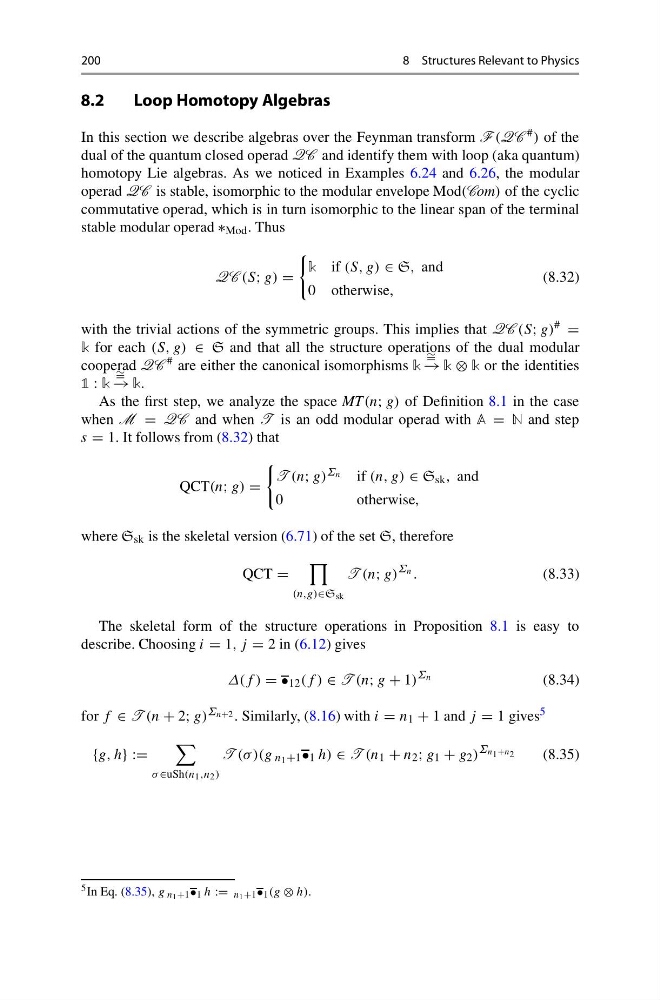
As the first step, we analyze the space MT(n; g) of Definition 8.1 in the case
when M = QC and when T is an odd modular operad with A = N and step
s = 1. It follows from (8.32) that
QCT(n; g) =
T (n; g) Σ n if (n, g) ∈ S sk , and
0
o t h e r w i s e ,
where S sk is the skeletal version (6.71) of the set S, therefore
QCT =
(n,g)∈S sk
T (n; g)
Σ n .
(8.33)
The skeletal form of the structure operations in Proposition 8.1 is easy to
describe. Choosing i = 1, j = 2 in (6.12) gives
Δ(f ) = • 12 (f ) ∈ T (n; g + 1)
Σ n
(8.34)
for f ∈ T (n + 2; g) Σ n+2 . Similarly, (8.16) with i = n 1 + 1 and j = 1 gives 5
{g, h} :=
σ ∈uSh(n 1 ,n 2 )
T (σ )(g n 1 +1 • 1 h) ∈ T (n 1 + n 2 ; g 1 + g 2 )
Σ n 1 +n 2
(8.35)
5 In Eq. (8.35), g n 1 +1 • 1 h := n 1 +1 • 1 (g ⊗ h).
8 Structures Relevant to Physics
8.2
Loop Homotopy Algebras
In this section we describe algebras over the Feynman transform F (QC # ) of the
dual of the quantum closed operad QC and identify them with loop (aka quantum)
homotopy Lie algebras. As we noticed in Examples 6.24 and 6.26, the modular
operad QC is stable, isomorphic to the modular envelope Mod(Com) of the cyclic
commutative operad, which is in turn isomorphic to the linear span of the terminal
stable modular operad ∗ Mod . Thus
QC (S; g) =
k if (S, g) ∈ S, and
0 otherwise,
(8.32)
with the trivial actions of the symmetric groups. This implies that QC (S; g) # =
k for each (S, g) ∈ S and that all the structure operations of the dual modular
cooperad QC # are either the canonical isomorphisms k
∼ =
− → k ⊗ k or the identities
1 : k
∼ =
− → k.
As the first step, we analyze the space MT(n; g) of Definition 8.1 in the case
when M = QC and when T is an odd modular operad with A = N and step
s = 1. It follows from (8.32) that
QCT(n; g) =
T (n; g) Σ n if (n, g) ∈ S sk , and
0
o t h e r w i s e ,
where S sk is the skeletal version (6.71) of the set S, therefore
QCT =
(n,g)∈S sk
T (n; g)
Σ n .
(8.33)
The skeletal form of the structure operations in Proposition 8.1 is easy to
describe. Choosing i = 1, j = 2 in (6.12) gives
Δ(f ) = • 12 (f ) ∈ T (n; g + 1)
Σ n
(8.34)
for f ∈ T (n + 2; g) Σ n+2 . Similarly, (8.16) with i = n 1 + 1 and j = 1 gives 5
{g, h} :=
σ ∈uSh(n 1 ,n 2 )
T (σ )(g n 1 +1 • 1 h) ∈ T (n 1 + n 2 ; g 1 + g 2 )
Σ n 1 +n 2
(8.35)
5 In Eq. (8.35), g n 1 +1 • 1 h := n 1 +1 • 1 (g ⊗ h).