

8.1 BV Algebras and the Master Equation
193
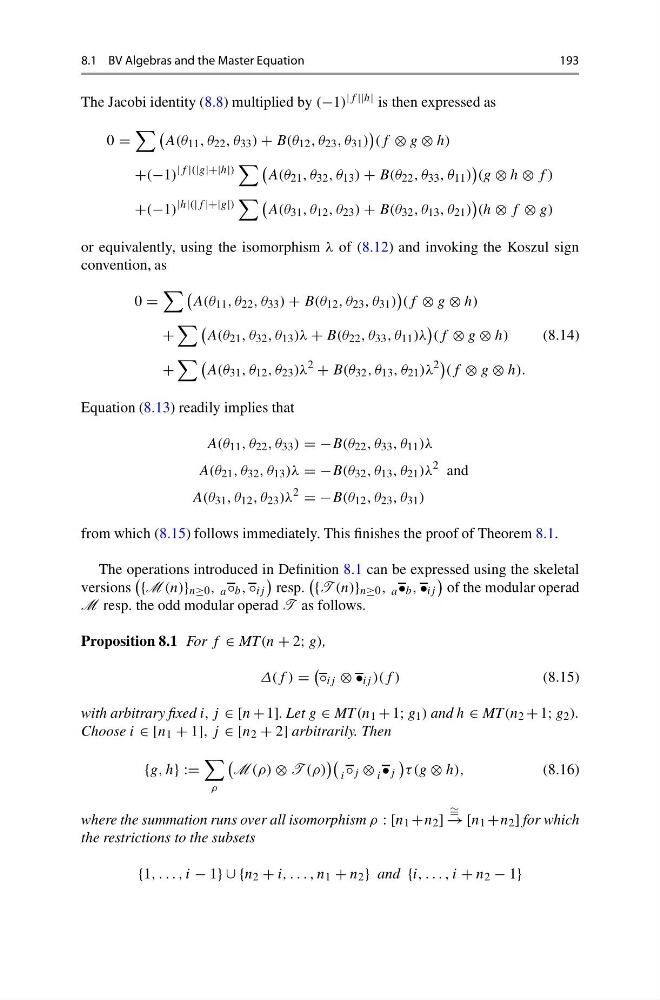
The Jacobi identity (8.8) multiplied by (−1) |f ||h| is then expressed as
0 =
A(θ 11 , θ 22 , θ 33 ) + B(θ 12 , θ 23 , θ 31 )
(f ⊗ g ⊗ h)
+(−1)
|f |(|g|+|h|)
A(θ 21 , θ 32 , θ 13 ) + B(θ 22 , θ 33 , θ 11 )
(g ⊗ h ⊗ f )
+(−1)
|h|(|f |+|g|)
A(θ 31 , θ 12 , θ 23 ) + B(θ 32 , θ 13 , θ 21 )
(h ⊗ f ⊗ g)
or equivalently, using the isomorphism λ of (8.12) and invoking the Koszul sign
convention, as
0 =
A(θ 11 , θ 22 , θ 33 ) + B(θ 12 , θ 23 , θ 31 )
(f ⊗ g ⊗ h)
+
A(θ 21 , θ 32 , θ 13 )λ + B(θ 22 , θ 33 , θ 11 )λ
(f ⊗ g ⊗ h)
(8.14)
+
A(θ 31 , θ 12 , θ 23 )λ
2
+ B(θ 32 , θ 13 , θ 21 )λ
2
(f ⊗ g ⊗ h).
Equation (8.13) readily implies that
A(θ 11 , θ 22 , θ 33 ) = −B(θ 22 , θ 33 , θ 11 )λ
A(θ 21 , θ 32 , θ 13 )λ = −B(θ 32 , θ 13 , θ 21 )λ
2 and
A(θ 31 , θ 12 , θ 23 )λ
2
= −B(θ 12 , θ 23 , θ 31 )
from which (8.15) follows immediately. This finishes the proof of Theorem 8.1.
The operations introduced in Definition 8.1 can be expressed using the skeletal
versions
{M (n)} n≥0 , a ◦ b , ◦ ij
resp.
{T (n)} n≥0 , a • b , • ij
of the modular operad
M resp. the odd modular operad T as follows.
Proposition 8.1 For f ∈ MT(n + 2; g),
Δ(f ) =
◦ ij ⊗ • ij )(f )
(8.15)
with arbitrary fixed i, j ∈ [n + 1]. Let g ∈ MT(n 1 + 1; g 1 ) and h ∈ MT(n 2 + 1; g 2 ).
Choose i ∈ [n 1 + 1], j ∈ [n 2 + 2] arbitrarily. Then
{g, h} :=
ρ
M (ρ) ⊗ T (ρ)
i ◦ j ⊗ i • j
τ (g ⊗ h),
(8.16)
where the summation runs over all isomorphism ρ : [n 1 +n 2 ]
∼ =
− → [n 1 +n 2 ] for which
the restrictions to the subsets
{1, . . . , i − 1} ∪ {n 2 + i, . . . , n 1 + n 2 } and {i, . . . , i + n 2 − 1}
193
The Jacobi identity (8.8) multiplied by (−1) |f ||h| is then expressed as
0 =
A(θ 11 , θ 22 , θ 33 ) + B(θ 12 , θ 23 , θ 31 )
(f ⊗ g ⊗ h)
+(−1)
|f |(|g|+|h|)
A(θ 21 , θ 32 , θ 13 ) + B(θ 22 , θ 33 , θ 11 )
(g ⊗ h ⊗ f )
+(−1)
|h|(|f |+|g|)
A(θ 31 , θ 12 , θ 23 ) + B(θ 32 , θ 13 , θ 21 )
(h ⊗ f ⊗ g)
or equivalently, using the isomorphism λ of (8.12) and invoking the Koszul sign
convention, as
0 =
A(θ 11 , θ 22 , θ 33 ) + B(θ 12 , θ 23 , θ 31 )
(f ⊗ g ⊗ h)
+
A(θ 21 , θ 32 , θ 13 )λ + B(θ 22 , θ 33 , θ 11 )λ
(f ⊗ g ⊗ h)
(8.14)
+
A(θ 31 , θ 12 , θ 23 )λ
2
+ B(θ 32 , θ 13 , θ 21 )λ
2
(f ⊗ g ⊗ h).
Equation (8.13) readily implies that
A(θ 11 , θ 22 , θ 33 ) = −B(θ 22 , θ 33 , θ 11 )λ
A(θ 21 , θ 32 , θ 13 )λ = −B(θ 32 , θ 13 , θ 21 )λ
2 and
A(θ 31 , θ 12 , θ 23 )λ
2
= −B(θ 12 , θ 23 , θ 31 )
from which (8.15) follows immediately. This finishes the proof of Theorem 8.1.
The operations introduced in Definition 8.1 can be expressed using the skeletal
versions
{M (n)} n≥0 , a ◦ b , ◦ ij
resp.
{T (n)} n≥0 , a • b , • ij
of the modular operad
M resp. the odd modular operad T as follows.
Proposition 8.1 For f ∈ MT(n + 2; g),
Δ(f ) =
◦ ij ⊗ • ij )(f )
(8.15)
with arbitrary fixed i, j ∈ [n + 1]. Let g ∈ MT(n 1 + 1; g 1 ) and h ∈ MT(n 2 + 1; g 2 ).
Choose i ∈ [n 1 + 1], j ∈ [n 2 + 2] arbitrarily. Then
{g, h} :=
ρ
M (ρ) ⊗ T (ρ)
i ◦ j ⊗ i • j
τ (g ⊗ h),
(8.16)
where the summation runs over all isomorphism ρ : [n 1 +n 2 ]
∼ =
− → [n 1 +n 2 ] for which
the restrictions to the subsets
{1, . . . , i − 1} ∪ {n 2 + i, . . . , n 1 + n 2 } and {i, . . . , i + n 2 − 1}