

8.1 BV Algebras and the Master Equation
191
of the tensor product
M (p; i) ⊗ T (p; i) ⊗ M (q; j ) ⊗ T (q; j ) ⊗ M (r; k) ⊗ T (r; k)
according to the permutation
(1, 2, 3, 4, 5, 6) −→ (1, 4, 2, 5, 3, 6).
The second map
B(θ 2 , θ 3 , θ 1 ) : MT(q; j ) ⊗ MT(r; k) ⊗ MT(p; i) →
→ M (S 1 S 2 S 3 ; i + j + k) ⊗ T (S 1 S 2 S 3 ; i + j + k)
is given by the formula
B(θ 2 , θ 3 , θ 1 ) :=
a ◦ b ( c ◦ d ⊗1)(θ 2 ⊗ θ 3 ⊗ θ 1 ) ⊗ a • b ( c • d ⊗1)(θ 2 ⊗ θ 3 ⊗ θ 1 )
ψ.
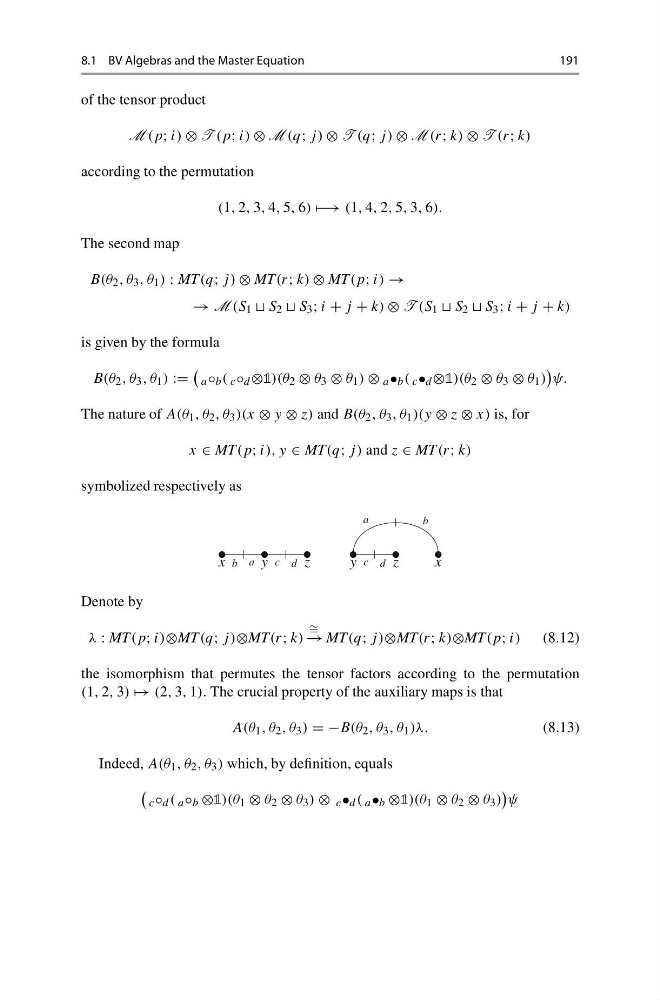
The nature of A(θ 1 , θ 2 , θ 3 )(x ⊗ y ⊗ z) and B(θ 2 , θ 3 , θ 1 )(y ⊗ z ⊗ x) is, for
x ∈ MT(p; i), y ∈ MT(q; j ) and z ∈ MT(r; k)
symbolized respectively as
x
y
z
b a
d
c
y
z
x
c d
a
b
Denote by
λ : MT(p; i)⊗MT(q; j )⊗MT(r; k)
∼ =
− → MT(q; j )⊗MT(r; k)⊗MT(p; i) (8.12)
the isomorphism that permutes the tensor factors according to the permutation
(1, 2, 3) → (2, 3, 1). The crucial property of the auxiliary maps is that
A(θ 1 , θ 2 , θ 3 ) = −B(θ 2 , θ 3 , θ 1 )λ.
(8.13)
Indeed, A(θ 1 , θ 2 , θ 3 ) which, by definition, equals
c ◦ d ( a ◦ b ⊗1)(θ 1 ⊗ θ 2 ⊗ θ 3 ) ⊗ c • d ( a • b ⊗1)(θ 1 ⊗ θ 2 ⊗ θ 3 )
ψ
191
of the tensor product
M (p; i) ⊗ T (p; i) ⊗ M (q; j ) ⊗ T (q; j ) ⊗ M (r; k) ⊗ T (r; k)
according to the permutation
(1, 2, 3, 4, 5, 6) −→ (1, 4, 2, 5, 3, 6).
The second map
B(θ 2 , θ 3 , θ 1 ) : MT(q; j ) ⊗ MT(r; k) ⊗ MT(p; i) →
→ M (S 1 S 2 S 3 ; i + j + k) ⊗ T (S 1 S 2 S 3 ; i + j + k)
is given by the formula
B(θ 2 , θ 3 , θ 1 ) :=
a ◦ b ( c ◦ d ⊗1)(θ 2 ⊗ θ 3 ⊗ θ 1 ) ⊗ a • b ( c • d ⊗1)(θ 2 ⊗ θ 3 ⊗ θ 1 )
ψ.
The nature of A(θ 1 , θ 2 , θ 3 )(x ⊗ y ⊗ z) and B(θ 2 , θ 3 , θ 1 )(y ⊗ z ⊗ x) is, for
x ∈ MT(p; i), y ∈ MT(q; j ) and z ∈ MT(r; k)
symbolized respectively as
x
y
z
b a
d
c
y
z
x
c d
a
b
Denote by
λ : MT(p; i)⊗MT(q; j )⊗MT(r; k)
∼ =
− → MT(q; j )⊗MT(r; k)⊗MT(p; i) (8.12)
the isomorphism that permutes the tensor factors according to the permutation
(1, 2, 3) → (2, 3, 1). The crucial property of the auxiliary maps is that
A(θ 1 , θ 2 , θ 3 ) = −B(θ 2 , θ 3 , θ 1 )λ.
(8.13)
Indeed, A(θ 1 , θ 2 , θ 3 ) which, by definition, equals
c ◦ d ( a ◦ b ⊗1)(θ 1 ⊗ θ 2 ⊗ θ 3 ) ⊗ c • d ( a • b ⊗1)(θ 1 ⊗ θ 2 ⊗ θ 3 )
ψ