

7.2 Feynman Transform
183
of linear degree 0 maps such that
A(n; g) = T (σ ) ◦ A(n; g) ◦ C (σ )
(7.37)
for each n ∈ N, g ∈ A and a permutation σ : [n]
∼ =
− → [n] ∈ Σ n . In elements,
Eq. (7.37) means that
A(n; g)(c) = σ A(n; g)(cσ )
for each c ∈ C (n; g). Let us verify this statement.
Each family (7.31) determines the skeletal family (7.36) by restricting to finite
sets of the form [n], n ∈ N. Condition (7.37) for this restricted family follows
from (7.32) taken with S = T = [n] and ρ = σ : [n]
∼ =
− → [n] ∈ Σ n .
On the other hand, suppose that we are given a skeletal family A sk as in (7.36).
For a finite set S choose an isomorphism ρ : [n]
∼ =
− → S and define A(S; g) in (7.31)
by
A(S; g) := T (ρ) ◦ A(n; g) ◦ C (ρ).
(7.38)
It follows from the equivariance (7.37) that A(S; g) does not depend on the concrete
choice of ρ and that the family defined this way satisfies (7.32). The correspondence
A ↔ A sk described above is clearly one-to-one.
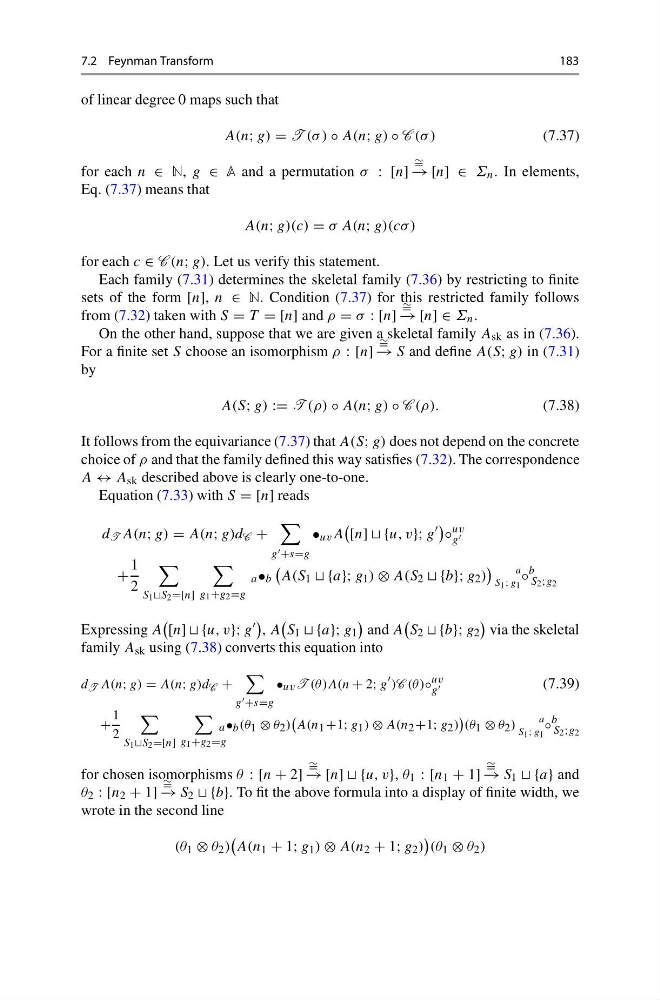
Equation (7.33) with S = [n] reads
d T A(n; g) = A(n; g)d C +
g +s=g
• uv A
[n] ] {u, v}; g
◦
uv
g
+
1
2
S 1 2 =[n]
g 1 +g 2 =g
a • b
A(S 1 {a}; g 1 ) ⊗ A(S 2 {b}; g 2 )
a
S 1 ; g 1
◦
b
S 2 ;g 2
Expressing A
[n] ] {u, v}; g
, A
S 1 {a}; g 1
and A
S 2 {b}; g 2
via the skeletal
family A sk using (7.38) converts this equation into
d T A(n; g) = A(n; g)d C +
g +s=g
• uv T (θ)A(n + 2; g )C (θ)◦ uv
g
(7.39)
+
1
2
S 1 2 =[n]
g 1 +g 2 =g
a • b (θ 1 ⊗ θ 2 )
A(n 1 +1; g 1 ) ⊗ A(n 2 +1; g 2 )
(θ 1 ⊗ θ 2 )
a
S 1 ; g 1
◦ b
S 2 ;g 2
for chosen isomorphisms θ : [n + 2]
∼ =
− → [n] ] {u, v}, θ 1 : [n 1 + 1]
∼ =
− → S 1 {a} and
θ 2 : [n 2 + 1]
∼ =
− → S 2 {b}. To fit the above formula into a display of finite width, we
wrote in the second line
(θ 1 ⊗ θ 2 )
A(n 1 + 1; g 1 ) ⊗ A(n 2 + 1; g 2 )
(θ 1 ⊗ θ 2 )
183
of linear degree 0 maps such that
A(n; g) = T (σ ) ◦ A(n; g) ◦ C (σ )
(7.37)
for each n ∈ N, g ∈ A and a permutation σ : [n]
∼ =
− → [n] ∈ Σ n . In elements,
Eq. (7.37) means that
A(n; g)(c) = σ A(n; g)(cσ )
for each c ∈ C (n; g). Let us verify this statement.
Each family (7.31) determines the skeletal family (7.36) by restricting to finite
sets of the form [n], n ∈ N. Condition (7.37) for this restricted family follows
from (7.32) taken with S = T = [n] and ρ = σ : [n]
∼ =
− → [n] ∈ Σ n .
On the other hand, suppose that we are given a skeletal family A sk as in (7.36).
For a finite set S choose an isomorphism ρ : [n]
∼ =
− → S and define A(S; g) in (7.31)
by
A(S; g) := T (ρ) ◦ A(n; g) ◦ C (ρ).
(7.38)
It follows from the equivariance (7.37) that A(S; g) does not depend on the concrete
choice of ρ and that the family defined this way satisfies (7.32). The correspondence
A ↔ A sk described above is clearly one-to-one.
Equation (7.33) with S = [n] reads
d T A(n; g) = A(n; g)d C +
g +s=g
• uv A
[n] ] {u, v}; g
◦
uv
g
+
1
2
S 1 2 =[n]
g 1 +g 2 =g
a • b
A(S 1 {a}; g 1 ) ⊗ A(S 2 {b}; g 2 )
a
S 1 ; g 1
◦
b
S 2 ;g 2
Expressing A
[n] ] {u, v}; g
, A
S 1 {a}; g 1
and A
S 2 {b}; g 2
via the skeletal
family A sk using (7.38) converts this equation into
d T A(n; g) = A(n; g)d C +
g +s=g
• uv T (θ)A(n + 2; g )C (θ)◦ uv
g
(7.39)
+
1
2
S 1 2 =[n]
g 1 +g 2 =g
a • b (θ 1 ⊗ θ 2 )
A(n 1 +1; g 1 ) ⊗ A(n 2 +1; g 2 )
(θ 1 ⊗ θ 2 )
a
S 1 ; g 1
◦ b
S 2 ;g 2
for chosen isomorphisms θ : [n + 2]
∼ =
− → [n] ] {u, v}, θ 1 : [n 1 + 1]
∼ =
− → S 1 {a} and
θ 2 : [n 2 + 1]
∼ =
− → S 2 {b}. To fit the above formula into a display of finite width, we
wrote in the second line
(θ 1 ⊗ θ 2 )
A(n 1 + 1; g 1 ) ⊗ A(n 2 + 1; g 2 )
(θ 1 ⊗ θ 2 )