

7.2 Feynman Transform
175
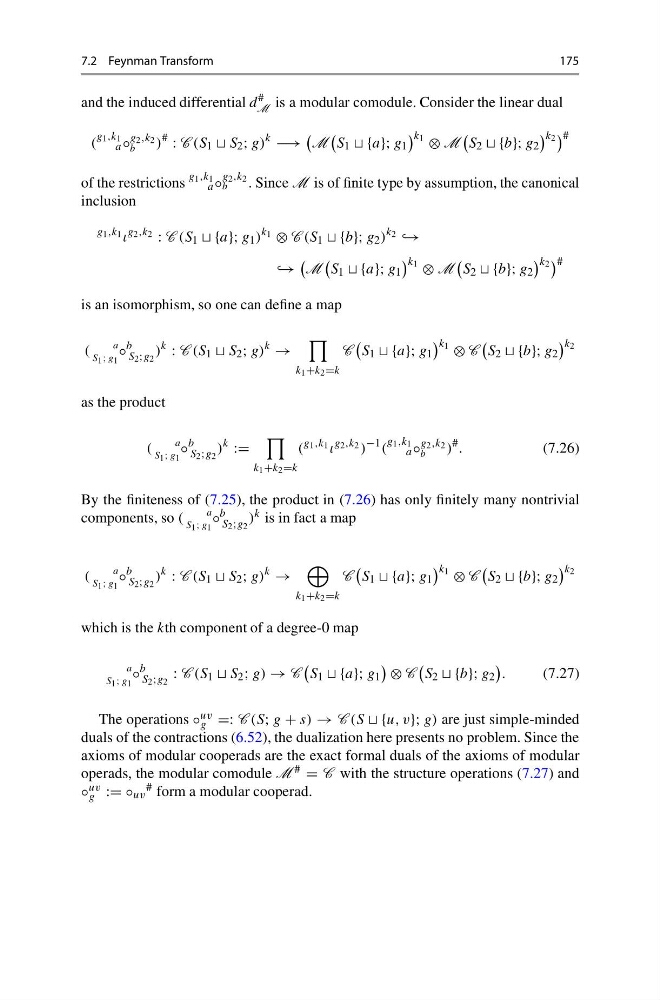
and the induced differential d #
M is a modular comodule. Consider the linear dual
(
g 1 ,k 1
a ◦
g 2 ,k 2
b
)
#
: C (S 1 S 2 ; g)
k
−→
M
S 1 {a}; g 1
k 1 ⊗ M
S 2 {b}; g 2
k 2 #
of the restrictions
g 1 ,k 1
a ◦
g 2 ,k 2
b
. Since M is of finite type by assumption, the canonical
inclusion
g 1 ,k 1 ι
g 2 ,k 2 : C (S 1 {a}; g 1 )
k 1 ⊗ C (S 1 {b}; g 2 )
k 2
M
S 1 {a}; g 1
k 1 ⊗ M
S 2 {b}; g 2
k 2 #
is an isomorphism, so one can define a map
(
a
S 1 ; g 1
◦
b
S 2 ;g 2
)
k
: C (S 1 S 2 ; g)
k
→
k 1 +k 2 =k
C
S 1 {a}; g 1
k 1 ⊗ C
S 2 {b}; g 2
k 2
as the product
(
a
S 1 ; g 1
◦
b
S 2 ;g 2
)
k
:=
k 1 +k 2 =k
(
g 1 ,k 1 ι
g 2 ,k 2 )
−1 (
g 1 ,k 1
a ◦
g 2 ,k 2
b
)
# .
(7.26)
By the finiteness of (7.25), the product in (7.26) has only finitely many nontrivial
components, so (
a
S 1 ; g 1
◦
b
S 2 ;g 2
) k is in fact a map
(
a
S 1 ; g 1
◦
b
S 2 ;g 2
)
k
: C (S 1 S 2 ; g)
k
→
k 1 +k 2 =k
C
S 1 {a}; g 1
k 1 ⊗ C
S 2 {b}; g 2
k 2
which is the kth component of a degree-0 map
a
S 1 ; g 1
◦
b
S 2 ;g 2
: C (S 1 S 2 ; g) → C
S 1 {a}; g 1
⊗ C
S 2 {b}; g 2
.
(7.27)
The operations ◦ uv
g =: C (S; g + s) → C (S {u, v}; g) are just simple-minded
duals of the contractions (6.52), the dualization here presents no problem. Since the
axioms of modular cooperads are the exact formal duals of the axioms of modular
operads, the modular comodule M # = C with the structure operations (7.27) and
◦ uv
g := ◦ uv
# form a modular cooperad.
175
and the induced differential d #
M is a modular comodule. Consider the linear dual
(
g 1 ,k 1
a ◦
g 2 ,k 2
b
)
#
: C (S 1 S 2 ; g)
k
−→
M
S 1 {a}; g 1
k 1 ⊗ M
S 2 {b}; g 2
k 2 #
of the restrictions
g 1 ,k 1
a ◦
g 2 ,k 2
b
. Since M is of finite type by assumption, the canonical
inclusion
g 1 ,k 1 ι
g 2 ,k 2 : C (S 1 {a}; g 1 )
k 1 ⊗ C (S 1 {b}; g 2 )
k 2
M
S 1 {a}; g 1
k 1 ⊗ M
S 2 {b}; g 2
k 2 #
is an isomorphism, so one can define a map
(
a
S 1 ; g 1
◦
b
S 2 ;g 2
)
k
: C (S 1 S 2 ; g)
k
→
k 1 +k 2 =k
C
S 1 {a}; g 1
k 1 ⊗ C
S 2 {b}; g 2
k 2
as the product
(
a
S 1 ; g 1
◦
b
S 2 ;g 2
)
k
:=
k 1 +k 2 =k
(
g 1 ,k 1 ι
g 2 ,k 2 )
−1 (
g 1 ,k 1
a ◦
g 2 ,k 2
b
)
# .
(7.26)
By the finiteness of (7.25), the product in (7.26) has only finitely many nontrivial
components, so (
a
S 1 ; g 1
◦
b
S 2 ;g 2
) k is in fact a map
(
a
S 1 ; g 1
◦
b
S 2 ;g 2
)
k
: C (S 1 S 2 ; g)
k
→
k 1 +k 2 =k
C
S 1 {a}; g 1
k 1 ⊗ C
S 2 {b}; g 2
k 2
which is the kth component of a degree-0 map
a
S 1 ; g 1
◦
b
S 2 ;g 2
: C (S 1 S 2 ; g) → C
S 1 {a}; g 1
⊗ C
S 2 {b}; g 2
.
(7.27)
The operations ◦ uv
g =: C (S; g + s) → C (S {u, v}; g) are just simple-minded
duals of the contractions (6.52), the dualization here presents no problem. Since the
axioms of modular cooperads are the exact formal duals of the axioms of modular
operads, the modular comodule M # = C with the structure operations (7.27) and
◦ uv
g := ◦ uv
# form a modular cooperad.