

7.2 Feynman Transform
173
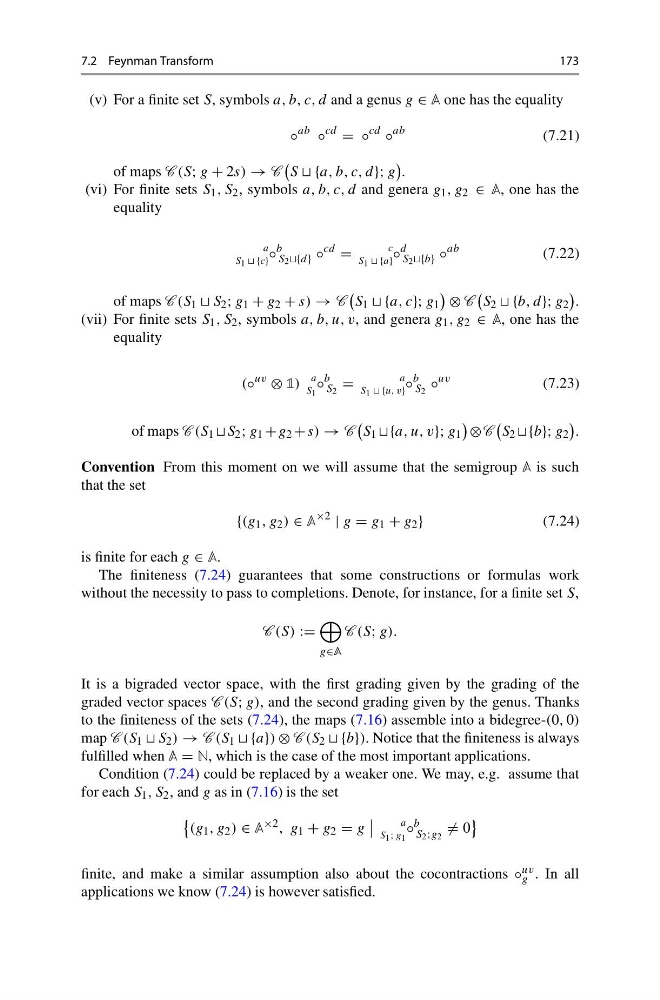
(v) For a finite set S, symbols a, b, c, d and a genus g ∈ A one has the equality
◦
ab
◦
cd
= ◦
cd
◦
ab
(7.21)
of maps C (S; g + 2s) → C
S {a, b, c, d}; g
.
(vi) For finite sets S 1 , S 2 , symbols a, b, c, d and genera g 1 , g 2 ∈ A, one has the
equality
a
S 1 {c}
◦
b
S 2 ◦
cd
=
c
S 1 {a}
◦
d
S 2 ◦
ab
(7.22)
of maps C (S 1 S 2 ; g 1 + g 2 + s) → C
S 1 {a, c}; g 1
⊗ C
S 2 {b, d}; g 2
.
(vii) For finite sets S 1 , S 2 , symbols a, b, u, v, and genera g 1 , g 2 ∈ A, one has the
equality
(◦
uv
⊗ 1)
a
S 1
◦
b
S 2
=
a
S 1 {u, v}
◦
b
S 2
◦
uv
(7.23)
of maps C (S 1 S 2 ; g 1 + g 2 + s) → C
S 1 {a, u, v}; g 1
⊗ C
S 2 g 2
.
Convention From this moment on we will assume that the semigroup A is such
that the set
{(g 1 , g 2 ) ∈ A
×2
| g = g 1 + g 2 }
(7.24)
is finite for each g ∈ A.
The finiteness (7.24) guarantees that some constructions or formulas work
without the necessity to pass to completions. Denote, for instance, for a finite set S,
C (S) :=
g∈A
C (S; g).
It is a bigraded vector space, with the first grading given by the grading of the
graded vector spaces C (S; g), and the second grading given by the genus. Thanks
to the finiteness of the sets (7.24), the maps (7.16) assemble into a bidegree-(0, 0)
map C (S 1 S 2 ) → C (S 1 {a}) ⊗ C (S 2 {b}). Notice that the finiteness is always
fulfilled when A = N, which is the case of the most important applications.
Condition (7.24) could be replaced by a weaker one. We may, e.g. assume that
for each S 1 , S 2 , and g as in (7.16) is the set
(g 1 , g 2 ) ∈ A ×2 , g 1 + g 2 = g
a
S 1 ; g 1
◦
b
S 2 ;g 2
= 0
finite, and make a similar assumption also about the cocontractions ◦ uv
g . In all
applications we know (7.24) is however satisfied.
173
(v) For a finite set S, symbols a, b, c, d and a genus g ∈ A one has the equality
◦
ab
◦
cd
= ◦
cd
◦
ab
(7.21)
of maps C (S; g + 2s) → C
S {a, b, c, d}; g
.
(vi) For finite sets S 1 , S 2 , symbols a, b, c, d and genera g 1 , g 2 ∈ A, one has the
equality
a
S 1 {c}
◦
b
S 2 ◦
cd
=
c
S 1 {a}
◦
d
S 2 ◦
ab
(7.22)
of maps C (S 1 S 2 ; g 1 + g 2 + s) → C
S 1 {a, c}; g 1
⊗ C
S 2 {b, d}; g 2
.
(vii) For finite sets S 1 , S 2 , symbols a, b, u, v, and genera g 1 , g 2 ∈ A, one has the
equality
(◦
uv
⊗ 1)
a
S 1
◦
b
S 2
=
a
S 1 {u, v}
◦
b
S 2
◦
uv
(7.23)
of maps C (S 1 S 2 ; g 1 + g 2 + s) → C
S 1 {a, u, v}; g 1
⊗ C
S 2 g 2
.
Convention From this moment on we will assume that the semigroup A is such
that the set
{(g 1 , g 2 ) ∈ A
×2
| g = g 1 + g 2 }
(7.24)
is finite for each g ∈ A.
The finiteness (7.24) guarantees that some constructions or formulas work
without the necessity to pass to completions. Denote, for instance, for a finite set S,
C (S) :=
g∈A
C (S; g).
It is a bigraded vector space, with the first grading given by the grading of the
graded vector spaces C (S; g), and the second grading given by the genus. Thanks
to the finiteness of the sets (7.24), the maps (7.16) assemble into a bidegree-(0, 0)
map C (S 1 S 2 ) → C (S 1 {a}) ⊗ C (S 2 {b}). Notice that the finiteness is always
fulfilled when A = N, which is the case of the most important applications.
Condition (7.24) could be replaced by a weaker one. We may, e.g. assume that
for each S 1 , S 2 , and g as in (7.16) is the set
(g 1 , g 2 ) ∈ A ×2 , g 1 + g 2 = g
a
S 1 ; g 1
◦
b
S 2 ;g 2
= 0
finite, and make a similar assumption also about the cocontractions ◦ uv
g . In all
applications we know (7.24) is however satisfied.