

7.1 Modules and Derivations
169
for t 1 ∈ ⊗
S 1 {a}; g 1
, t 2 ∈ ⊗
S 2 {a}; g 2
, and
• uv t, θ • uv (t)
= • uv
t, θ(t)
(7.13)
for t ∈ T
S {u, v}; g
.
By the definition of the operad structure of T ⊕ s −k M, the right-hand side
of (7.12) equals
t 1 a • b t 2 , t 1 a
L
• b θ(t 2 ) + θ(t 1 ) a
R
• b t 2
.
Since the degree of θ is 0, the second component of the above expression is precisely
the right-hand side of (7.10) evaluated at t 1 ⊗t 2 , so (7.12) holds. Similarly, the righthand side of (7.13) equals
(• uv t, uv θ(t)
), thus (7.11) is apparently equivalent
to (7.13). This shows that (ii) is equivalent to (iii) and finishes the proof of the
lemma.
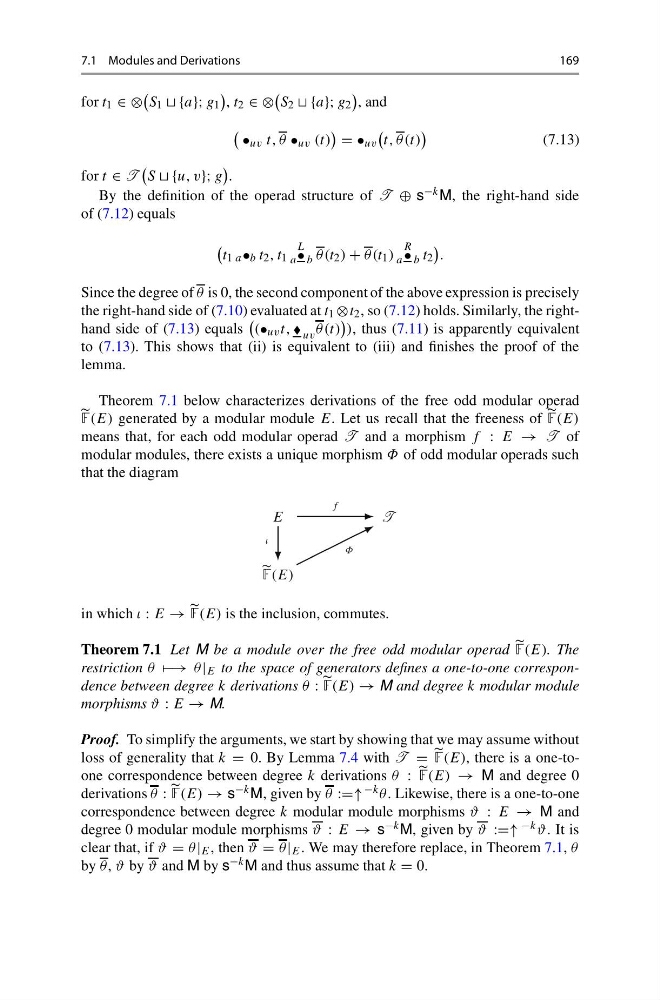
Theorem 7.1 below characterizes derivations of the free odd modular operad
F(E) generated by a modular module E. Let us recall that the freeness of F(E)
means that, for each odd modular operad T and a morphism f : E → T of
modular modules, there exists a unique morphism Φ of odd modular operads such
that the diagram
E
(E)
ι
f
Φ
in which ι : E → F(E) is the inclusion, commutes.
Theorem 7.1 Let M be a module over the free odd modular operad F(E). The
restriction θ −→ θ | E to the space of generators defines a one-to-one correspondence between degree k derivations θ : F(E) → M and degree k modular module
morphisms ϑ : E → M.
Proof. To simplify the arguments, we start by showing that we may assume without
loss of generality that k = 0. By Lemma 7.4 with T = F(E), there is a one-toone correspondence between degree k derivations θ : F(E) → M and degree 0
derivations θ : F(E) → s −k M, given by θ :=↑ −k θ . Likewise, there is a one-to-one
correspondence between degree k modular module morphisms ϑ : E → M and
degree 0 modular module morphisms ϑ : E → s −k M, given by ϑ :=↑ −k ϑ. It is
clear that, if ϑ = θ | E , then ϑ = θ| E . We may therefore replace, in Theorem 7.1, θ
by θ, ϑ by ϑ and M by s −k M and thus assume that k = 0.
169
for t 1 ∈ ⊗
S 1 {a}; g 1
, t 2 ∈ ⊗
S 2 {a}; g 2
, and
• uv t, θ • uv (t)
= • uv
t, θ(t)
(7.13)
for t ∈ T
S {u, v}; g
.
By the definition of the operad structure of T ⊕ s −k M, the right-hand side
of (7.12) equals
t 1 a • b t 2 , t 1 a
L
• b θ(t 2 ) + θ(t 1 ) a
R
• b t 2
.
Since the degree of θ is 0, the second component of the above expression is precisely
the right-hand side of (7.10) evaluated at t 1 ⊗t 2 , so (7.12) holds. Similarly, the righthand side of (7.13) equals
(• uv t, uv θ(t)
), thus (7.11) is apparently equivalent
to (7.13). This shows that (ii) is equivalent to (iii) and finishes the proof of the
lemma.
Theorem 7.1 below characterizes derivations of the free odd modular operad
F(E) generated by a modular module E. Let us recall that the freeness of F(E)
means that, for each odd modular operad T and a morphism f : E → T of
modular modules, there exists a unique morphism Φ of odd modular operads such
that the diagram
E
(E)
ι
f
Φ
in which ι : E → F(E) is the inclusion, commutes.
Theorem 7.1 Let M be a module over the free odd modular operad F(E). The
restriction θ −→ θ | E to the space of generators defines a one-to-one correspondence between degree k derivations θ : F(E) → M and degree k modular module
morphisms ϑ : E → M.
Proof. To simplify the arguments, we start by showing that we may assume without
loss of generality that k = 0. By Lemma 7.4 with T = F(E), there is a one-toone correspondence between degree k derivations θ : F(E) → M and degree 0
derivations θ : F(E) → s −k M, given by θ :=↑ −k θ . Likewise, there is a one-to-one
correspondence between degree k modular module morphisms ϑ : E → M and
degree 0 modular module morphisms ϑ : E → s −k M, given by ϑ :=↑ −k ϑ. It is
clear that, if ϑ = θ | E , then ϑ = θ| E . We may therefore replace, in Theorem 7.1, θ
by θ, ϑ by ϑ and M by s −k M and thus assume that k = 0.