

142
6 Operads
that we could replace s ⊗ 1 in (6.62) by 1 ⊗ s with the same result. Equivalently,
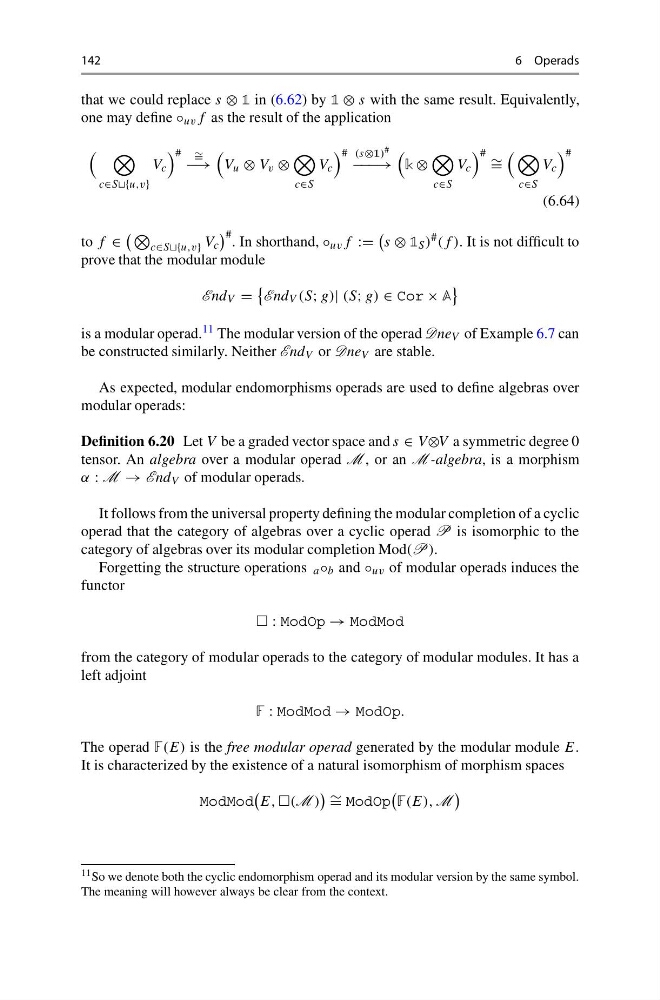
one may define ◦ uv f as the result of the application
c∈S{u,v}
V c
# ∼ =
−→
V u ⊗ V v ⊗
c∈S
V c
# (s⊗1) #
−−−→
k ⊗
c∈S
V c
# ∼ =
c∈S
V c
#
(6.64)
to f ∈
c∈S{u,v} V c
# . In shorthand, ◦ uv f :=
s ⊗ 1 S ) # (f ). It is not difficult to
prove that the modular module
End V =
End V (S; g)| (S; g) ∈ Cor × A
is a modular operad. 11 The modular version of the operad Dne V of Example 6.7 can
be constructed similarly. Neither End V or Dne V are stable.
As expected, modular endomorphisms operads are used to define algebras over
modular operads:
Definition 6.20 Let V be a graded vector space and s ∈ V⊗V a symmetric degree 0
tensor. An algebra over a modular operad M , or an M -algebra, is a morphism
α : M → End V of modular operads.
It follows from the universal property defining the modular completion of a cyclic
operad that the category of algebras over a cyclic operad P is isomorphic to the
category of algebras over its modular completion Mod(P).
Forgetting the structure operations a ◦ b and ◦ uv of modular operads induces the
functor
: ModOp → ModMod
from the category of modular operads to the category of modular modules. It has a
left adjoint
F : ModMod → ModOp.
The operad F(E) is the free modular operad generated by the modular module E.
It is characterized by the existence of a natural isomorphism of morphism spaces
ModMod
E, )
∼ = ModOp
F(E), M
11 So we denote both the cyclic endomorphism operad and its modular version by the same symbol.
The meaning will however always be clear from the context.
6 Operads
that we could replace s ⊗ 1 in (6.62) by 1 ⊗ s with the same result. Equivalently,
one may define ◦ uv f as the result of the application
c∈S{u,v}
V c
# ∼ =
−→
V u ⊗ V v ⊗
c∈S
V c
# (s⊗1) #
−−−→
k ⊗
c∈S
V c
# ∼ =
c∈S
V c
#
(6.64)
to f ∈
c∈S{u,v} V c
# . In shorthand, ◦ uv f :=
s ⊗ 1 S ) # (f ). It is not difficult to
prove that the modular module
End V =
End V (S; g)| (S; g) ∈ Cor × A
is a modular operad. 11 The modular version of the operad Dne V of Example 6.7 can
be constructed similarly. Neither End V or Dne V are stable.
As expected, modular endomorphisms operads are used to define algebras over
modular operads:
Definition 6.20 Let V be a graded vector space and s ∈ V⊗V a symmetric degree 0
tensor. An algebra over a modular operad M , or an M -algebra, is a morphism
α : M → End V of modular operads.
It follows from the universal property defining the modular completion of a cyclic
operad that the category of algebras over a cyclic operad P is isomorphic to the
category of algebras over its modular completion Mod(P).
Forgetting the structure operations a ◦ b and ◦ uv of modular operads induces the
functor
: ModOp → ModMod
from the category of modular operads to the category of modular modules. It has a
left adjoint
F : ModMod → ModOp.
The operad F(E) is the free modular operad generated by the modular module E.
It is characterized by the existence of a natural isomorphism of morphism spaces
ModMod
E, )
∼ = ModOp
F(E), M
11 So we denote both the cyclic endomorphism operad and its modular version by the same symbol.
The meaning will however always be clear from the context.