

6.4 Modular Operads
133
commutative, multiplications μ on V such that
B
μ(a, b), c
= B
a, μ(b, c)
.
So Ass-algebras in the above sense are non-unital Frobenius algebras with s the
corresponding Casimir element.
6.4
Modular Operads
While cyclic operads were abstractions of structures of blobs and propagators with
simply connected underlying graphs, modular operads have arbitrary graphs as their
pasting schemes. As a result, there is another grading by the genus of the underlying
graph. Let us give a general definition. Let A be an abelian semigroup, i.e., a set
with an associative commutative operation + : A × A → A and a unit 0 ∈ A. A
typical example will be the semigroup N = {0, 1, 2, . . .} of natural numbers. When
convenient, we consider A as a discrete category.
Definition 6.15 A modular module is a covariant functor
E : Cor × A → Chain.
A morphism Ψ : E → F of modular modules is a natural transformation from the
functor E to the functor F .
Explicitly, a modular module E is a collection E(S; g), S ∈ Cor, g ∈ A, of
dg-vector spaces together with functorial degree 0 morphisms
E(σ ) : E(S; g) → E(T ; g)
(6.48)
specified for any isomorphism σ : S
∼ =
−→ T and g ∈ A. We call g ∈ A the operadic
genus or simply the genus of the component E(S; g) of E. A morphism Ψ : E → F
of modular modules is then a family
Ψ = {Ψ (S; g) : E(S; g) → F (S; g) | (S; g) ∈ Cor × A}
(6.49)
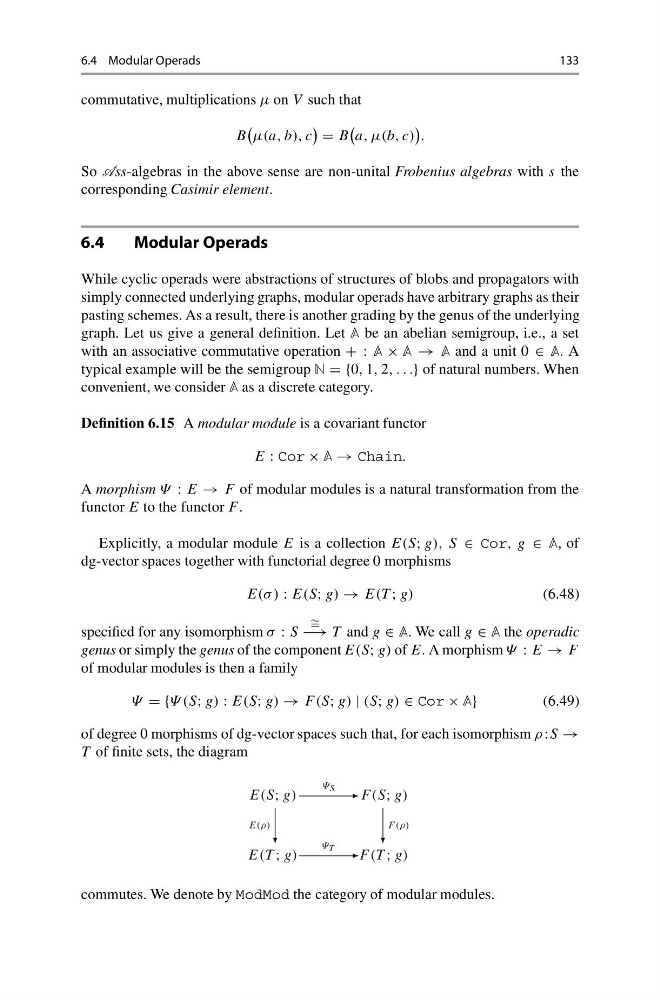
of degree 0 morphisms of dg-vector spaces such that, for each isomorphism ρ :S →
T of finite sets, the diagram
Ψ T
F (ρ)
E(ρ)
Ψ S
F (T ; g)
E(T ; g)
F (S; g)
E(S; g)
commutes. We denote by ModMod the category of modular modules.
133
commutative, multiplications μ on V such that
B
μ(a, b), c
= B
a, μ(b, c)
.
So Ass-algebras in the above sense are non-unital Frobenius algebras with s the
corresponding Casimir element.
6.4
Modular Operads
While cyclic operads were abstractions of structures of blobs and propagators with
simply connected underlying graphs, modular operads have arbitrary graphs as their
pasting schemes. As a result, there is another grading by the genus of the underlying
graph. Let us give a general definition. Let A be an abelian semigroup, i.e., a set
with an associative commutative operation + : A × A → A and a unit 0 ∈ A. A
typical example will be the semigroup N = {0, 1, 2, . . .} of natural numbers. When
convenient, we consider A as a discrete category.
Definition 6.15 A modular module is a covariant functor
E : Cor × A → Chain.
A morphism Ψ : E → F of modular modules is a natural transformation from the
functor E to the functor F .
Explicitly, a modular module E is a collection E(S; g), S ∈ Cor, g ∈ A, of
dg-vector spaces together with functorial degree 0 morphisms
E(σ ) : E(S; g) → E(T ; g)
(6.48)
specified for any isomorphism σ : S
∼ =
−→ T and g ∈ A. We call g ∈ A the operadic
genus or simply the genus of the component E(S; g) of E. A morphism Ψ : E → F
of modular modules is then a family
Ψ = {Ψ (S; g) : E(S; g) → F (S; g) | (S; g) ∈ Cor × A}
(6.49)
of degree 0 morphisms of dg-vector spaces such that, for each isomorphism ρ :S →
T of finite sets, the diagram
Ψ T
F (ρ)
E(ρ)
Ψ S
F (T ; g)
E(T ; g)
F (S; g)
E(S; g)
commutes. We denote by ModMod the category of modular modules.