

120
6 Operads
Explicitly, a cyclic module is a collection E(S) of dg-vector spaces together
with functorial degree 0 morphisms E(σ ) : E(S) → E(T ) specified for any
isomorphism σ : S
∼ =
−→ T . A morphism Ψ : E → F of cyclic modules is then
a family
Ψ = {Ψ S : E(S) → F (S) | S ∈ Cor}
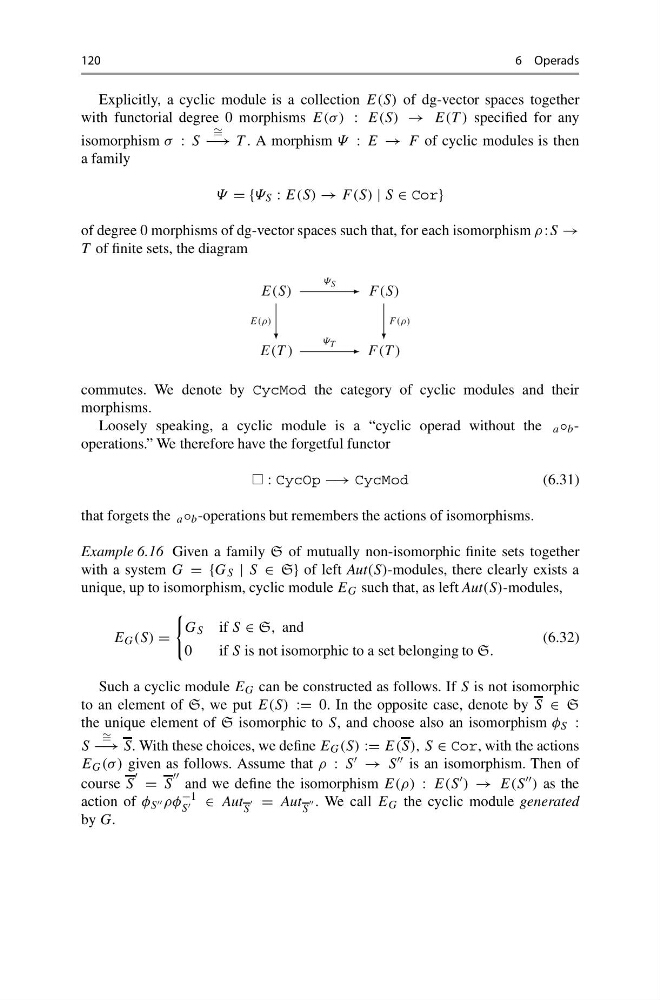
of degree 0 morphisms of dg-vector spaces such that, for each isomorphism ρ :S →
T of finite sets, the diagram
Ψ T
F (ρ)
E(ρ)
Ψ S
F (T )
E(T )
F (S)
E(S)
commutes. We denote by CycMod the category of cyclic modules and their
morphisms.
Loosely speaking, a cyclic module is a “cyclic operad without the a ◦ b -
operations.” We therefore have the forgetful functor
: CycOp −→ CycMod
(6.31)
that forgets the a ◦ b -operations but remembers the actions of isomorphisms.
Example 6.16 Given a family S of mutually non-isomorphic finite sets together
with a system G = {G S | S ∈ S} of left Aut(S)-modules, there clearly exists a
unique, up to isomorphism, cyclic module E G such that, as left Aut(S)-modules,
E G (S) =
G S if S ∈ S, and
0
ifS is not isomorphic to a set belonging to S.
(6.32)
Such a cyclic module E G can be constructed as follows. If S is not isomorphic
to an element of S, we put E(S) := 0. In the opposite case, denote by S ∈ S
the unique element of S isomorphic to S, and choose also an isomorphism φ S :
S
∼ =
−→ S. With these choices, we define E G (S) := E(S), S ∈ Cor, with the actions
E G (σ ) given as follows. Assume that ρ : S → S is an isomorphism. Then of
course S
= S
and we define the isomorphism E(ρ) : E(S ) → E(S ) as the
action of φ S ρφ
−1
S ∈ Aut S
= Aut S
. We call E G the cyclic module generated
by G.
6 Operads
Explicitly, a cyclic module is a collection E(S) of dg-vector spaces together
with functorial degree 0 morphisms E(σ ) : E(S) → E(T ) specified for any
isomorphism σ : S
∼ =
−→ T . A morphism Ψ : E → F of cyclic modules is then
a family
Ψ = {Ψ S : E(S) → F (S) | S ∈ Cor}
of degree 0 morphisms of dg-vector spaces such that, for each isomorphism ρ :S →
T of finite sets, the diagram
Ψ T
F (ρ)
E(ρ)
Ψ S
F (T )
E(T )
F (S)
E(S)
commutes. We denote by CycMod the category of cyclic modules and their
morphisms.
Loosely speaking, a cyclic module is a “cyclic operad without the a ◦ b -
operations.” We therefore have the forgetful functor
: CycOp −→ CycMod
(6.31)
that forgets the a ◦ b -operations but remembers the actions of isomorphisms.
Example 6.16 Given a family S of mutually non-isomorphic finite sets together
with a system G = {G S | S ∈ S} of left Aut(S)-modules, there clearly exists a
unique, up to isomorphism, cyclic module E G such that, as left Aut(S)-modules,
E G (S) =
G S if S ∈ S, and
0
ifS is not isomorphic to a set belonging to S.
(6.32)
Such a cyclic module E G can be constructed as follows. If S is not isomorphic
to an element of S, we put E(S) := 0. In the opposite case, denote by S ∈ S
the unique element of S isomorphic to S, and choose also an isomorphism φ S :
S
∼ =
−→ S. With these choices, we define E G (S) := E(S), S ∈ Cor, with the actions
E G (σ ) given as follows. Assume that ρ : S → S is an isomorphism. Then of
course S
= S
and we define the isomorphism E(ρ) : E(S ) → E(S ) as the
action of φ S ρφ
−1
S ∈ Aut S
= Aut S
. We call E G the cyclic module generated
by G.