

6.1 Cyclic Operads
111
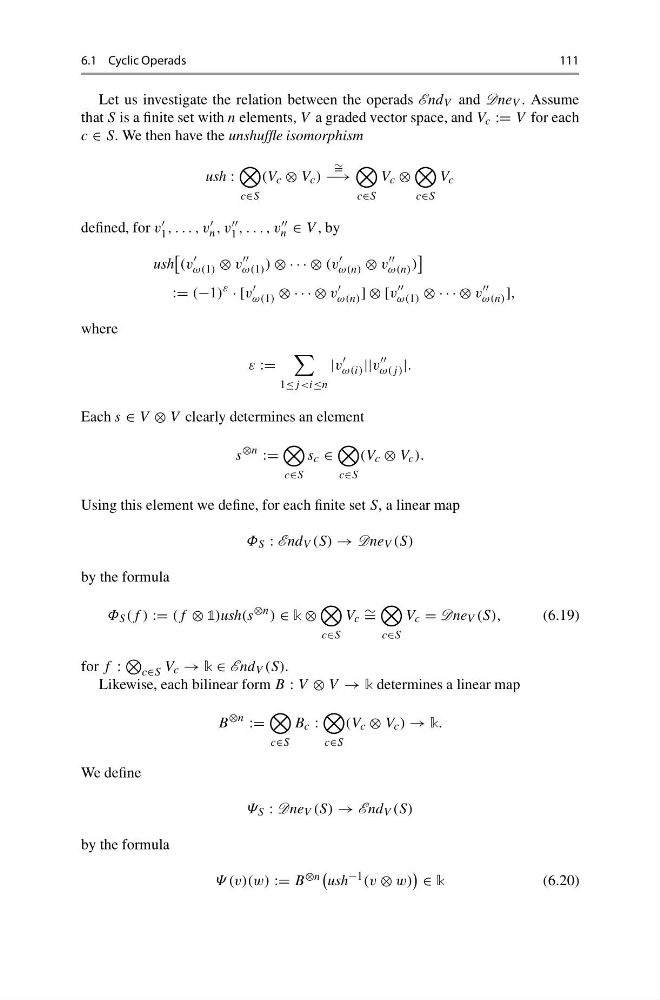
Let us investigate the relation between the operads End V and Dne V . Assume
that S is a finite set with n elements, V a graded vector space, and V c := V for each
c ∈ S. We then have the unshuffle isomorphism
ush :
c∈S
(V c ⊗ V c )
∼ =
−→
c∈S
V c ⊗
c∈S
V c
defined, for v
1 , . . . , v
n , v
1 , . . . , v
n ∈ V , by
ush
(v
ω(1) ⊗ v
ω(1) ) ⊗ · · · ⊗ (v
ω(n) ⊗ v
ω(n) )
:= (−1)
ε
· [v
ω(1) ⊗ · · · ⊗ v
ω(n) ] ⊗ [v
ω(1) ⊗ · · · ⊗ v
ω(n) ],
where
ε :=
1≤j
ω(i) ||v
ω(j) |.
Each s ∈ V ⊗ V clearly determines an element
s
⊗n
:=
c∈S
s c ∈
c∈S
(V c ⊗ V c ).
Using this element we define, for each finite set S, a linear map
Φ S : End V (S) → Dne V (S)
by the formula
Φ S (f ) := (f ⊗ 1)ush(s
⊗n ) ∈ k ⊗
c∈S
V c ∼ =
c∈S
V c = Dne V (S),
(6.19)
for f :
c∈S V c → k ∈ End V (S).
Likewise, each bilinear form B : V ⊗ V → k determines a linear map
B
⊗n
:=
c∈S
B c :
c∈S
(V c ⊗ V c ) → k.
We define
Ψ S : Dne V (S) → End V (S)
by the formula
Ψ (v)(w) := B ⊗n
ush −1 (v ⊗ w)
∈ k
(6.20)
111
Let us investigate the relation between the operads End V and Dne V . Assume
that S is a finite set with n elements, V a graded vector space, and V c := V for each
c ∈ S. We then have the unshuffle isomorphism
ush :
c∈S
(V c ⊗ V c )
∼ =
−→
c∈S
V c ⊗
c∈S
V c
defined, for v
1 , . . . , v
n , v
1 , . . . , v
n ∈ V , by
ush
(v
ω(1) ⊗ v
ω(1) ) ⊗ · · · ⊗ (v
ω(n) ⊗ v
ω(n) )
:= (−1)
ε
· [v
ω(1) ⊗ · · · ⊗ v
ω(n) ] ⊗ [v
ω(1) ⊗ · · · ⊗ v
ω(n) ],
where
ε :=
1≤j
ω(i) ||v
ω(j) |.
Each s ∈ V ⊗ V clearly determines an element
s
⊗n
:=
c∈S
s c ∈
c∈S
(V c ⊗ V c ).
Using this element we define, for each finite set S, a linear map
Φ S : End V (S) → Dne V (S)
by the formula
Φ S (f ) := (f ⊗ 1)ush(s
⊗n ) ∈ k ⊗
c∈S
V c ∼ =
c∈S
V c = Dne V (S),
(6.19)
for f :
c∈S V c → k ∈ End V (S).
Likewise, each bilinear form B : V ⊗ V → k determines a linear map
B
⊗n
:=
c∈S
B c :
c∈S
(V c ⊗ V c ) → k.
We define
Ψ S : Dne V (S) → End V (S)
by the formula
Ψ (v)(w) := B ⊗n
ush −1 (v ⊗ w)
∈ k
(6.20)