

6.1 Cyclic Operads
109
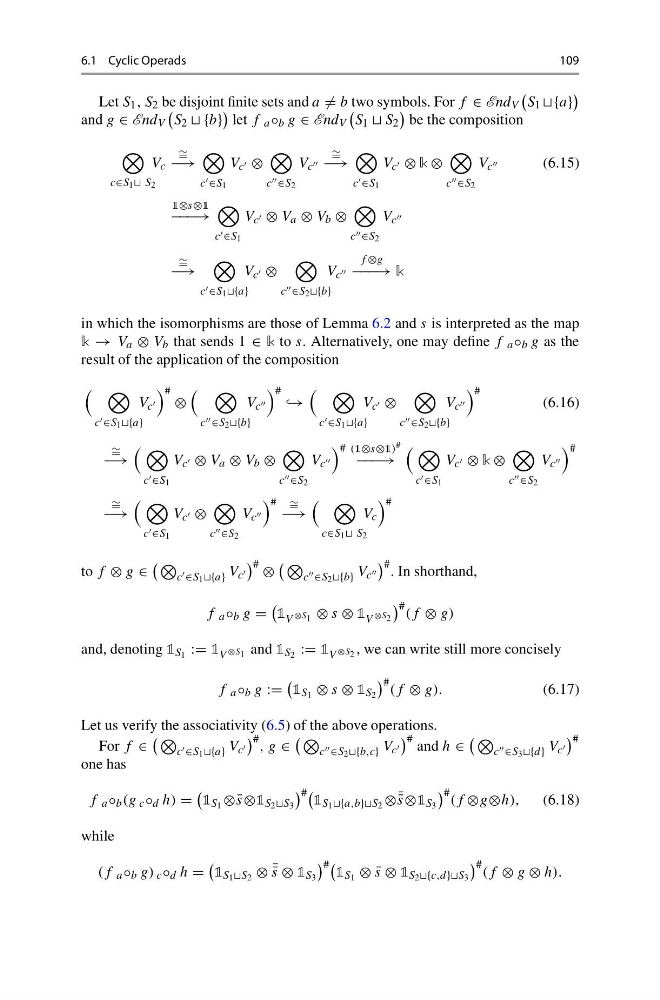
Let S 1 , S 2 be disjoint finite sets and a = b two symbols. For f ∈ End V
S 1
and g ∈ End V
S 2 {b}
let f a ◦ b g ∈ End V
S 1 S 2
be the composition
c∈S 1 S 2
V c
∼ =
−→
c ∈S 1
V c ⊗
c ∈S 2
V c
∼ =
−→
c ∈S 1
V c ⊗ k ⊗
c ∈S 2
V c
(6.15)
1⊗s⊗1
−−−→
c ∈S 1
V c ⊗ V a ⊗ V b ⊗
c ∈S 2
V c
∼ =
−→
c ∈S 1
V c ⊗
c ∈S 2
V c
f ⊗g
−−−→ k
in which the isomorphisms are those of Lemma 6.2 and s is interpreted as the map
k → V a ⊗ V b that sends 1 ∈ k to s. Alternatively, one may define f a ◦ b g as the
result of the application of the composition
c ∈S 1
V c
# ⊗
c ∈S 2
V c
#
c ∈S 1
V c ⊗
c ∈S 2
V c
#
(6.16)
∼ =
−→
c ∈S 1
V c ⊗ V a ⊗ V b ⊗
c ∈S 2
V c
# (1⊗s⊗1) #
−−−→
c ∈S 1
V c ⊗ k ⊗
c ∈S 2
V c
#
∼ =
−→
c ∈S 1
V c ⊗
c ∈S 2
V c
# ∼ =
−→
c∈S 1 S 2
V c
#
to f ⊗ g ∈
c ∈S 1 V c
# ⊗
c ∈S 2 V c
# . In shorthand,
f a ◦ b g =
1 V ⊗S 1 ⊗ s ⊗ 1 V ⊗S 2
# (f ⊗ g)
and, denoting 1 S 1 := 1 V ⊗S 1 and 1 S 2 := 1 V ⊗S 2 , we can write still more concisely
f a ◦ b g :=
1 S 1 ⊗ s ⊗ 1 S 2
# (f ⊗ g).
(6.17)
Let us verify the associativity (6.5) of the above operations.
For f ∈
c ∈S 1 V c
# , g ∈
c ∈S 2 {b,c} V c
# and h ∈
c ∈S 3 V c
#
one has
f a ◦ b (g c ◦ d h) =
1 S 1 ⊗ ¯
s ⊗1 S 2 3
#
1 S 1 {a,b}}S 2 ⊗ ¯ ¯
s ⊗1 S 3
# (f ⊗g⊗h),
(6.18)
while
(f a ◦ b g) c ◦ d h =
1 S 1 2 ⊗ ¯ ¯
s ⊗ 1 S 3
# 1 S 1 ⊗ ¯
s ⊗ 1 S 2 {c,d}}S 3
# (f ⊗ g ⊗ h).
109
Let S 1 , S 2 be disjoint finite sets and a = b two symbols. For f ∈ End V
S 1
and g ∈ End V
S 2 {b}
let f a ◦ b g ∈ End V
S 1 S 2
be the composition
c∈S 1 S 2
V c
∼ =
−→
c ∈S 1
V c ⊗
c ∈S 2
V c
∼ =
−→
c ∈S 1
V c ⊗ k ⊗
c ∈S 2
V c
(6.15)
1⊗s⊗1
−−−→
c ∈S 1
V c ⊗ V a ⊗ V b ⊗
c ∈S 2
V c
∼ =
−→
c ∈S 1
V c ⊗
c ∈S 2
V c
f ⊗g
−−−→ k
in which the isomorphisms are those of Lemma 6.2 and s is interpreted as the map
k → V a ⊗ V b that sends 1 ∈ k to s. Alternatively, one may define f a ◦ b g as the
result of the application of the composition
c ∈S 1
V c
# ⊗
c ∈S 2
V c
#
c ∈S 1
V c ⊗
c ∈S 2
V c
#
(6.16)
∼ =
−→
c ∈S 1
V c ⊗ V a ⊗ V b ⊗
c ∈S 2
V c
# (1⊗s⊗1) #
−−−→
c ∈S 1
V c ⊗ k ⊗
c ∈S 2
V c
#
∼ =
−→
c ∈S 1
V c ⊗
c ∈S 2
V c
# ∼ =
−→
c∈S 1 S 2
V c
#
to f ⊗ g ∈
c ∈S 1 V c
# ⊗
c ∈S 2 V c
# . In shorthand,
f a ◦ b g =
1 V ⊗S 1 ⊗ s ⊗ 1 V ⊗S 2
# (f ⊗ g)
and, denoting 1 S 1 := 1 V ⊗S 1 and 1 S 2 := 1 V ⊗S 2 , we can write still more concisely
f a ◦ b g :=
1 S 1 ⊗ s ⊗ 1 S 2
# (f ⊗ g).
(6.17)
Let us verify the associativity (6.5) of the above operations.
For f ∈
c ∈S 1 V c
# , g ∈
c ∈S 2 {b,c} V c
# and h ∈
c ∈S 3 V c
#
one has
f a ◦ b (g c ◦ d h) =
1 S 1 ⊗ ¯
s ⊗1 S 2 3
#
1 S 1 {a,b}}S 2 ⊗ ¯ ¯
s ⊗1 S 3
# (f ⊗g⊗h),
(6.18)
while
(f a ◦ b g) c ◦ d h =
1 S 1 2 ⊗ ¯ ¯
s ⊗ 1 S 3
# 1 S 1 ⊗ ¯
s ⊗ 1 S 2 {c,d}}S 3
# (f ⊗ g ⊗ h).