

106
6 Operads
a
b
c
d
e
a
b
c
d
e
x
y
z
u
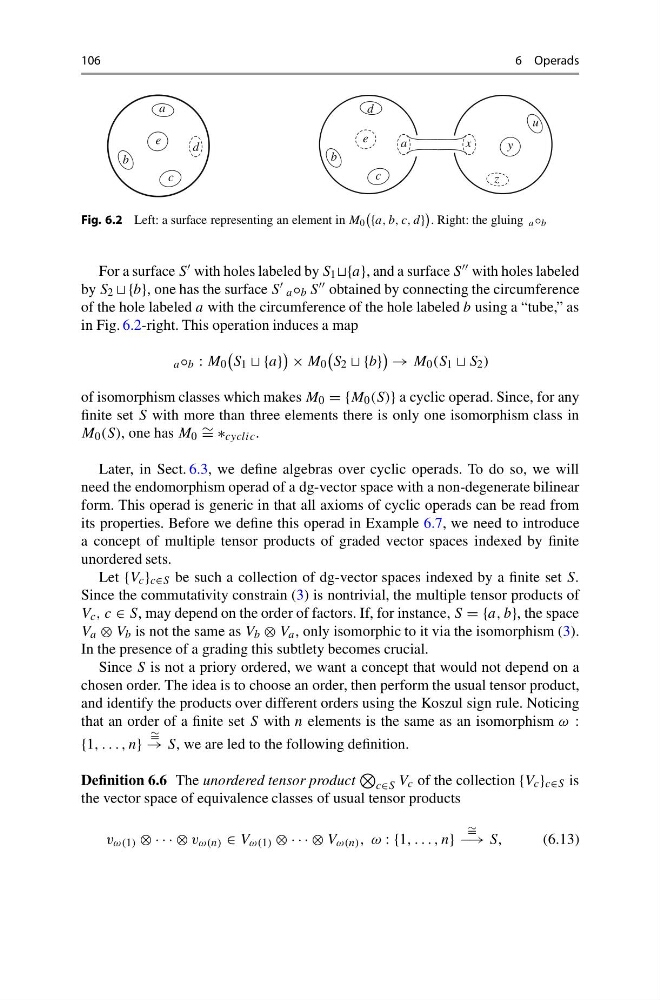
Fig. 6.2 Left: a surface representing an element in M 0
{a, b, c, d}
. Right: the gluing a ◦ b
For a surface S with holes labeled by S 1 and a surface S with holes labeled
by S 2 {b}, one has the surface S a ◦ b S obtained by connecting the circumference
of the hole labeled a with the circumference of the hole labeled b using a “tube,” as
in Fig. 6.2-right. This operation induces a map
a ◦ b : M 0
S 1 {a}
× M 0
S 2 {b}
→ M 0 (S 1 S 2 )
of isomorphism classes which makes M 0 = {M 0 (S)} a cyclic operad. Since, for any
finite set S with more than three elements there is only one isomorphism class in
M 0 (S), one has M 0 ∼ = ∗ cyclic .
Later, in Sect. 6.3, we define algebras over cyclic operads. To do so, we will
need the endomorphism operad of a dg-vector space with a non-degenerate bilinear
form. This operad is generic in that all axioms of cyclic operads can be read from
its properties. Before we define this operad in Example 6.7, we need to introduce
a concept of multiple tensor products of graded vector spaces indexed by finite
unordered sets.
Let {V c } c∈S be such a collection of dg-vector spaces indexed by a finite set S.
Since the commutativity constrain (3) is nontrivial, the multiple tensor products of
V c , c ∈ S, may depend on the order of factors. If, for instance, S = {a, b}, the space
V a ⊗ V b is not the same as V b ⊗ V a , only isomorphic to it via the isomorphism (3).
In the presence of a grading this subtlety becomes crucial.
Since S is not a priory ordered, we want a concept that would not depend on a
chosen order. The idea is to choose an order, then perform the usual tensor product,
and identify the products over different orders using the Koszul sign rule. Noticing
that an order of a finite set S with n elements is the same as an isomorphism ω :
{1, . . . , n}
∼ =
→ S, we are led to the following definition.
Definition 6.6 The unordered tensor product
c∈S V c of the collection {V c } c∈S is
the vector space of equivalence classes of usual tensor products
v ω(1) ⊗ · · · ⊗ v ω(n) ∈ V ω(1) ⊗ · · · ⊗ V ω(n) , ω : {1, . . . , n}
∼ =
−→ S,
(6.13)
6 Operads
a
b
c
d
e
a
b
c
d
e
x
y
z
u
Fig. 6.2 Left: a surface representing an element in M 0
{a, b, c, d}
. Right: the gluing a ◦ b
For a surface S with holes labeled by S 1 and a surface S with holes labeled
by S 2 {b}, one has the surface S a ◦ b S obtained by connecting the circumference
of the hole labeled a with the circumference of the hole labeled b using a “tube,” as
in Fig. 6.2-right. This operation induces a map
a ◦ b : M 0
S 1 {a}
× M 0
S 2 {b}
→ M 0 (S 1 S 2 )
of isomorphism classes which makes M 0 = {M 0 (S)} a cyclic operad. Since, for any
finite set S with more than three elements there is only one isomorphism class in
M 0 (S), one has M 0 ∼ = ∗ cyclic .
Later, in Sect. 6.3, we define algebras over cyclic operads. To do so, we will
need the endomorphism operad of a dg-vector space with a non-degenerate bilinear
form. This operad is generic in that all axioms of cyclic operads can be read from
its properties. Before we define this operad in Example 6.7, we need to introduce
a concept of multiple tensor products of graded vector spaces indexed by finite
unordered sets.
Let {V c } c∈S be such a collection of dg-vector spaces indexed by a finite set S.
Since the commutativity constrain (3) is nontrivial, the multiple tensor products of
V c , c ∈ S, may depend on the order of factors. If, for instance, S = {a, b}, the space
V a ⊗ V b is not the same as V b ⊗ V a , only isomorphic to it via the isomorphism (3).
In the presence of a grading this subtlety becomes crucial.
Since S is not a priory ordered, we want a concept that would not depend on a
chosen order. The idea is to choose an order, then perform the usual tensor product,
and identify the products over different orders using the Koszul sign rule. Noticing
that an order of a finite set S with n elements is the same as an isomorphism ω :
{1, . . . , n}
∼ =
→ S, we are led to the following definition.
Definition 6.6 The unordered tensor product
c∈S V c of the collection {V c } c∈S is
the vector space of equivalence classes of usual tensor products
v ω(1) ⊗ · · · ⊗ v ω(n) ∈ V ω(1) ⊗ · · · ⊗ V ω(n) , ω : {1, . . . , n}
∼ =
−→ S,
(6.13)