

102
6 Operads
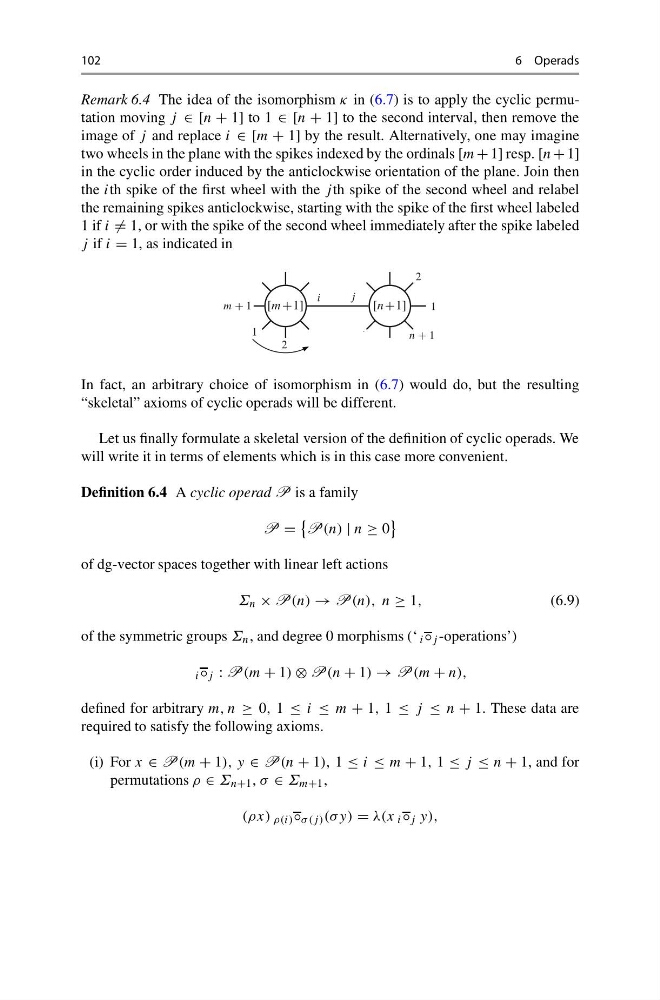
Remark 6.4 The idea of the isomorphism κ in (6.7) is to apply the cyclic permutation moving j ∈ [n + 1] to 1 ∈ [n + 1] to the second interval, then remove the
image of j and replace i ∈ [m + 1] by the result. Alternatively, one may imagine
two wheels in the plane with the spikes indexed by the ordinals [m + 1] resp. [n + 1]
in the cyclic order induced by the anticlockwise orientation of the plane. Join then
the ith spike of the first wheel with the j th spike of the second wheel and relabel
the remaining spikes anticlockwise, starting with the spike of the first wheel labeled
1 if i = 1, or with the spike of the second wheel immediately after the spike labeled
j if i = 1, as indicated in
[m+1]
[ n+1]
1
i
j
1
2
n + 1
2
m + 1
.
In fact, an arbitrary choice of isomorphism in (6.7) would do, but the resulting
“skeletal” axioms of cyclic operads will be different.
Let us finally formulate a skeletal version of the definition of cyclic operads. We
will write it in terms of elements which is in this case more convenient.
Definition 6.4 A cyclic operad P is a family
P =
P(n) | n ≥ 0
of dg-vector spaces together with linear left actions
Σ n × P(n) → P(n), n ≥ 1,
(6.9)
of the symmetric groups Σ n , and degree 0 morphisms (‘ i ◦ j -operations’)
i ◦ j : P(m + 1) ⊗ P(n + 1) → P(m + n),
defined for arbitrary m, n ≥ 0, 1 ≤ i ≤ m + 1, 1 ≤ j ≤ n + 1. These data are
required to satisfy the following axioms.
(i) For x ∈ P(m + 1), y ∈ P(n + 1), 1 ≤ i ≤ m + 1, 1 ≤ j ≤ n + 1, and for
permutations ρ ∈ Σ n+1 , σ ∈ Σ m+1 ,
(ρx) ρ(i) ◦ σ (j) (σy) = λ(x i ◦ j y),
6 Operads
Remark 6.4 The idea of the isomorphism κ in (6.7) is to apply the cyclic permutation moving j ∈ [n + 1] to 1 ∈ [n + 1] to the second interval, then remove the
image of j and replace i ∈ [m + 1] by the result. Alternatively, one may imagine
two wheels in the plane with the spikes indexed by the ordinals [m + 1] resp. [n + 1]
in the cyclic order induced by the anticlockwise orientation of the plane. Join then
the ith spike of the first wheel with the j th spike of the second wheel and relabel
the remaining spikes anticlockwise, starting with the spike of the first wheel labeled
1 if i = 1, or with the spike of the second wheel immediately after the spike labeled
j if i = 1, as indicated in
[m+1]
[ n+1]
1
i
j
1
2
n + 1
2
m + 1
.
In fact, an arbitrary choice of isomorphism in (6.7) would do, but the resulting
“skeletal” axioms of cyclic operads will be different.
Let us finally formulate a skeletal version of the definition of cyclic operads. We
will write it in terms of elements which is in this case more convenient.
Definition 6.4 A cyclic operad P is a family
P =
P(n) | n ≥ 0
of dg-vector spaces together with linear left actions
Σ n × P(n) → P(n), n ≥ 1,
(6.9)
of the symmetric groups Σ n , and degree 0 morphisms (‘ i ◦ j -operations’)
i ◦ j : P(m + 1) ⊗ P(n + 1) → P(m + n),
defined for arbitrary m, n ≥ 0, 1 ≤ i ≤ m + 1, 1 ≤ j ≤ n + 1. These data are
required to satisfy the following axioms.
(i) For x ∈ P(m + 1), y ∈ P(n + 1), 1 ≤ i ≤ m + 1, 1 ≤ j ≤ n + 1, and for
permutations ρ ∈ Σ n+1 , σ ∈ Σ m+1 ,
(ρx) ρ(i) ◦ σ (j) (σy) = λ(x i ◦ j y),