

4.3 Registry and Sublayer-Order Resolution
69
30.8 31.0 31.2 31.4 31.6 31.8
Intensity (a.u.)
BE (eV)
W(100) 4f 7/2
B
S1
S2
(a)
21.2
21.6
22.0
22.4
22.8
(d)
Intensity (a.u.)
BE (eV)
Exp
BOLS
B
S 2
S 1
S D
30.8 31.0 31.2 31.4 31.6 31.8
W(110) 4f 7/2
Intensity (a.u.)
BE (eV)
B
S1
S2
(b)
21.2
21.6
22.0
22.4
(e)
Intensity (a.u.)
BE (eV)
Exp
BOLS
B
S 2
S 1
30.8 31.0 31.2 31.4 31.6 31.8
W(111) 4f 7/2
Intensity (a.u.)
BE (eV)
S1
S2
B
(c)
21.2
21.6
22.0
22.4
22.8
(f)
Intensity (a.u.)
BE (eV)
Exp
BOLS
B
S 2
S 1
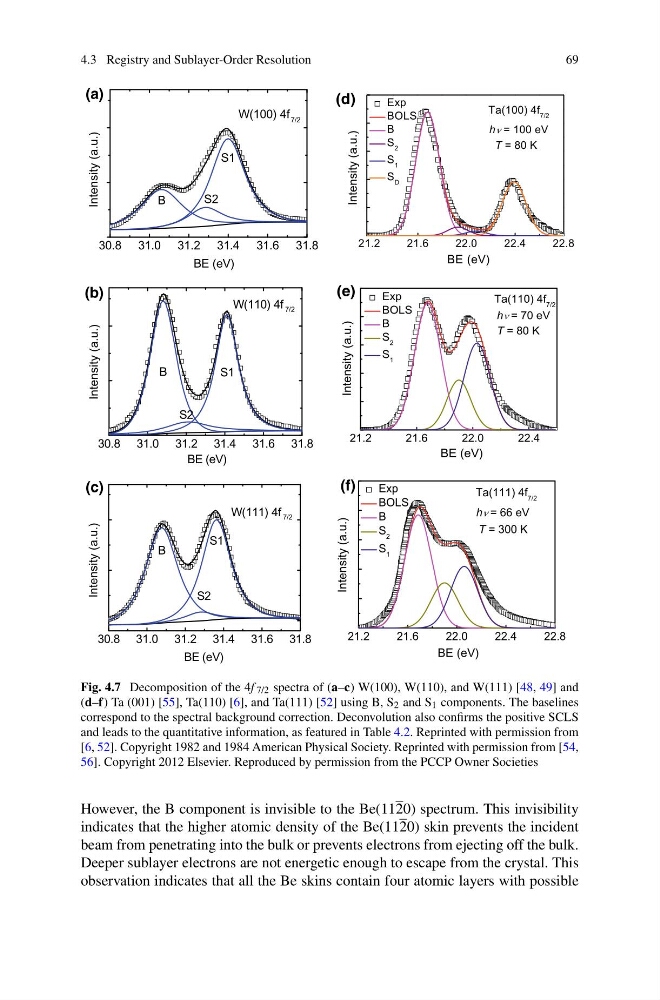
Fig. 4.7 Decomposition of the 4f 7/2 spectra of (a–c) W(100), W(110), and W(111) [48, 49] and
(d–f) Ta (001) [55], Ta(110) [6], and Ta(111) [52] using B, S 2 and S 1 components. The baselines
correspond to the spectral background correction. Deconvolution also confirms the positive SCLS
and leads to the quantitative information, as featured in Table 4.2. Reprinted with permission from
[6, 52]. Copyright 1982 and 1984 American Physical Society. Reprinted with permission from [54,
56]. Copyright 2012 Elsevier. Reproduced by permission from the PCCP Owner Societies
However, the B component is invisible to the Be(1120) spectrum. This invisibility
indicates that the higher atomic density of the Be(1120) skin prevents the incident
beam from penetrating into the bulk or prevents electrons from ejecting off the bulk.
Deeper sublayer electrons are not energetic enough to escape from the crystal. This
observation indicates that all the Be skins contain four atomic layers with possible
69
30.8 31.0 31.2 31.4 31.6 31.8
Intensity (a.u.)
BE (eV)
W(100) 4f 7/2
B
S1
S2
(a)
21.2
21.6
22.0
22.4
22.8
(d)
Intensity (a.u.)
BE (eV)
Exp
BOLS
B
S 2
S 1
S D
30.8 31.0 31.2 31.4 31.6 31.8
W(110) 4f 7/2
Intensity (a.u.)
BE (eV)
B
S1
S2
(b)
21.2
21.6
22.0
22.4
(e)
Intensity (a.u.)
BE (eV)
Exp
BOLS
B
S 2
S 1
30.8 31.0 31.2 31.4 31.6 31.8
W(111) 4f 7/2
Intensity (a.u.)
BE (eV)
S1
S2
B
(c)
21.2
21.6
22.0
22.4
22.8
(f)
Intensity (a.u.)
BE (eV)
Exp
BOLS
B
S 2
S 1
Fig. 4.7 Decomposition of the 4f 7/2 spectra of (a–c) W(100), W(110), and W(111) [48, 49] and
(d–f) Ta (001) [55], Ta(110) [6], and Ta(111) [52] using B, S 2 and S 1 components. The baselines
correspond to the spectral background correction. Deconvolution also confirms the positive SCLS
and leads to the quantitative information, as featured in Table 4.2. Reprinted with permission from
[6, 52]. Copyright 1982 and 1984 American Physical Society. Reprinted with permission from [54,
56]. Copyright 2012 Elsevier. Reproduced by permission from the PCCP Owner Societies
However, the B component is invisible to the Be(1120) spectrum. This invisibility
indicates that the higher atomic density of the Be(1120) skin prevents the incident
beam from penetrating into the bulk or prevents electrons from ejecting off the bulk.
Deeper sublayer electrons are not energetic enough to escape from the crystal. This
observation indicates that all the Be skins contain four atomic layers with possible