

3.3 PES and AES: Valence- and Core-Band Shift
49
3.3.2 PES and AES
Using light sources of different energies, PES measures energy states of different
bands. With energy less than 50 eV He-II radiation at 40.8 eV, UPS monitors the
change of the valence band consisting electrons of all constituents due to charge
transportation, entrapment, polarization, and electron-hole production. The inverse
IPES (He-I radiation at 21.2 eV) probes the occupation of the unoccupied DOS about
E F by antibonding dipoles, which functionalize the same as STS.
X-ray Photoelectron Spectroscopy (XPS), also known as ESCA, is a surface analysis technique that uses an X-ray beam to eject electrons from a surface. The kinetic
energies of the ejected electrons (photoelectrons) are then analyzed to produce a
spectrum, in which photoelectron peaks coming from different chemical elements
can be identified by their characteristic energies. The typical sample areas that can
be analyzed are between 1 mm
2 and 1 cm
2 , which makes XPS a useful technique for
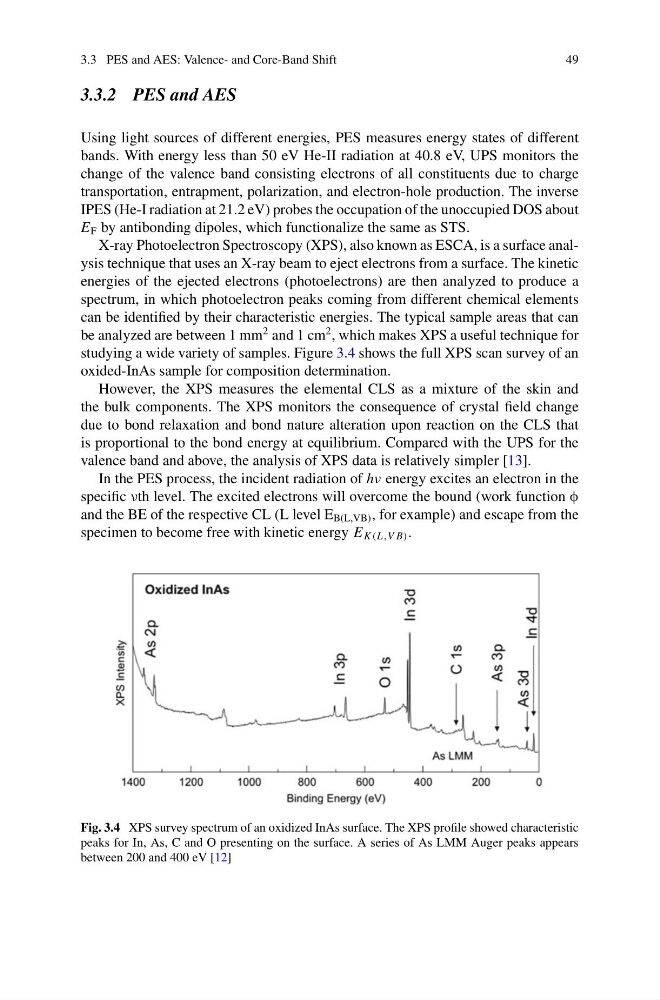
studying a wide variety of samples. Figure 3.4 shows the full XPS scan survey of an
oxided-InAs sample for composition determination.
However, the XPS measures the elemental CLS as a mixture of the skin and
the bulk components. The XPS monitors the consequence of crystal field change
due to bond relaxation and bond nature alteration upon reaction on the CLS that
is proportional to the bond energy at equilibrium. Compared with the UPS for the
valence band and above, the analysis of XPS data is relatively simpler [13].
In the PES process, the incident radiation of hν energy excites an electron in the
specific νth level. The excited electrons will overcome the bound (work function φ
and the BE of the respective CL (L level E B(L,VB) , for example) and escape from the
specimen to become free with kinetic energy E K (L ,V B) .
Fig. 3.4 XPS survey spectrum of an oxidized InAs surface. The XPS profile showed characteristic
peaks for In, As, C and O presenting on the surface. A series of As LMM Auger peaks appears
between 200 and 400 eV [12]
49
3.3.2 PES and AES
Using light sources of different energies, PES measures energy states of different
bands. With energy less than 50 eV He-II radiation at 40.8 eV, UPS monitors the
change of the valence band consisting electrons of all constituents due to charge
transportation, entrapment, polarization, and electron-hole production. The inverse
IPES (He-I radiation at 21.2 eV) probes the occupation of the unoccupied DOS about
E F by antibonding dipoles, which functionalize the same as STS.
X-ray Photoelectron Spectroscopy (XPS), also known as ESCA, is a surface analysis technique that uses an X-ray beam to eject electrons from a surface. The kinetic
energies of the ejected electrons (photoelectrons) are then analyzed to produce a
spectrum, in which photoelectron peaks coming from different chemical elements
can be identified by their characteristic energies. The typical sample areas that can
be analyzed are between 1 mm
2 and 1 cm
2 , which makes XPS a useful technique for
studying a wide variety of samples. Figure 3.4 shows the full XPS scan survey of an
oxided-InAs sample for composition determination.
However, the XPS measures the elemental CLS as a mixture of the skin and
the bulk components. The XPS monitors the consequence of crystal field change
due to bond relaxation and bond nature alteration upon reaction on the CLS that
is proportional to the bond energy at equilibrium. Compared with the UPS for the
valence band and above, the analysis of XPS data is relatively simpler [13].
In the PES process, the incident radiation of hν energy excites an electron in the
specific νth level. The excited electrons will overcome the bound (work function φ
and the BE of the respective CL (L level E B(L,VB) , for example) and escape from the
specimen to become free with kinetic energy E K (L ,V B) .
Fig. 3.4 XPS survey spectrum of an oxidized InAs surface. The XPS profile showed characteristic
peaks for In, As, C and O presenting on the surface. A series of As LMM Auger peaks appears
between 200 and 400 eV [12]