

40
2 Theory: Bond-Electron-Energy Correlation
of polarization and work function reduction. Presence of these localized nonbonding states is responsible for the size derivacy of defects and nanostructures such
as the Dirac-Fermions creation, dilute magnetism, catalytic enhancement, superhydrophobicity, etc. Such nonbonding and antibonding states play significant roles
in the topologic insulators, thermoelectric materials, and high-T C superconductors
[15]. The nonbonding electrons, the O:H interaction and its cooperativity with H-O
intra-molecular bond dictates the mysteries of water and ice [5, 23, 41].
2.5 Numerical Strategies: Formulation and Quantification
2.5.1 Irregular-Coordination Effect
With the BOLS-NEP notion and its formulation, one can decompose a skin XPS
spectrum accordingly. Parameters of concern are the number and order of components
and their intensities, energies, and their full width at half maximum (FWHM) if one
describes the peak using, but not limited to, Gaussian distribution function. Ideally,
the following provide guidelines:
⎧
⎪ ⎪ ⎨
⎪ ⎪ ⎩
I =
i I zi exp
−
E−E ν (zi )
E νW (zi )
2
(Spectral intensity)
E ν (zi )−Eν (0)
E ν (12)−Eν (0)
=
E zi
E b
= C
−m
zi
(Component peak energy)
E νwi (zi )
E νwb (12)
=
z i E zi
z b E b
= z ib C
−m
zi
(Component width)
(2.14)
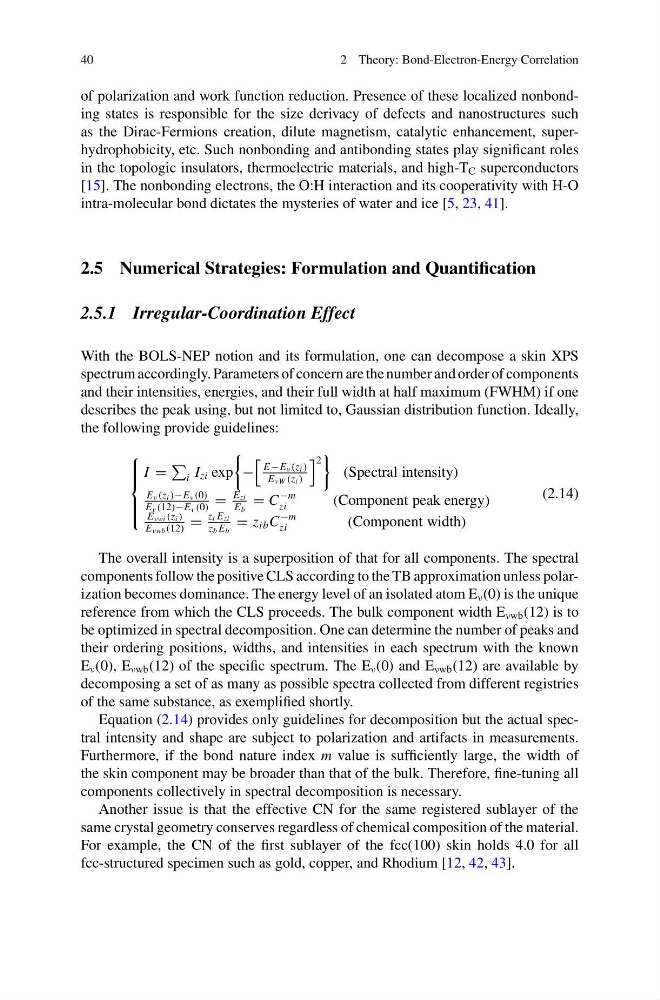
The overall intensity is a superposition of that for all components. The spectral
components follow the positive CLS according to the TB approximation unless polarization becomes dominance. The energy level of an isolated atom E ν (0) is the unique
reference from which the CLS proceeds. The bulk component width E νwb (12) is to
be optimized in spectral decomposition. One can determine the number of peaks and
their ordering positions, widths, and intensities in each spectrum with the known
E ν (0), E νwb (12) of the specific spectrum. The E ν (0) and E νwb (12) are available by
decomposing a set of as many as possible spectra collected from different registries
of the same substance, as exemplified shortly.
Equation (2.14) provides only guidelines for decomposition but the actual spectral intensity and shape are subject to polarization and artifacts in measurements.
Furthermore, if the bond nature index m value is sufficiently large, the width of
the skin component may be broader than that of the bulk. Therefore, fine-tuning all
components collectively in spectral decomposition is necessary.
Another issue is that the effective CN for the same registered sublayer of the
same crystal geometry conserves regardless of chemical composition of the material.
For example, the CN of the first sublayer of the fcc(100) skin holds 4.0 for all
fcc-structured specimen such as gold, copper, and Rhodium [12, 42, 43].
2 Theory: Bond-Electron-Energy Correlation
of polarization and work function reduction. Presence of these localized nonbonding states is responsible for the size derivacy of defects and nanostructures such
as the Dirac-Fermions creation, dilute magnetism, catalytic enhancement, superhydrophobicity, etc. Such nonbonding and antibonding states play significant roles
in the topologic insulators, thermoelectric materials, and high-T C superconductors
[15]. The nonbonding electrons, the O:H interaction and its cooperativity with H-O
intra-molecular bond dictates the mysteries of water and ice [5, 23, 41].
2.5 Numerical Strategies: Formulation and Quantification
2.5.1 Irregular-Coordination Effect
With the BOLS-NEP notion and its formulation, one can decompose a skin XPS
spectrum accordingly. Parameters of concern are the number and order of components
and their intensities, energies, and their full width at half maximum (FWHM) if one
describes the peak using, but not limited to, Gaussian distribution function. Ideally,
the following provide guidelines:
⎧
⎪ ⎪ ⎨
⎪ ⎪ ⎩
I =
i I zi exp
−
E−E ν (zi )
E νW (zi )
2
(Spectral intensity)
E ν (zi )−Eν (0)
E ν (12)−Eν (0)
=
E zi
E b
= C
−m
zi
(Component peak energy)
E νwi (zi )
E νwb (12)
=
z i E zi
z b E b
= z ib C
−m
zi
(Component width)
(2.14)
The overall intensity is a superposition of that for all components. The spectral
components follow the positive CLS according to the TB approximation unless polarization becomes dominance. The energy level of an isolated atom E ν (0) is the unique
reference from which the CLS proceeds. The bulk component width E νwb (12) is to
be optimized in spectral decomposition. One can determine the number of peaks and
their ordering positions, widths, and intensities in each spectrum with the known
E ν (0), E νwb (12) of the specific spectrum. The E ν (0) and E νwb (12) are available by
decomposing a set of as many as possible spectra collected from different registries
of the same substance, as exemplified shortly.
Equation (2.14) provides only guidelines for decomposition but the actual spectral intensity and shape are subject to polarization and artifacts in measurements.
Furthermore, if the bond nature index m value is sufficiently large, the width of
the skin component may be broader than that of the bulk. Therefore, fine-tuning all
components collectively in spectral decomposition is necessary.
Another issue is that the effective CN for the same registered sublayer of the
same crystal geometry conserves regardless of chemical composition of the material.
For example, the CN of the first sublayer of the fcc(100) skin holds 4.0 for all
fcc-structured specimen such as gold, copper, and Rhodium [12, 42, 43].