

Appendix A: Advantages and Limitations of the Electron and Phonon …
503
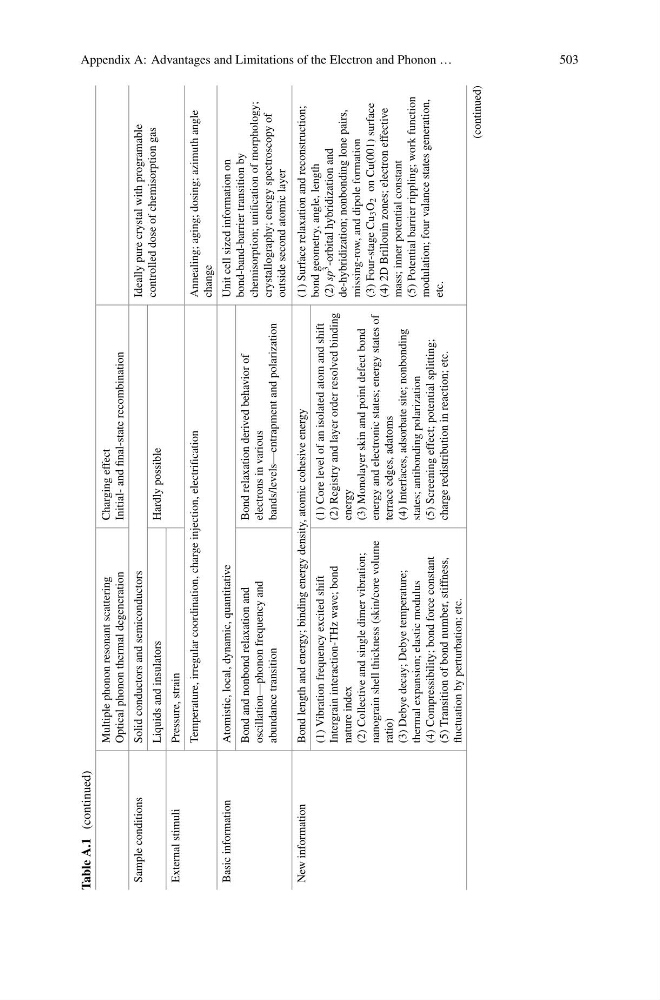
Table A.1
(continued)
Multiple phonon resonant scattering
Optical phonon thermal degeneration
Charging effect
Initial- and final-state recombination
Sample conditions
Solid conductors and semiconductors
Ideally pure crystal with programable
controlled dose of chemisorption gas
Liquids and insulators
Hardly possible
External stimuli
Pressure, strain
Temperature, irregular coordination, charge injection, electrification
Annealing; aging; dosing; azimuth angle
change
Basic information
Atomistic, local, dynamic, quantitative
Unit cell sized information on
bond-band-barrier transition by
chemisorption; unification of morphology;
crystallography; energy spectroscopy of
outside second atomic layer
Bond and nonbond relaxation and
oscillation—phonon frequency and
abundance transition
Bond relaxation derived behavior of
electrons in various
bands/levels—entrapment and polarization
New information
Bond length and energy; binding energy density, atomic cohesive energy
(1) Surface relaxation and reconstruction;
bond geometry, angle, length
(2) sp 3
-orbital hybridization and
de-hybridization; nonbonding lone pairs,
missing-row, and dipole formation
(3) Four-stage Cu
3 O
2 on Cu(001) surface
(4) 2D Brillouin zones; electron effective
mass; inner potential constant
(5) Potential barrier rippling; work function
modulation; four valance states generation,
etc.
(1) Vibration frequency excited shift
Intergrain interaction-THz wave; bond
nature index
(2) Collective and single dimer vibration;
nanograin shell thickness (skin/core volume
ratio)
(3) Debye decay; Debye temperature;
thermal expansion; elastic modulus
(4) Compressibility; bond force constant
(5) Transition of bond number, stiffness,
fluctuation by perturbation; etc.
(1) Core level of an isolated atom and shift
(2) Registry and layer order resolved binding
energy
(3) Monolayer skin and point defect bond
energy and electronic states; energy states of
terrace edges, adatoms
(4) Interfaces, adsorbate site; nonbonding
states; antibonding polarization
(5) Screening effect; potential splitting;
charge redistribution in reaction; etc.
(continued)
503
Table A.1
(continued)
Multiple phonon resonant scattering
Optical phonon thermal degeneration
Charging effect
Initial- and final-state recombination
Sample conditions
Solid conductors and semiconductors
Ideally pure crystal with programable
controlled dose of chemisorption gas
Liquids and insulators
Hardly possible
External stimuli
Pressure, strain
Temperature, irregular coordination, charge injection, electrification
Annealing; aging; dosing; azimuth angle
change
Basic information
Atomistic, local, dynamic, quantitative
Unit cell sized information on
bond-band-barrier transition by
chemisorption; unification of morphology;
crystallography; energy spectroscopy of
outside second atomic layer
Bond and nonbond relaxation and
oscillation—phonon frequency and
abundance transition
Bond relaxation derived behavior of
electrons in various
bands/levels—entrapment and polarization
New information
Bond length and energy; binding energy density, atomic cohesive energy
(1) Surface relaxation and reconstruction;
bond geometry, angle, length
(2) sp 3
-orbital hybridization and
de-hybridization; nonbonding lone pairs,
missing-row, and dipole formation
(3) Four-stage Cu
3 O
2 on Cu(001) surface
(4) 2D Brillouin zones; electron effective
mass; inner potential constant
(5) Potential barrier rippling; work function
modulation; four valance states generation,
etc.
(1) Vibration frequency excited shift
Intergrain interaction-THz wave; bond
nature index
(2) Collective and single dimer vibration;
nanograin shell thickness (skin/core volume
ratio)
(3) Debye decay; Debye temperature;
thermal expansion; elastic modulus
(4) Compressibility; bond force constant
(5) Transition of bond number, stiffness,
fluctuation by perturbation; etc.
(1) Core level of an isolated atom and shift
(2) Registry and layer order resolved binding
energy
(3) Monolayer skin and point defect bond
energy and electronic states; energy states of
terrace edges, adatoms
(4) Interfaces, adsorbate site; nonbonding
states; antibonding polarization
(5) Screening effect; potential splitting;
charge redistribution in reaction; etc.
(continued)