

26
2 Theory: Bond-Electron-Energy Correlation
Table 2.1 Classification, origin, annotation, and the size dependency and size-induced emerging
properties of a substance at the nanoscales, edges, skins and interfaces associated with bond
relaxation and potential trap or barrier formation
Tetrahedral
CN (C, N, O,
F)
Isolated
atom
Atomic chain,
sheet, tube, wire,
dot, skin,
nanocrystal, …
Ideal bulk
Interface/impurity
Interaction
0
1
1
1
Atomic CN
0
<12 (under)
12 (full)
Hetero
Notions
• Interaction between undercoordinated atoms differs in nature nanostructures from an
isolated atom or the bulk in performance
• Bond between undercoordinated atoms becomes shorter and stronger
• Defects, skins, adatoms, nanostructures of various shapes share the same attribute of
undercoordination
• Skin atoms/bonds dictate the size dependency of nanocrystals in various properties
• Interface potential barrier/trap formation results in local entrapment and/or
polarization
Electronic
behavior
Atomic irregular coordination causes local bond relaxation or bond nature alteration,
which results in local quantum entrapment of core electrons and polarization of
nonbonding electrons
The energetic behaviors of bonds and electrons mediate the BE shift and the
functionalities of a substance
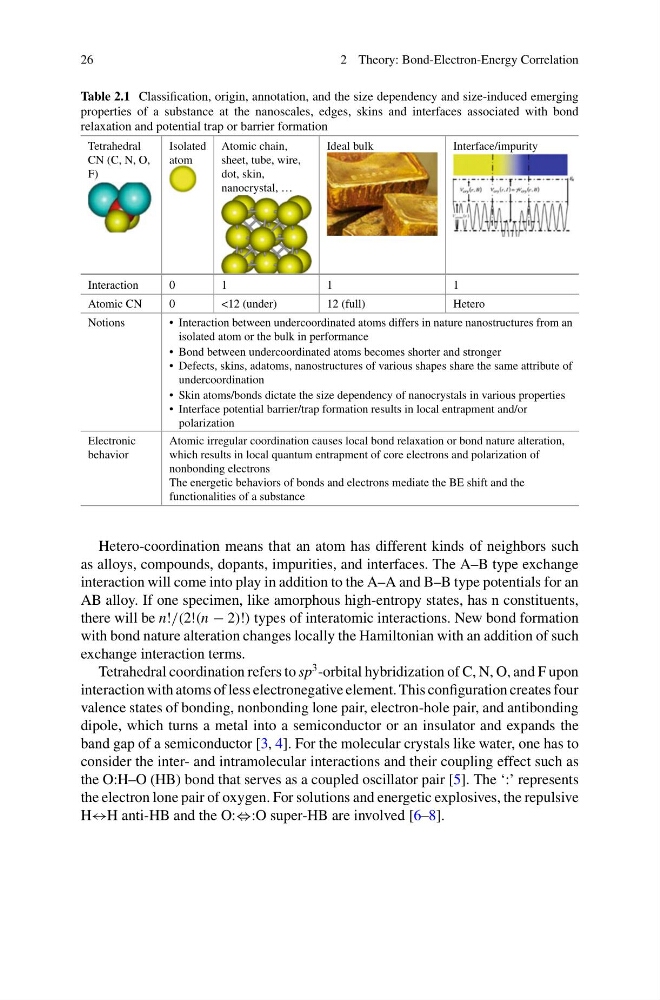
Hetero-coordination means that an atom has different kinds of neighbors such
as alloys, compounds, dopants, impurities, and interfaces. The A–B type exchange
interaction will come into play in addition to the A–A and B–B type potentials for an
AB alloy. If one specimen, like amorphous high-entropy states, has n constituents,
there will be n!/(2!(n − 2)!) types of interatomic interactions. New bond formation
with bond nature alteration changes locally the Hamiltonian with an addition of such
exchange interaction terms.
Tetrahedral coordination refers to sp
3 -orbital hybridization of C, N, O, and F upon
interaction with atoms of less electronegative element. This configuration creates four
valence states of bonding, nonbonding lone pair, electron-hole pair, and antibonding
dipole, which turns a metal into a semiconductor or an insulator and expands the
band gap of a semiconductor [3, 4]. For the molecular crystals like water, one has to
consider the inter- and intramolecular interactions and their coupling effect such as
the O:H–O (HB) bond that serves as a coupled oscillator pair [5]. The ‘:’ represents
the electron lone pair of oxygen. For solutions and energetic explosives, the repulsive
H↔H anti-HB and the O:⇔:O super-HB are involved [6–8].
2 Theory: Bond-Electron-Energy Correlation
Table 2.1 Classification, origin, annotation, and the size dependency and size-induced emerging
properties of a substance at the nanoscales, edges, skins and interfaces associated with bond
relaxation and potential trap or barrier formation
Tetrahedral
CN (C, N, O,
F)
Isolated
atom
Atomic chain,
sheet, tube, wire,
dot, skin,
nanocrystal, …
Ideal bulk
Interface/impurity
Interaction
0
1
1
1
Atomic CN
0
<12 (under)
12 (full)
Hetero
Notions
• Interaction between undercoordinated atoms differs in nature nanostructures from an
isolated atom or the bulk in performance
• Bond between undercoordinated atoms becomes shorter and stronger
• Defects, skins, adatoms, nanostructures of various shapes share the same attribute of
undercoordination
• Skin atoms/bonds dictate the size dependency of nanocrystals in various properties
• Interface potential barrier/trap formation results in local entrapment and/or
polarization
Electronic
behavior
Atomic irregular coordination causes local bond relaxation or bond nature alteration,
which results in local quantum entrapment of core electrons and polarization of
nonbonding electrons
The energetic behaviors of bonds and electrons mediate the BE shift and the
functionalities of a substance
Hetero-coordination means that an atom has different kinds of neighbors such
as alloys, compounds, dopants, impurities, and interfaces. The A–B type exchange
interaction will come into play in addition to the A–A and B–B type potentials for an
AB alloy. If one specimen, like amorphous high-entropy states, has n constituents,
there will be n!/(2!(n − 2)!) types of interatomic interactions. New bond formation
with bond nature alteration changes locally the Hamiltonian with an addition of such
exchange interaction terms.
Tetrahedral coordination refers to sp
3 -orbital hybridization of C, N, O, and F upon
interaction with atoms of less electronegative element. This configuration creates four
valence states of bonding, nonbonding lone pair, electron-hole pair, and antibonding
dipole, which turns a metal into a semiconductor or an insulator and expands the
band gap of a semiconductor [3, 4]. For the molecular crystals like water, one has to
consider the inter- and intramolecular interactions and their coupling effect such as
the O:H–O (HB) bond that serves as a coupled oscillator pair [5]. The ‘:’ represents
the electron lone pair of oxygen. For solutions and energetic explosives, the repulsive
H↔H anti-HB and the O:⇔:O super-HB are involved [6–8].