

490
24 Water and Aqueous Solutions
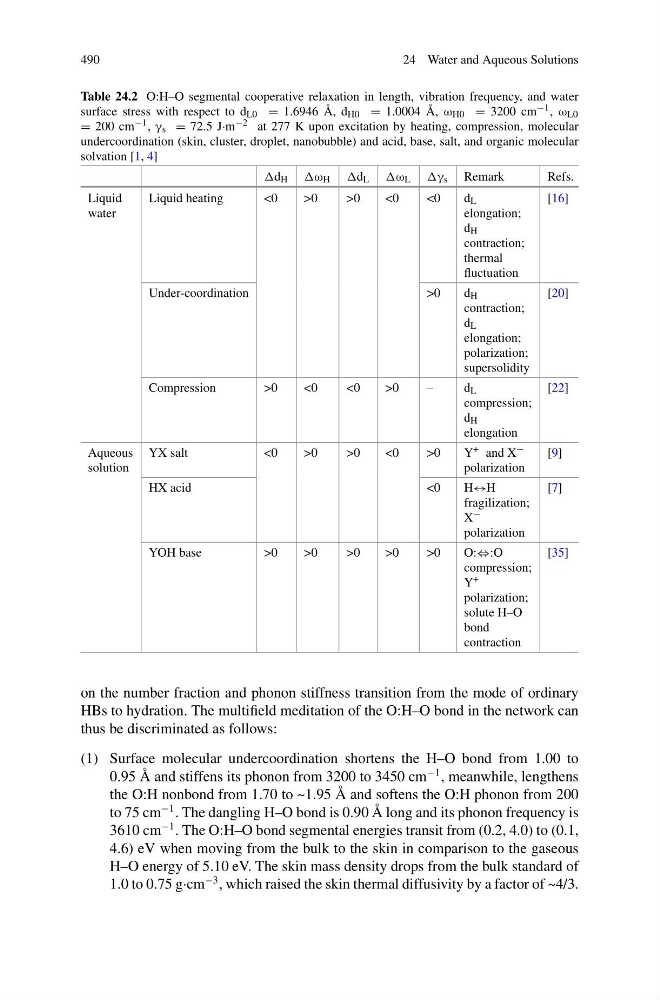
Table 24.2 O:H–O segmental cooperative relaxation in length, vibration frequency, and water
surface stress with respect to d L0 = 1.6946 Å, d H0 = 1.0004 Å, ω H0 = 3200 cm −1 , ω L0
= 200 cm −1 , γ s = 72.5 J·m −2 at 277 K upon excitation by heating, compression, molecular
undercoordination (skin, cluster, droplet, nanobubble) and acid, base, salt, and organic molecular
solvation [1, 4]
d H ω H d L ω L γ s Remark
Refs.
Liquid
water
Liquid heating
<0
>0
>0
<0
<0
d L
elongation;
d H
contraction;
thermal
fluctuation
[16]
Under-coordination
>0
d H
contraction;
d L
elongation;
polarization;
supersolidity
[20]
Compression
>0
<0
<0
>0
–
d L
compression;
d H
elongation
[22]
Aqueous
solution
YX salt
<0
>0
>0
<0
>0
Y + and X −
polarization
[9]
HX acid
<0
H↔H
fragilization;
X −
polarization
[7]
YOH base
>0
>0
>0
>0
>0
O:⇔:O
compression;
Y +
polarization;
solute H–O
bond
contraction
[35]
on the number fraction and phonon stiffness transition from the mode of ordinary
HBs to hydration. The multifield meditation of the O:H–O bond in the network can
thus be discriminated as follows:
(1) Surface molecular undercoordination shortens the H–O bond from 1.00 to
0.95 Å and stiffens its phonon from 3200 to 3450 cm
−1 , meanwhile, lengthens
the O:H nonbond from 1.70 to ~1.95 Å and softens the O:H phonon from 200
to 75 cm
−1 . The dangling H–O bond is 0.90 Å long and its phonon frequency is
3610 cm
−1 . The O:H–O bond segmental energies transit from (0.2, 4.0) to (0.1,
4.6) eV when moving from the bulk to the skin in comparison to the gaseous
H–O energy of 5.10 eV. The skin mass density drops from the bulk standard of
1.0 to 0.75 g·cm
−3 , which raised the skin thermal diffusivity by a factor of ~4/3.
24 Water and Aqueous Solutions
Table 24.2 O:H–O segmental cooperative relaxation in length, vibration frequency, and water
surface stress with respect to d L0 = 1.6946 Å, d H0 = 1.0004 Å, ω H0 = 3200 cm −1 , ω L0
= 200 cm −1 , γ s = 72.5 J·m −2 at 277 K upon excitation by heating, compression, molecular
undercoordination (skin, cluster, droplet, nanobubble) and acid, base, salt, and organic molecular
solvation [1, 4]
d H ω H d L ω L γ s Remark
Refs.
Liquid
water
Liquid heating
<0
>0
>0
<0
<0
d L
elongation;
d H
contraction;
thermal
fluctuation
[16]
Under-coordination
>0
d H
contraction;
d L
elongation;
polarization;
supersolidity
[20]
Compression
>0
<0
<0
>0
–
d L
compression;
d H
elongation
[22]
Aqueous
solution
YX salt
<0
>0
>0
<0
>0
Y + and X −
polarization
[9]
HX acid
<0
H↔H
fragilization;
X −
polarization
[7]
YOH base
>0
>0
>0
>0
>0
O:⇔:O
compression;
Y +
polarization;
solute H–O
bond
contraction
[35]
on the number fraction and phonon stiffness transition from the mode of ordinary
HBs to hydration. The multifield meditation of the O:H–O bond in the network can
thus be discriminated as follows:
(1) Surface molecular undercoordination shortens the H–O bond from 1.00 to
0.95 Å and stiffens its phonon from 3200 to 3450 cm
−1 , meanwhile, lengthens
the O:H nonbond from 1.70 to ~1.95 Å and softens the O:H phonon from 200
to 75 cm
−1 . The dangling H–O bond is 0.90 Å long and its phonon frequency is
3610 cm
−1 . The O:H–O bond segmental energies transit from (0.2, 4.0) to (0.1,
4.6) eV when moving from the bulk to the skin in comparison to the gaseous
H–O energy of 5.10 eV. The skin mass density drops from the bulk standard of
1.0 to 0.75 g·cm
−3 , which raised the skin thermal diffusivity by a factor of ~4/3.