

480
24 Water and Aqueous Solutions
local electric field. The stronger electric field stiffens the dangling H–O bond but the
X − screening weakens the signal of detection.
Acid solvation shares the same effect of segmental length and phonon stiffness
relaxation and surface stress depression but different origins. X − polarization and
H–O thermal contraction stiffen the ω H , X − polarization and O:H thermal expansion
softens the ω L . H↔H fragilization and thermal fluctuation lowers the surface stress.
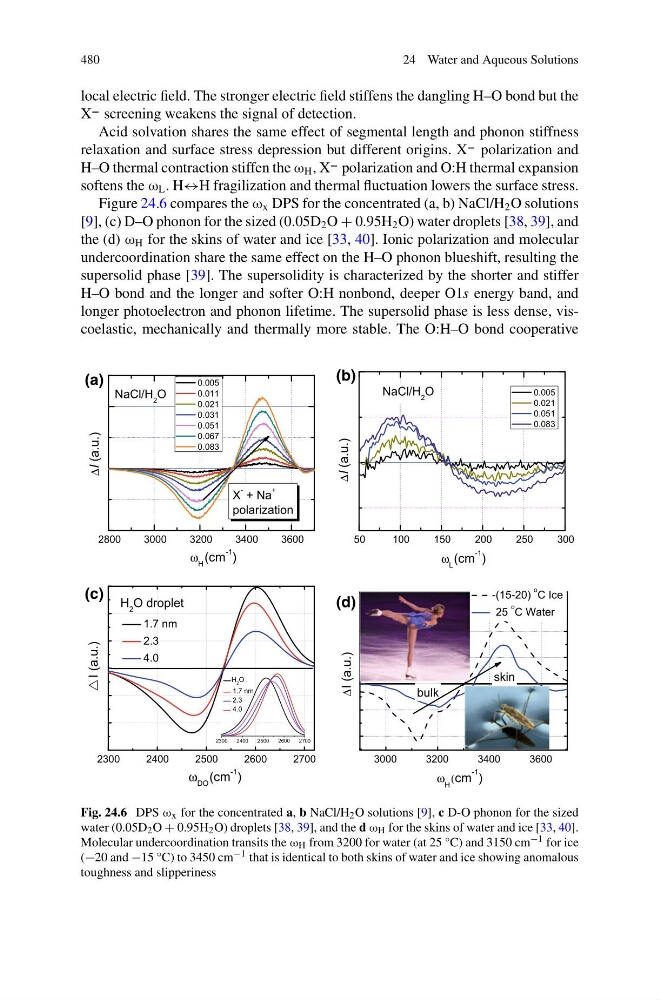
Figure 24.6 compares the ω x DPS for the concentrated (a, b) NaCl/H 2 O solutions
[9], (c) D–O phonon for the sized (0.05D 2 O + 0.95H 2 O) water droplets [38, 39], and
the (d) ω H for the skins of water and ice [33, 40]. Ionic polarization and molecular
undercoordination share the same effect on the H–O phonon blueshift, resulting the
supersolid phase [39]. The supersolidity is characterized by the shorter and stiffer
H–O bond and the longer and softer O:H nonbond, deeper O1s energy band, and
longer photoelectron and phonon lifetime. The supersolid phase is less dense, viscoelastic, mechanically and thermally more stable. The O:H–O bond cooperative
0.005
0.011
0.021
0.031
0.051
0.067
0.083
ΔI (a.u.)
ω H (cm
-1
)
NaCl/H 2 O
(a)
X
- + Na
+
polarization
0.005
0.021
0.051
0.083
NaCl/H 2 O
ω L (cm
-1
)
ΔI (a.u.)
(b)
I (a.u.)
ω DO (cm
-1 )
1.7 nm
2.3
4.0
(c) H 2 O droplet
H 2 O
1.7 nm
2.3
4.0
20
40
60
2300
2400
2500
2600
2700
2800
3000
3200
3400
3600
50
100
150
200
250
300
2300
2400
2500
2600
2700
3000
3200
3400
3600
ΔI (a.u.)
ω H (cm
-1 )
(d)
skin
bulk
-(15-20)
o C Ice
25
o
C Water
Fig. 24.6 DPS ω x for the concentrated a, b NaCl/H 2 O solutions [9], c D-O phonon for the sized
water (0.05D 2 O + 0.95H 2 O) droplets [38, 39], and the d ω H for the skins of water and ice [33, 40].
Molecular undercoordination transits the ω H from 3200 for water (at 25 °C) and 3150 cm −1 for ice
(−20 and −15 °C) to 3450 cm −1 that is identical to both skins of water and ice showing anomalous
toughness and slipperiness
24 Water and Aqueous Solutions
local electric field. The stronger electric field stiffens the dangling H–O bond but the
X − screening weakens the signal of detection.
Acid solvation shares the same effect of segmental length and phonon stiffness
relaxation and surface stress depression but different origins. X − polarization and
H–O thermal contraction stiffen the ω H , X − polarization and O:H thermal expansion
softens the ω L . H↔H fragilization and thermal fluctuation lowers the surface stress.
Figure 24.6 compares the ω x DPS for the concentrated (a, b) NaCl/H 2 O solutions
[9], (c) D–O phonon for the sized (0.05D 2 O + 0.95H 2 O) water droplets [38, 39], and
the (d) ω H for the skins of water and ice [33, 40]. Ionic polarization and molecular
undercoordination share the same effect on the H–O phonon blueshift, resulting the
supersolid phase [39]. The supersolidity is characterized by the shorter and stiffer
H–O bond and the longer and softer O:H nonbond, deeper O1s energy band, and
longer photoelectron and phonon lifetime. The supersolid phase is less dense, viscoelastic, mechanically and thermally more stable. The O:H–O bond cooperative
0.005
0.011
0.021
0.031
0.051
0.067
0.083
ΔI (a.u.)
ω H (cm
-1
)
NaCl/H 2 O
(a)
X
- + Na
+
polarization
0.005
0.021
0.051
0.083
NaCl/H 2 O
ω L (cm
-1
)
ΔI (a.u.)
(b)
I (a.u.)
ω DO (cm
-1 )
1.7 nm
2.3
4.0
(c) H 2 O droplet
H 2 O
1.7 nm
2.3
4.0
20
40
60
2300
2400
2500
2600
2700
2800
3000
3200
3400
3600
50
100
150
200
250
300
2300
2400
2500
2600
2700
3000
3200
3400
3600
ΔI (a.u.)
ω H (cm
-1 )
(d)
skin
bulk
-(15-20)
o C Ice
25
o
C Water
Fig. 24.6 DPS ω x for the concentrated a, b NaCl/H 2 O solutions [9], c D-O phonon for the sized
water (0.05D 2 O + 0.95H 2 O) droplets [38, 39], and the d ω H for the skins of water and ice [33, 40].
Molecular undercoordination transits the ω H from 3200 for water (at 25 °C) and 3150 cm −1 for ice
(−20 and −15 °C) to 3450 cm −1 that is identical to both skins of water and ice showing anomalous
toughness and slipperiness