

476
24 Water and Aqueous Solutions
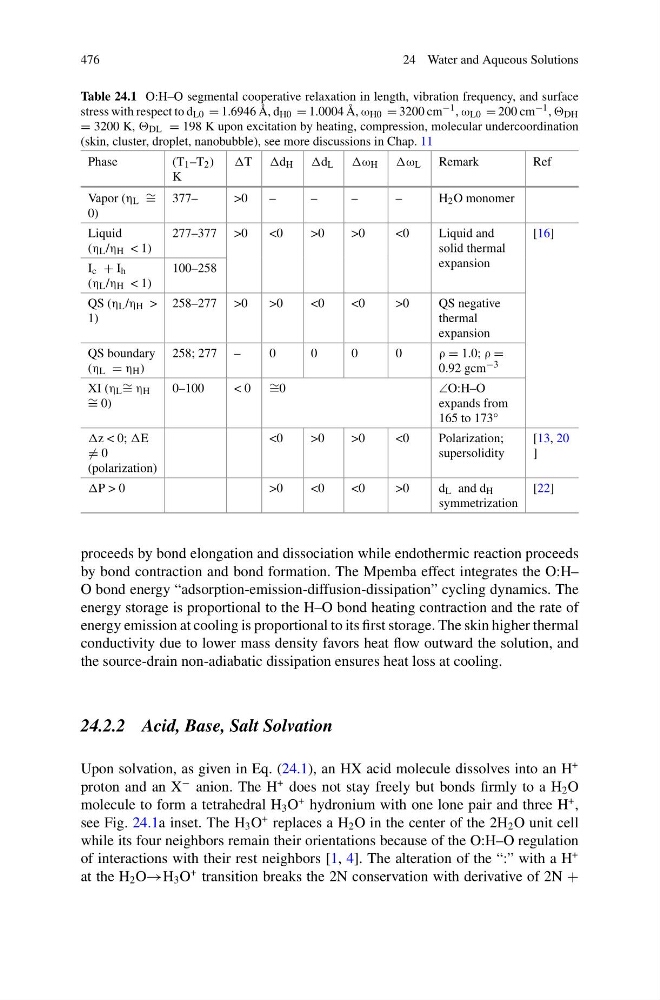
Table 24.1 O:H–O segmental cooperative relaxation in length, vibration frequency, and surface
stress with respect to d L0 = 1.6946 Å, d H0 = 1.0004 Å, ω H0 = 3200 cm −1 , ω L0 = 200 cm −1 , DH
= 3200 K, DL = 198 K upon excitation by heating, compression, molecular undercoordination
(skin, cluster, droplet, nanobubble), see more discussions in Chap. 11
Phase
(T 1 –T 2 )
K
T d H d L ω H ω L Remark
Ref
Vapor (η L ∼ =
0)
377–
>0
–
–
–
–
H 2 O monomer
Liquid
(η L /η H < 1)
277–377 >0
<0
>0
>0
<0
Liquid and
solid thermal
expansion
[16]
I c + I h
(η L /η H < 1)
100–258
QS (η L /η H >
1)
258–277 >0
>0
<0
<0
>0
QS negative
thermal
expansion
QS boundary
(η L = η H )
258; 277 –
0
0
0
0
ρ = 1.0; ρ =
0.92 gcm −3
XI (η L ∼ = η H
∼ = 0)
0–100
< 0 ∼ =0
∠O:H–O
expands from
165 to 173°
z < 0; E
= 0
(polarization)
<0
>0
>0
<0
Polarization;
supersolidity
[13, 20
]
P > 0
>0
<0
<0
>0
d L and d H
symmetrization
[22]
proceeds by bond elongation and dissociation while endothermic reaction proceeds
by bond contraction and bond formation. The Mpemba effect integrates the O:H–
O bond energy “adsorption-emission-diffusion-dissipation” cycling dynamics. The
energy storage is proportional to the H–O bond heating contraction and the rate of
energy emission at cooling is proportional to its first storage. The skin higher thermal
conductivity due to lower mass density favors heat flow outward the solution, and
the source-drain non-adiabatic dissipation ensures heat loss at cooling.
24.2.2 Acid, Base, Salt Solvation
Upon solvation, as given in Eq. (24.1), an HX acid molecule dissolves into an H
+
proton and an X
− anion. The H
+ does not stay freely but bonds firmly to a H 2 O
molecule to form a tetrahedral H 3 O
+ hydronium with one lone pair and three H
+ ,
see Fig. 24.1a inset. The H 3 O
+ replaces a H 2 O in the center of the 2H 2 O unit cell
while its four neighbors remain their orientations because of the O:H–O regulation
of interactions with their rest neighbors [1, 4]. The alteration of the “:” with a H
+
at the H 2 O→H 3 O
+ transition breaks the 2N conservation with derivative of 2N +
24 Water and Aqueous Solutions
Table 24.1 O:H–O segmental cooperative relaxation in length, vibration frequency, and surface
stress with respect to d L0 = 1.6946 Å, d H0 = 1.0004 Å, ω H0 = 3200 cm −1 , ω L0 = 200 cm −1 , DH
= 3200 K, DL = 198 K upon excitation by heating, compression, molecular undercoordination
(skin, cluster, droplet, nanobubble), see more discussions in Chap. 11
Phase
(T 1 –T 2 )
K
T d H d L ω H ω L Remark
Ref
Vapor (η L ∼ =
0)
377–
>0
–
–
–
–
H 2 O monomer
Liquid
(η L /η H < 1)
277–377 >0
<0
>0
>0
<0
Liquid and
solid thermal
expansion
[16]
I c + I h
(η L /η H < 1)
100–258
QS (η L /η H >
1)
258–277 >0
>0
<0
<0
>0
QS negative
thermal
expansion
QS boundary
(η L = η H )
258; 277 –
0
0
0
0
ρ = 1.0; ρ =
0.92 gcm −3
XI (η L ∼ = η H
∼ = 0)
0–100
< 0 ∼ =0
∠O:H–O
expands from
165 to 173°
z < 0; E
= 0
(polarization)
<0
>0
>0
<0
Polarization;
supersolidity
[13, 20
]
P > 0
>0
<0
<0
>0
d L and d H
symmetrization
[22]
proceeds by bond elongation and dissociation while endothermic reaction proceeds
by bond contraction and bond formation. The Mpemba effect integrates the O:H–
O bond energy “adsorption-emission-diffusion-dissipation” cycling dynamics. The
energy storage is proportional to the H–O bond heating contraction and the rate of
energy emission at cooling is proportional to its first storage. The skin higher thermal
conductivity due to lower mass density favors heat flow outward the solution, and
the source-drain non-adiabatic dissipation ensures heat loss at cooling.
24.2.2 Acid, Base, Salt Solvation
Upon solvation, as given in Eq. (24.1), an HX acid molecule dissolves into an H
+
proton and an X
− anion. The H
+ does not stay freely but bonds firmly to a H 2 O
molecule to form a tetrahedral H 3 O
+ hydronium with one lone pair and three H
+ ,
see Fig. 24.1a inset. The H 3 O
+ replaces a H 2 O in the center of the 2H 2 O unit cell
while its four neighbors remain their orientations because of the O:H–O regulation
of interactions with their rest neighbors [1, 4]. The alteration of the “:” with a H
+
at the H 2 O→H 3 O
+ transition breaks the 2N conservation with derivative of 2N +