

474
24 Water and Aqueous Solutions
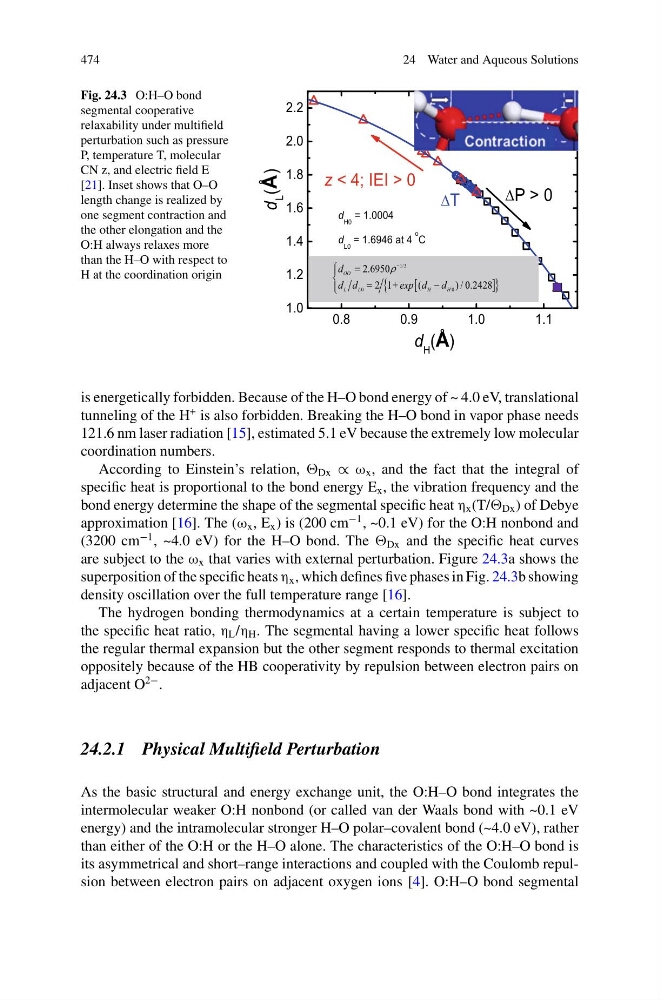
Fig. 24.3 O:H–O bond
segmental cooperative
relaxability under multifield
perturbation such as pressure
P, temperature T, molecular
CN z, and electric field E
[21]. Inset shows that O–O
length change is realized by
one segment contraction and
the other elongation and the
O:H always relaxes more
than the H–O with respect to
H at the coordination origin
0.8
0.9
1.0
1.1
1.0
1.2
1.4
1.6
1.8
2.0
2.2
T
z < 4; IEI > 0
d
L
(Å)
d H (Å)
d H0 = 1.0004
d L0 = 1.6946 at 4
o C
1/3
0
0
2.6950
2 1
(
/0.24
)
2 8
OO
H
L
H
L
d
d d
exp
d
d
P > 0
is energetically forbidden. Because of the H–O bond energy of ~ 4.0 eV, translational
tunneling of the H
+ is also forbidden. Breaking the H–O bond in vapor phase needs
121.6 nm laser radiation [15], estimated 5.1 eV because the extremely low molecular
coordination numbers.
According to Einstein’s relation, Dx ∝ ω x , and the fact that the integral of
specific heat is proportional to the bond energy E x , the vibration frequency and the
bond energy determine the shape of the segmental specific heat η x (T/ Dx ) of Debye
approximation [16]. The (ω x , E x ) is (200 cm
−1 , ~0.1 eV) for the O:H nonbond and
(3200 cm
−1 , ~4.0 eV) for the H–O bond. The Dx and the specific heat curves
are subject to the ω x that varies with external perturbation. Figure 24.3a shows the
superposition of the specific heats η x , which defines five phases in Fig. 24.3b showing
density oscillation over the full temperature range [16].
The hydrogen bonding thermodynamics at a certain temperature is subject to
the specific heat ratio, η L /η H . The segmental having a lower specific heat follows
the regular thermal expansion but the other segment responds to thermal excitation
oppositely because of the HB cooperativity by repulsion between electron pairs on
adjacent O
2− .
24.2.1 Physical Multifield Perturbation
As the basic structural and energy exchange unit, the O:H–O bond integrates the
intermolecular weaker O:H nonbond (or called van der Waals bond with ~0.1 eV
energy) and the intramolecular stronger H–O polar–covalent bond (~4.0 eV), rather
than either of the O:H or the H–O alone. The characteristics of the O:H–O bond is
its asymmetrical and short–range interactions and coupled with the Coulomb repulsion between electron pairs on adjacent oxygen ions [4]. O:H–O bond segmental
24 Water and Aqueous Solutions
Fig. 24.3 O:H–O bond
segmental cooperative
relaxability under multifield
perturbation such as pressure
P, temperature T, molecular
CN z, and electric field E
[21]. Inset shows that O–O
length change is realized by
one segment contraction and
the other elongation and the
O:H always relaxes more
than the H–O with respect to
H at the coordination origin
0.8
0.9
1.0
1.1
1.0
1.2
1.4
1.6
1.8
2.0
2.2
T
z < 4; IEI > 0
d
L
(Å)
d H (Å)
d H0 = 1.0004
d L0 = 1.6946 at 4
o C
1/3
0
0
2.6950
2 1
(
/0.24
)
2 8
OO
H
L
H
L
d
d d
exp
d
d
P > 0
is energetically forbidden. Because of the H–O bond energy of ~ 4.0 eV, translational
tunneling of the H
+ is also forbidden. Breaking the H–O bond in vapor phase needs
121.6 nm laser radiation [15], estimated 5.1 eV because the extremely low molecular
coordination numbers.
According to Einstein’s relation, Dx ∝ ω x , and the fact that the integral of
specific heat is proportional to the bond energy E x , the vibration frequency and the
bond energy determine the shape of the segmental specific heat η x (T/ Dx ) of Debye
approximation [16]. The (ω x , E x ) is (200 cm
−1 , ~0.1 eV) for the O:H nonbond and
(3200 cm
−1 , ~4.0 eV) for the H–O bond. The Dx and the specific heat curves
are subject to the ω x that varies with external perturbation. Figure 24.3a shows the
superposition of the specific heats η x , which defines five phases in Fig. 24.3b showing
density oscillation over the full temperature range [16].
The hydrogen bonding thermodynamics at a certain temperature is subject to
the specific heat ratio, η L /η H . The segmental having a lower specific heat follows
the regular thermal expansion but the other segment responds to thermal excitation
oppositely because of the HB cooperativity by repulsion between electron pairs on
adjacent O
2− .
24.2.1 Physical Multifield Perturbation
As the basic structural and energy exchange unit, the O:H–O bond integrates the
intermolecular weaker O:H nonbond (or called van der Waals bond with ~0.1 eV
energy) and the intramolecular stronger H–O polar–covalent bond (~4.0 eV), rather
than either of the O:H or the H–O alone. The characteristics of the O:H–O bond is
its asymmetrical and short–range interactions and coupled with the Coulomb repulsion between electron pairs on adjacent oxygen ions [4]. O:H–O bond segmental