

410
21 Theory: Multifield Oscillation Dynamics
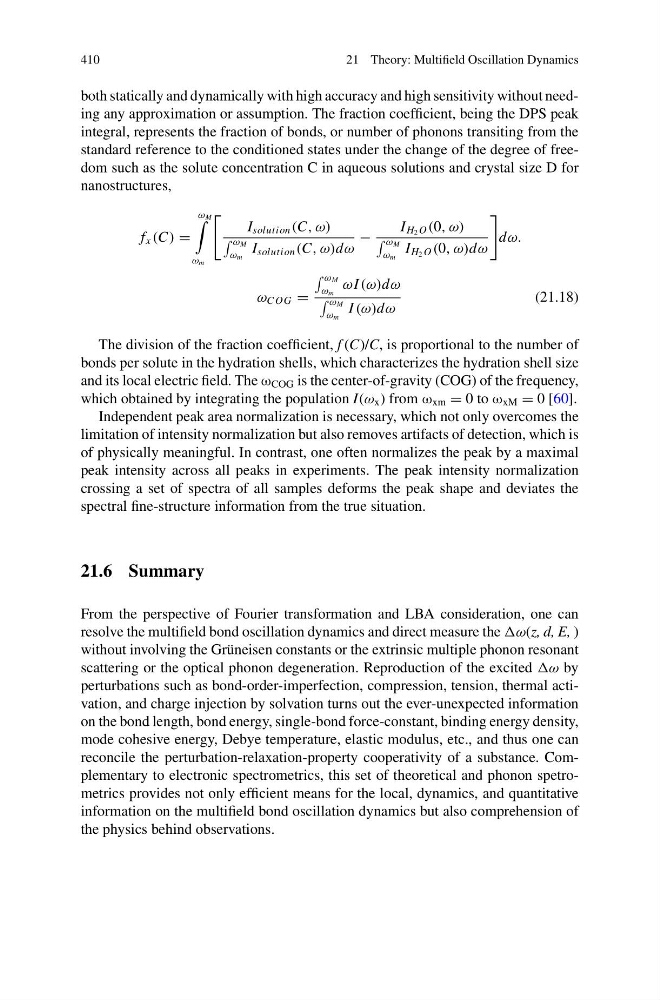
both statically and dynamically with high accuracy and high sensitivity without needing any approximation or assumption. The fraction coefficient, being the DPS peak
integral, represents the fraction of bonds, or number of phonons transiting from the
standard reference to the conditioned states under the change of the degree of freedom such as the solute concentration C in aqueous solutions and crystal size D for
nanostructures,
f x (C) =
ω M
ω m
I solution (C, ω)
ω M
ω m
I solution (C, ω)dω
−
I H 2 O (0, ω)
ω M
ω m
I H 2 O (0, ω)dω
dω.
ω C OG =
ω M
ω m
ωI (ω)dω
ω M
ω m
I (ω)dω
(21.18)
The division of the fraction coefficient, f (C)/C, is proportional to the number of
bonds per solute in the hydration shells, which characterizes the hydration shell size
and its local electric field. The ω COG is the center-of-gravity (COG) of the frequency,
which obtained by integrating the population I(ω x ) from ω xm = 0 to ω xM = 0 [60].
Independent peak area normalization is necessary, which not only overcomes the
limitation of intensity normalization but also removes artifacts of detection, which is
of physically meaningful. In contrast, one often normalizes the peak by a maximal
peak intensity across all peaks in experiments. The peak intensity normalization
crossing a set of spectra of all samples deforms the peak shape and deviates the
spectral fine-structure information from the true situation.
21.6 Summary
From the perspective of Fourier transformation and LBA consideration, one can
resolve the multifield bond oscillation dynamics and direct measure the ω(z, d, E, )
without involving the Grüneisen constants or the extrinsic multiple phonon resonant
scattering or the optical phonon degeneration. Reproduction of the excited ω by
perturbations such as bond-order-imperfection, compression, tension, thermal activation, and charge injection by solvation turns out the ever-unexpected information
on the bond length, bond energy, single-bond force-constant, binding energy density,
mode cohesive energy, Debye temperature, elastic modulus, etc., and thus one can
reconcile the perturbation-relaxation-property cooperativity of a substance. Complementary to electronic spectrometrics, this set of theoretical and phonon spetrometrics provides not only efficient means for the local, dynamics, and quantitative
information on the multifield bond oscillation dynamics but also comprehension of
the physics behind observations.
21 Theory: Multifield Oscillation Dynamics
both statically and dynamically with high accuracy and high sensitivity without needing any approximation or assumption. The fraction coefficient, being the DPS peak
integral, represents the fraction of bonds, or number of phonons transiting from the
standard reference to the conditioned states under the change of the degree of freedom such as the solute concentration C in aqueous solutions and crystal size D for
nanostructures,
f x (C) =
ω M
ω m
I solution (C, ω)
ω M
ω m
I solution (C, ω)dω
−
I H 2 O (0, ω)
ω M
ω m
I H 2 O (0, ω)dω
dω.
ω C OG =
ω M
ω m
ωI (ω)dω
ω M
ω m
I (ω)dω
(21.18)
The division of the fraction coefficient, f (C)/C, is proportional to the number of
bonds per solute in the hydration shells, which characterizes the hydration shell size
and its local electric field. The ω COG is the center-of-gravity (COG) of the frequency,
which obtained by integrating the population I(ω x ) from ω xm = 0 to ω xM = 0 [60].
Independent peak area normalization is necessary, which not only overcomes the
limitation of intensity normalization but also removes artifacts of detection, which is
of physically meaningful. In contrast, one often normalizes the peak by a maximal
peak intensity across all peaks in experiments. The peak intensity normalization
crossing a set of spectra of all samples deforms the peak shape and deviates the
spectral fine-structure information from the true situation.
21.6 Summary
From the perspective of Fourier transformation and LBA consideration, one can
resolve the multifield bond oscillation dynamics and direct measure the ω(z, d, E, )
without involving the Grüneisen constants or the extrinsic multiple phonon resonant
scattering or the optical phonon degeneration. Reproduction of the excited ω by
perturbations such as bond-order-imperfection, compression, tension, thermal activation, and charge injection by solvation turns out the ever-unexpected information
on the bond length, bond energy, single-bond force-constant, binding energy density,
mode cohesive energy, Debye temperature, elastic modulus, etc., and thus one can
reconcile the perturbation-relaxation-property cooperativity of a substance. Complementary to electronic spectrometrics, this set of theoretical and phonon spetrometrics provides not only efficient means for the local, dynamics, and quantitative
information on the multifield bond oscillation dynamics but also comprehension of
the physics behind observations.