

404
21 Theory: Multifield Oscillation Dynamics
21.4.1.2 Atomic-Site and Crystal-Size Resolved Shift
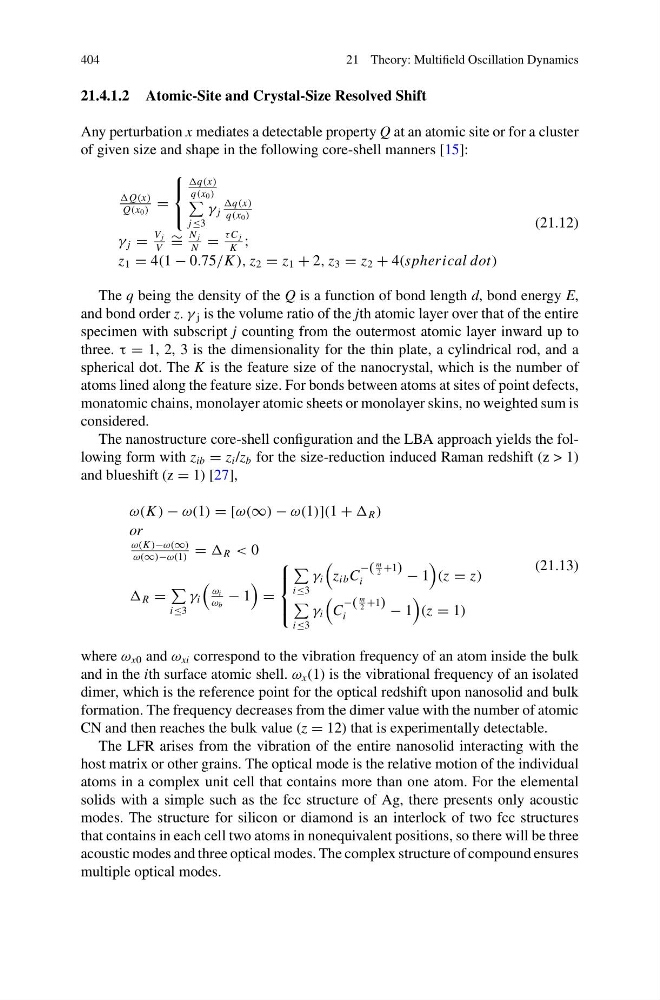
Any perturbation x mediates a detectable property Q at an atomic site or for a cluster
of given size and shape in the following core-shell manners [15]:
Q(x)
Q(x 0 )
=
⎧
⎨
⎩
q(x)
q(x 0 )
j≤3
γ j
q(x)
q(x 0 )
γ j =
V j
V
∼ =
N j
N
=
τ C j
K
;
z 1 = 4(1 − 0.75/K ), z 2 = z 1 + 2, z 3 = z 2 + 4(spherical dot)
(21.12)
The q being the density of the Q is a function of bond length d, bond energy E,
and bond order z. γ j is the volume ratio of the jth atomic layer over that of the entire
specimen with subscript j counting from the outermost atomic layer inward up to
three. τ = 1, 2, 3 is the dimensionality for the thin plate, a cylindrical rod, and a
spherical dot. The K is the feature size of the nanocrystal, which is the number of
atoms lined along the feature size. For bonds between atoms at sites of point defects,
monatomic chains, monolayer atomic sheets or monolayer skins, no weighted sum is
considered.
The nanostructure core-shell configuration and the LBA approach yields the following form with z ib = z i /z b for the size-reduction induced Raman redshift (z > 1)
and blueshift (z = 1) [27],
ω(K ) − ω(1) = [ω(∞) − ω(1)](1 + R )
or
ω(K )−ω(∞)
ω(∞)−ω(1)
= R < 0
R =
i≤3
γ i
ω i
ω b
− 1
=
⎧
⎪ ⎨
⎪ ⎩
i≤3
γ i
z ib C
−(
m
2 +1)
i
− 1
(z = z)
i≤3
γ i
C
−(
m
2 +1)
i
− 1
(z = 1)
(21.13)
where ω x0 and ω xi correspond to the vibration frequency of an atom inside the bulk
and in the ith surface atomic shell. ω x (1) is the vibrational frequency of an isolated
dimer, which is the reference point for the optical redshift upon nanosolid and bulk
formation. The frequency decreases from the dimer value with the number of atomic
CN and then reaches the bulk value (z = 12) that is experimentally detectable.
The LFR arises from the vibration of the entire nanosolid interacting with the
host matrix or other grains. The optical mode is the relative motion of the individual
atoms in a complex unit cell that contains more than one atom. For the elemental
solids with a simple such as the fcc structure of Ag, there presents only acoustic
modes. The structure for silicon or diamond is an interlock of two fcc structures
that contains in each cell two atoms in nonequivalent positions, so there will be three
acoustic modes and three optical modes. The complex structure of compound ensures
multiple optical modes.
21 Theory: Multifield Oscillation Dynamics
21.4.1.2 Atomic-Site and Crystal-Size Resolved Shift
Any perturbation x mediates a detectable property Q at an atomic site or for a cluster
of given size and shape in the following core-shell manners [15]:
Q(x)
Q(x 0 )
=
⎧
⎨
⎩
q(x)
q(x 0 )
j≤3
γ j
q(x)
q(x 0 )
γ j =
V j
V
∼ =
N j
N
=
τ C j
K
;
z 1 = 4(1 − 0.75/K ), z 2 = z 1 + 2, z 3 = z 2 + 4(spherical dot)
(21.12)
The q being the density of the Q is a function of bond length d, bond energy E,
and bond order z. γ j is the volume ratio of the jth atomic layer over that of the entire
specimen with subscript j counting from the outermost atomic layer inward up to
three. τ = 1, 2, 3 is the dimensionality for the thin plate, a cylindrical rod, and a
spherical dot. The K is the feature size of the nanocrystal, which is the number of
atoms lined along the feature size. For bonds between atoms at sites of point defects,
monatomic chains, monolayer atomic sheets or monolayer skins, no weighted sum is
considered.
The nanostructure core-shell configuration and the LBA approach yields the following form with z ib = z i /z b for the size-reduction induced Raman redshift (z > 1)
and blueshift (z = 1) [27],
ω(K ) − ω(1) = [ω(∞) − ω(1)](1 + R )
or
ω(K )−ω(∞)
ω(∞)−ω(1)
= R < 0
R =
i≤3
γ i
ω i
ω b
− 1
=
⎧
⎪ ⎨
⎪ ⎩
i≤3
γ i
z ib C
−(
m
2 +1)
i
− 1
(z = z)
i≤3
γ i
C
−(
m
2 +1)
i
− 1
(z = 1)
(21.13)
where ω x0 and ω xi correspond to the vibration frequency of an atom inside the bulk
and in the ith surface atomic shell. ω x (1) is the vibrational frequency of an isolated
dimer, which is the reference point for the optical redshift upon nanosolid and bulk
formation. The frequency decreases from the dimer value with the number of atomic
CN and then reaches the bulk value (z = 12) that is experimentally detectable.
The LFR arises from the vibration of the entire nanosolid interacting with the
host matrix or other grains. The optical mode is the relative motion of the individual
atoms in a complex unit cell that contains more than one atom. For the elemental
solids with a simple such as the fcc structure of Ag, there presents only acoustic
modes. The structure for silicon or diamond is an interlock of two fcc structures
that contains in each cell two atoms in nonequivalent positions, so there will be three
acoustic modes and three optical modes. The complex structure of compound ensures
multiple optical modes.