

References
363
variation of the energy states, as well as the reduction in both the work function and the inner potential constant result from the electron transportation
from one energy level to the other of different atoms such as polarization and
ionization.
(9) The various observations are consequences of bond formation that depends on
the electronegativity, atomic size and lattice geometry of the host surface differing from case to case, and the controlling parameters seem not surprisingly
to be the temperature, oxygen exposure and aging time.
(10) Although the surface morphologies and atomic geometries vary from case to
case, the basic oxide tetrahedron, the DOS features, and the electronic process
of oxidation are substantially the same in all the considered samples. The
electronic processes of oxidation and its extension to technical applications
has formed the subject of review, referring to [2].
(11) Most strikingly, this work reveals two essential events occurred at an oxygen
chemisorbed surface. One is the surface bond contraction and the other is
the sp-orbital hybridization with lone pair and dipole formation, which laid
the foundations of the sequential work in this practationer’s career life. The
spontaneous bond contraction leads to a change of the binding energy and
their derivatives. Surface bond contraction and the rise in surface-to-volume
ratio have been found to be responsible for the size-dependency of nanometric
solid, such as lattice contraction [21, 22], enhancement of surface stress and
Young’s modulus [22, 23], band gap expansion [24, 25] and dielectric suppression [26–28] nanometric semiconductors and diamond melting point rise
or depression [29], enhancement of magnetization [30], modification of phase
transition temperature [31–33]. Surface bond contraction has led to a consistent understanding of the size-dependent properties of nanometric solid, which
has reconciled the performance of undercoordinated atoms associated with
adatoms, defects, terrace edges, skins of solid and liquid, and nanostructures
of various shapes.
(12) An extension of sp-orbital hybridization to the interaction of C, N and O to the
fcc (001) surface of Rh and Ni, has enabled the quantification surface bond
stress, and as a consequence, improves the adhesion between diamond and
metals [34], and as a consequence, improves the adhesion between diamond
and metals [34]. The band-gap generation mechanism has led to a finding that
the PbZrTi oxide emits intensive blue light [35].
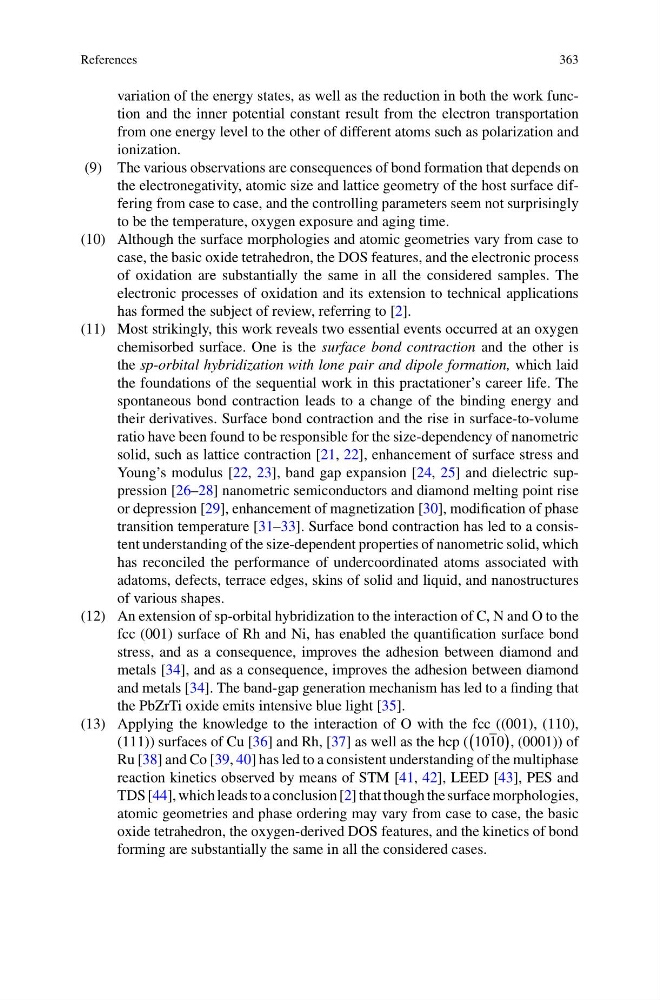
(13) Applying the knowledge to the interaction of O with the fcc ((001), (110),
(111)) surfaces of Cu [36] and Rh, [37] as well as the hcp (
1010
, (0001)) of
Ru [38] and Co [39, 40] has led to a consistent understanding of the multiphase
reaction kinetics observed by means of STM [41, 42], LEED [43], PES and
TDS [44], which leads to a conclusion [2] that though the surface morphologies,
atomic geometries and phase ordering may vary from case to case, the basic
oxide tetrahedron, the oxygen-derived DOS features, and the kinetics of bond
forming are substantially the same in all the considered cases.
363
variation of the energy states, as well as the reduction in both the work function and the inner potential constant result from the electron transportation
from one energy level to the other of different atoms such as polarization and
ionization.
(9) The various observations are consequences of bond formation that depends on
the electronegativity, atomic size and lattice geometry of the host surface differing from case to case, and the controlling parameters seem not surprisingly
to be the temperature, oxygen exposure and aging time.
(10) Although the surface morphologies and atomic geometries vary from case to
case, the basic oxide tetrahedron, the DOS features, and the electronic process
of oxidation are substantially the same in all the considered samples. The
electronic processes of oxidation and its extension to technical applications
has formed the subject of review, referring to [2].
(11) Most strikingly, this work reveals two essential events occurred at an oxygen
chemisorbed surface. One is the surface bond contraction and the other is
the sp-orbital hybridization with lone pair and dipole formation, which laid
the foundations of the sequential work in this practationer’s career life. The
spontaneous bond contraction leads to a change of the binding energy and
their derivatives. Surface bond contraction and the rise in surface-to-volume
ratio have been found to be responsible for the size-dependency of nanometric
solid, such as lattice contraction [21, 22], enhancement of surface stress and
Young’s modulus [22, 23], band gap expansion [24, 25] and dielectric suppression [26–28] nanometric semiconductors and diamond melting point rise
or depression [29], enhancement of magnetization [30], modification of phase
transition temperature [31–33]. Surface bond contraction has led to a consistent understanding of the size-dependent properties of nanometric solid, which
has reconciled the performance of undercoordinated atoms associated with
adatoms, defects, terrace edges, skins of solid and liquid, and nanostructures
of various shapes.
(12) An extension of sp-orbital hybridization to the interaction of C, N and O to the
fcc (001) surface of Rh and Ni, has enabled the quantification surface bond
stress, and as a consequence, improves the adhesion between diamond and
metals [34], and as a consequence, improves the adhesion between diamond
and metals [34]. The band-gap generation mechanism has led to a finding that
the PbZrTi oxide emits intensive blue light [35].
(13) Applying the knowledge to the interaction of O with the fcc ((001), (110),
(111)) surfaces of Cu [36] and Rh, [37] as well as the hcp (
1010
, (0001)) of
Ru [38] and Co [39, 40] has led to a consistent understanding of the multiphase
reaction kinetics observed by means of STM [41, 42], LEED [43], PES and
TDS [44], which leads to a conclusion [2] that though the surface morphologies,
atomic geometries and phase ordering may vary from case to case, the basic
oxide tetrahedron, the oxygen-derived DOS features, and the kinetics of bond
forming are substantially the same in all the considered cases.