

340
17 Blouin Zones, Effective Mass, Muffin-tin Potential…
+
+
+
+
+
+
+
+
+
+
+
+
+
+
+
+
+
+
+
+
+
+
+
+
+
+
+
+
+
+
+
+
+
+
+
+
+
+
+
+
+
+
+
+
+
+
2
2
2
2
2
2
2
2
2
2
2
2
2
2
2
2
3
3
3
3
3
3
3
3
3
3
3
3
1
1
1
1
1
1
1
1
1
1
1
a: pure Cu(001) surface
+
+
+
+
+
+
+
+
+
+
+
+
+
+
+
1
+
+
+
Cu core
Cu
Cu
+
1
+2
2
3
3
MR vacancy
+
O -2
Cu quadruple
b: top layer of the O-Cu(001)
c: 2nd layer of the O-Cu(001)
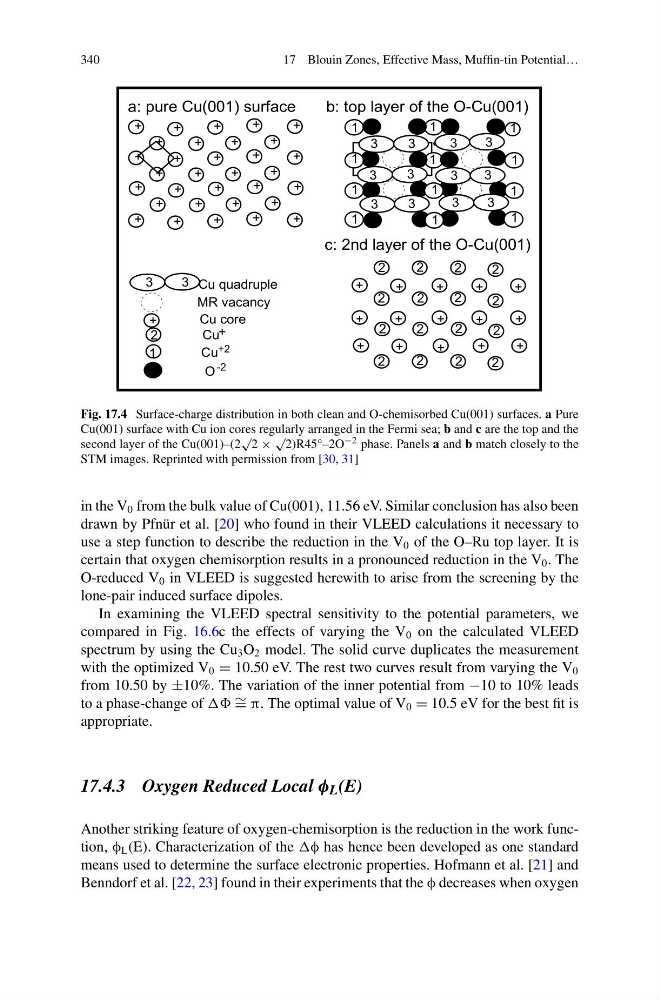
Fig. 17.4 Surface-charge distribution in both clean and O-chemisorbed Cu(001) surfaces. a Pure
Cu(001) surface with Cu ion cores regularly arranged in the Fermi sea; b and c are the top and the
second layer of the Cu(001)–(2
√
2 ×
√
2)R45°–2O −2 phase. Panels a and b match closely to the
STM images. Reprinted with permission from [30, 31]
in the V 0 from the bulk value of Cu(001), 11.56 eV. Similar conclusion has also been
drawn by Pfnür et al. [20] who found in their VLEED calculations it necessary to
use a step function to describe the reduction in the V 0 of the O–Ru top layer. It is
certain that oxygen chemisorption results in a pronounced reduction in the V 0 . The
O-reduced V 0 in VLEED is suggested herewith to arise from the screening by the
lone-pair induced surface dipoles.
In examining the VLEED spectral sensitivity to the potential parameters, we
compared in Fig. 16.6c the effects of varying the V 0 on the calculated VLEED
spectrum by using the Cu 3 O 2 model. The solid curve duplicates the measurement
with the optimized V 0 = 10.50 eV. The rest two curves result from varying the V 0
from 10.50 by ±10%. The variation of the inner potential from −10 to 10% leads
to a phase-change of ∼ = π. The optimal value of V 0 = 10.5 eV for the best fit is
appropriate.
17.4.3 Oxygen Reduced Local φ L (E)
Another striking feature of oxygen-chemisorption is the reduction in the work function, φ L (E). Characterization of the has hence been developed as one standard
means used to determine the surface electronic properties. Hofmann et al. [21] and
Benndorf et al. [22, 23] found in their experiments that the φ decreases when oxygen
17 Blouin Zones, Effective Mass, Muffin-tin Potential…
+
+
+
+
+
+
+
+
+
+
+
+
+
+
+
+
+
+
+
+
+
+
+
+
+
+
+
+
+
+
+
+
+
+
+
+
+
+
+
+
+
+
+
+
+
+
2
2
2
2
2
2
2
2
2
2
2
2
2
2
2
2
3
3
3
3
3
3
3
3
3
3
3
3
1
1
1
1
1
1
1
1
1
1
1
a: pure Cu(001) surface
+
+
+
+
+
+
+
+
+
+
+
+
+
+
+
1
+
+
+
Cu core
Cu
Cu
+
1
+2
2
3
3
MR vacancy
+
O -2
Cu quadruple
b: top layer of the O-Cu(001)
c: 2nd layer of the O-Cu(001)
Fig. 17.4 Surface-charge distribution in both clean and O-chemisorbed Cu(001) surfaces. a Pure
Cu(001) surface with Cu ion cores regularly arranged in the Fermi sea; b and c are the top and the
second layer of the Cu(001)–(2
√
2 ×
√
2)R45°–2O −2 phase. Panels a and b match closely to the
STM images. Reprinted with permission from [30, 31]
in the V 0 from the bulk value of Cu(001), 11.56 eV. Similar conclusion has also been
drawn by Pfnür et al. [20] who found in their VLEED calculations it necessary to
use a step function to describe the reduction in the V 0 of the O–Ru top layer. It is
certain that oxygen chemisorption results in a pronounced reduction in the V 0 . The
O-reduced V 0 in VLEED is suggested herewith to arise from the screening by the
lone-pair induced surface dipoles.
In examining the VLEED spectral sensitivity to the potential parameters, we
compared in Fig. 16.6c the effects of varying the V 0 on the calculated VLEED
spectrum by using the Cu 3 O 2 model. The solid curve duplicates the measurement
with the optimized V 0 = 10.50 eV. The rest two curves result from varying the V 0
from 10.50 by ±10%. The variation of the inner potential from −10 to 10% leads
to a phase-change of ∼ = π. The optimal value of V 0 = 10.5 eV for the best fit is
appropriate.
17.4.3 Oxygen Reduced Local φ L (E)
Another striking feature of oxygen-chemisorption is the reduction in the work function, φ L (E). Characterization of the has hence been developed as one standard
means used to determine the surface electronic properties. Hofmann et al. [21] and
Benndorf et al. [22, 23] found in their experiments that the φ decreases when oxygen