

308
15 Methodology: Parameterization
0.78
0.80
0.82
0
2.5
5.0
7.5
10.0
7.5 10.0 12.5 15.0
7.5 10.0 12.5 15.0
(a) clean Cu(001)
(b) O-Cu(001)
23.5
43.5 o
o
ImV(E)
(eV)
Energy (eV)
Im V(E) = - (1+ E/ )
γ
δ
φ
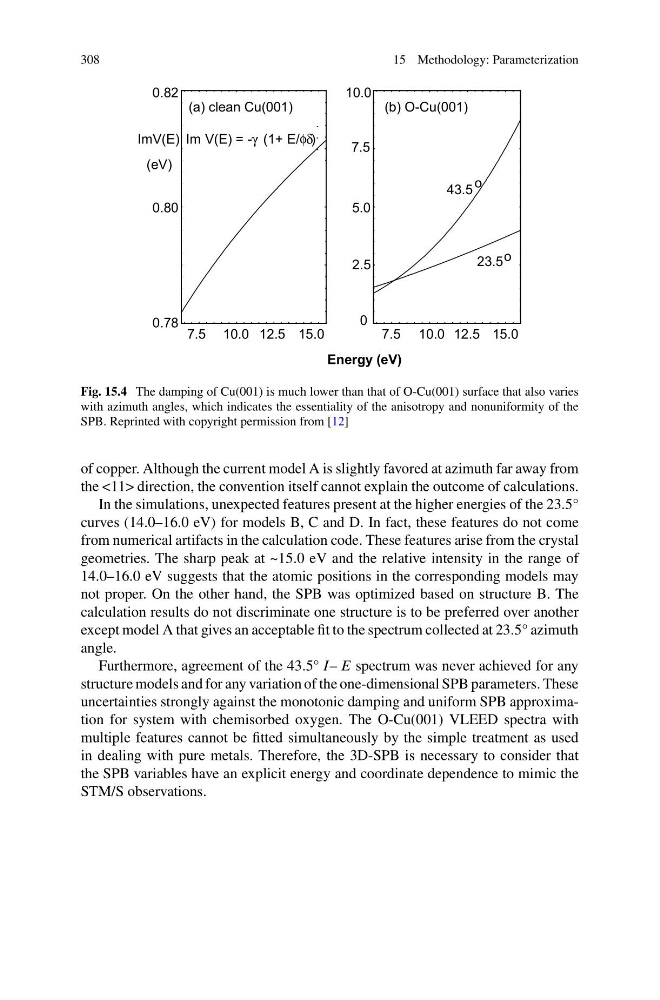
Fig. 15.4 The damping of Cu(001) is much lower than that of O-Cu(001) surface that also varies
with azimuth angles, which indicates the essentiality of the anisotropy and nonuniformity of the
SPB. Reprinted with copyright permission from [12]
of copper. Although the current model A is slightly favored at azimuth far away from
the <11> direction, the convention itself cannot explain the outcome of calculations.
In the simulations, unexpected features present at the higher energies of the 23.5°
curves (14.0–16.0 eV) for models B, C and D. In fact, these features do not come
from numerical artifacts in the calculation code. These features arise from the crystal
geometries. The sharp peak at ~15.0 eV and the relative intensity in the range of
14.0–16.0 eV suggests that the atomic positions in the corresponding models may
not proper. On the other hand, the SPB was optimized based on structure B. The
calculation results do not discriminate one structure is to be preferred over another
except model A that gives an acceptable fit to the spectrum collected at 23.5° azimuth
angle.
Furthermore, agreement of the 43.5° I– E spectrum was never achieved for any
structure models and for any variation of the one-dimensional SPB parameters. These
uncertainties strongly against the monotonic damping and uniform SPB approximation for system with chemisorbed oxygen. The O-Cu(001) VLEED spectra with
multiple features cannot be fitted simultaneously by the simple treatment as used
in dealing with pure metals. Therefore, the 3D-SPB is necessary to consider that
the SPB variables have an explicit energy and coordinate dependence to mimic the
STM/S observations.
15 Methodology: Parameterization
0.78
0.80
0.82
0
2.5
5.0
7.5
10.0
7.5 10.0 12.5 15.0
7.5 10.0 12.5 15.0
(a) clean Cu(001)
(b) O-Cu(001)
23.5
43.5 o
o
ImV(E)
(eV)
Energy (eV)
Im V(E) = - (1+ E/ )
γ
δ
φ
Fig. 15.4 The damping of Cu(001) is much lower than that of O-Cu(001) surface that also varies
with azimuth angles, which indicates the essentiality of the anisotropy and nonuniformity of the
SPB. Reprinted with copyright permission from [12]
of copper. Although the current model A is slightly favored at azimuth far away from
the <11> direction, the convention itself cannot explain the outcome of calculations.
In the simulations, unexpected features present at the higher energies of the 23.5°
curves (14.0–16.0 eV) for models B, C and D. In fact, these features do not come
from numerical artifacts in the calculation code. These features arise from the crystal
geometries. The sharp peak at ~15.0 eV and the relative intensity in the range of
14.0–16.0 eV suggests that the atomic positions in the corresponding models may
not proper. On the other hand, the SPB was optimized based on structure B. The
calculation results do not discriminate one structure is to be preferred over another
except model A that gives an acceptable fit to the spectrum collected at 23.5° azimuth
angle.
Furthermore, agreement of the 43.5° I– E spectrum was never achieved for any
structure models and for any variation of the one-dimensional SPB parameters. These
uncertainties strongly against the monotonic damping and uniform SPB approximation for system with chemisorbed oxygen. The O-Cu(001) VLEED spectra with
multiple features cannot be fitted simultaneously by the simple treatment as used
in dealing with pure metals. Therefore, the 3D-SPB is necessary to consider that
the SPB variables have an explicit energy and coordinate dependence to mimic the
STM/S observations.