

306
15 Methodology: Parameterization
Cu
Cu
Cu
Substrate
[001]
D12
[001]
-2
+
-
x
z
Top layer
O
DO z
DOx
DCu x
DCu z
model A
model B
model C
model D
O
O
O
side view
Cu
Φ
O-Cu chain
M
Cu
Cu
Cu
top view
O
-2
>
v
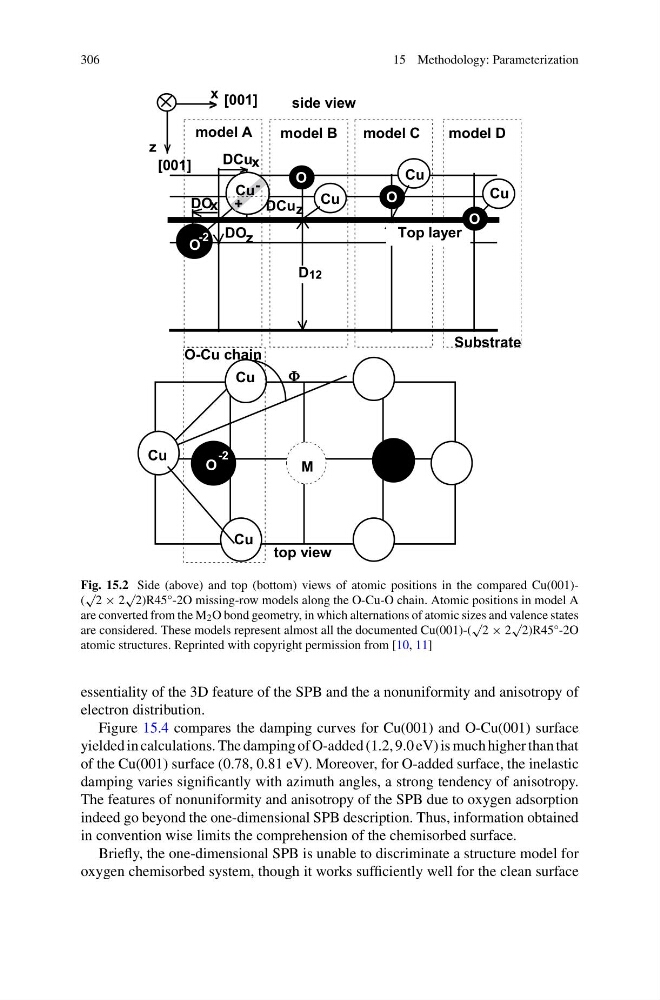
Fig. 15.2 Side (above) and top (bottom) views of atomic positions in the compared Cu(001)(
√
2 × 2
√
2)R45°-2O missing-row models along the O-Cu-O chain. Atomic positions in model A
are converted from the M 2 O bond geometry, in which alternations of atomic sizes and valence states
are considered. These models represent almost all the documented Cu(001)-(
√
2 × 2
√
2)R45°-2O
atomic structures. Reprinted with copyright permission from [10, 11]
essentiality of the 3D feature of the SPB and the a nonuniformity and anisotropy of
electron distribution.
Figure 15.4 compares the damping curves for Cu(001) and O-Cu(001) surface
yielded in calculations. The damping of O-added (1.2, 9.0 eV) is much higher than that
of the Cu(001) surface (0.78, 0.81 eV). Moreover, for O-added surface, the inelastic
damping varies significantly with azimuth angles, a strong tendency of anisotropy.
The features of nonuniformity and anisotropy of the SPB due to oxygen adsorption
indeed go beyond the one-dimensional SPB description. Thus, information obtained
in convention wise limits the comprehension of the chemisorbed surface.
Briefly, the one-dimensional SPB is unable to discriminate a structure model for
oxygen chemisorbed system, though it works sufficiently well for the clean surface
15 Methodology: Parameterization
Cu
Cu
Cu
Substrate
[001]
D12
[001]
-2
+
-
x
z
Top layer
O
DO z
DOx
DCu x
DCu z
model A
model B
model C
model D
O
O
O
side view
Cu
Φ
O-Cu chain
M
Cu
Cu
Cu
top view
O
-2
>
v
Fig. 15.2 Side (above) and top (bottom) views of atomic positions in the compared Cu(001)(
√
2 × 2
√
2)R45°-2O missing-row models along the O-Cu-O chain. Atomic positions in model A
are converted from the M 2 O bond geometry, in which alternations of atomic sizes and valence states
are considered. These models represent almost all the documented Cu(001)-(
√
2 × 2
√
2)R45°-2O
atomic structures. Reprinted with copyright permission from [10, 11]
essentiality of the 3D feature of the SPB and the a nonuniformity and anisotropy of
electron distribution.
Figure 15.4 compares the damping curves for Cu(001) and O-Cu(001) surface
yielded in calculations. The damping of O-added (1.2, 9.0 eV) is much higher than that
of the Cu(001) surface (0.78, 0.81 eV). Moreover, for O-added surface, the inelastic
damping varies significantly with azimuth angles, a strong tendency of anisotropy.
The features of nonuniformity and anisotropy of the SPB due to oxygen adsorption
indeed go beyond the one-dimensional SPB description. Thus, information obtained
in convention wise limits the comprehension of the chemisorbed surface.
Briefly, the one-dimensional SPB is unable to discriminate a structure model for
oxygen chemisorbed system, though it works sufficiently well for the clean surface