

304
15 Methodology: Parameterization
(1) Searching the dominant parameters and locking the value ranges of the parameters for possible best fit. Statistical analyses of the calculation results confirmed
that the spectrum intensity is very insensitive to parameter α and β, thus, they can
hence be taken as constants. The V 0 was kept constant at 11.56 eV as optimized
for pure Cu(001) surface [2]. Doing so, reduces the number of independent
variables from nine to six for the subsequent optimizations.
(2) Utilizing correlations between the parameters. The combinations of (z 0 , λ) and
(γ, δ; z 1 , α; β, η) are correlated through the integration of ReV(z; z 0 , λ) and
ImV(z, E; γ, δ; z 1 , α; β, η). Then we could fix one parameter and adjust the other
one in each of the couples. Thus, the number of variables is further reduced from
three pairs to three independent ones.
(3) Repeating (i) and (ii) to refine the parameters. The parameter values for the
given crystal structure could then be optimized.
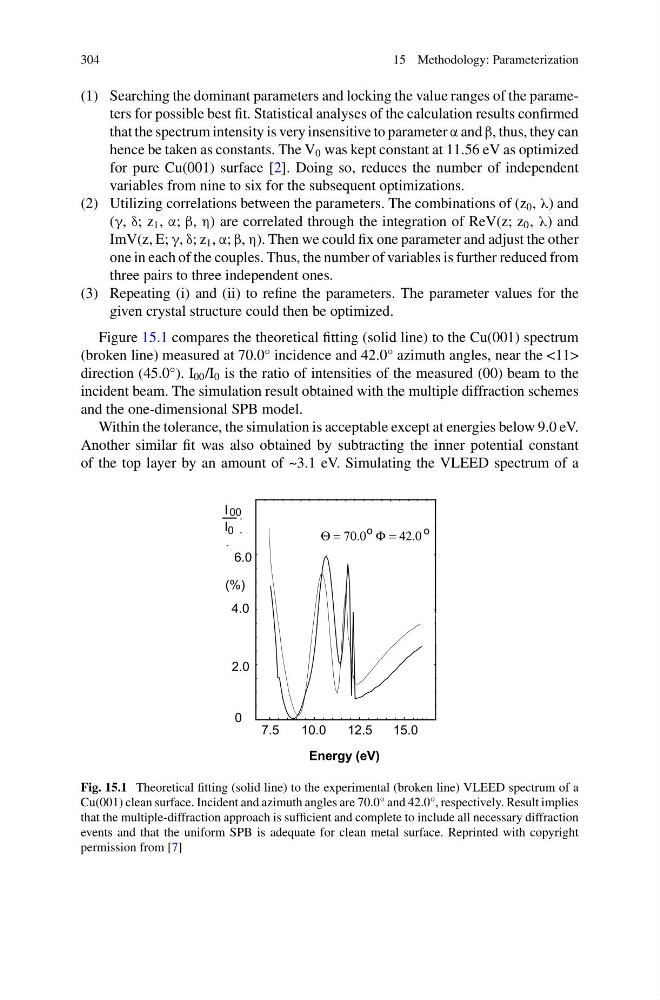
Figure 15.1 compares the theoretical fitting (solid line) to the Cu(001) spectrum
(broken line) measured at 70.0° incidence and 42.0° azimuth angles, near the <11>
direction (45.0°). I 00 /I 0 is the ratio of intensities of the measured (00) beam to the
incident beam. The simulation result obtained with the multiple diffraction schemes
and the one-dimensional SPB model.
Within the tolerance, the simulation is acceptable except at energies below 9.0 eV.
Another similar fit was also obtained by subtracting the inner potential constant
of the top layer by an amount of ~3.1 eV. Simulating the VLEED spectrum of a
7.5
10.0
12.5
15.0
0
2.0
4.0
6.0
(%)
Energy (eV)
Θ = 70.0 Φ = 42.0
I
I
00
0
o
o
Fig. 15.1 Theoretical fitting (solid line) to the experimental (broken line) VLEED spectrum of a
Cu(001) clean surface. Incident and azimuth angles are 70.0° and 42.0°, respectively. Result implies
that the multiple-diffraction approach is sufficient and complete to include all necessary diffraction
events and that the uniform SPB is adequate for clean metal surface. Reprinted with copyright
permission from [7]
15 Methodology: Parameterization
(1) Searching the dominant parameters and locking the value ranges of the parameters for possible best fit. Statistical analyses of the calculation results confirmed
that the spectrum intensity is very insensitive to parameter α and β, thus, they can
hence be taken as constants. The V 0 was kept constant at 11.56 eV as optimized
for pure Cu(001) surface [2]. Doing so, reduces the number of independent
variables from nine to six for the subsequent optimizations.
(2) Utilizing correlations between the parameters. The combinations of (z 0 , λ) and
(γ, δ; z 1 , α; β, η) are correlated through the integration of ReV(z; z 0 , λ) and
ImV(z, E; γ, δ; z 1 , α; β, η). Then we could fix one parameter and adjust the other
one in each of the couples. Thus, the number of variables is further reduced from
three pairs to three independent ones.
(3) Repeating (i) and (ii) to refine the parameters. The parameter values for the
given crystal structure could then be optimized.
Figure 15.1 compares the theoretical fitting (solid line) to the Cu(001) spectrum
(broken line) measured at 70.0° incidence and 42.0° azimuth angles, near the <11>
direction (45.0°). I 00 /I 0 is the ratio of intensities of the measured (00) beam to the
incident beam. The simulation result obtained with the multiple diffraction schemes
and the one-dimensional SPB model.
Within the tolerance, the simulation is acceptable except at energies below 9.0 eV.
Another similar fit was also obtained by subtracting the inner potential constant
of the top layer by an amount of ~3.1 eV. Simulating the VLEED spectrum of a
7.5
10.0
12.5
15.0
0
2.0
4.0
6.0
(%)
Energy (eV)
Θ = 70.0 Φ = 42.0
I
I
00
0
o
o
Fig. 15.1 Theoretical fitting (solid line) to the experimental (broken line) VLEED spectrum of a
Cu(001) clean surface. Incident and azimuth angles are 70.0° and 42.0°, respectively. Result implies
that the multiple-diffraction approach is sufficient and complete to include all necessary diffraction
events and that the uniform SPB is adequate for clean metal surface. Reprinted with copyright
permission from [7]