

8
1 Introduction
Mixing two or more substances together forms an interface that performs differently from the respective constituent [86, 87]. One can modify the bond strain and
charge distribution surrounding the bonded atoms [88, 89] by varying compositions
or thermal annealing upon continuous deposition of dissimilar metals [90, 91]. For
instances, Ag or Cu atoms can pair with Pd atoms to form alloys with improved
heterogeneous catalysts [92] to meet different needs [93]. Cu/Pd is active for CO
and alkene oxidation, ethanol decomposition, benzene, toluene, and 1, 3-butadiene
hydrogenation. Pd atom is active for CO oxidation while Cu is active for NO dissociation. Ag/Pd alloy is a good candidate for reduction or hydrogen reaction and
permeation [94]. Both Ag and Cu can grow on Pd in a layer-by-layer fashion at
room temperature. Annealing at certain temperatures turns the layered structures
into alloys [90, 95]. Reaction with electronegative elements such as F, O, N, C, etc.,
a metal turns into a semiconductor or into an insulator.
Dispersion of an individual Ir atom into FeO x enhances greatly the reducibility
of the FeO x , leading to the dispersed single-atom catalysts such as Ir/FeO x for water
gas shift reaction [96]. Likewise, the extremely undercoordinated metallic atoms
serve as catalysts for various applications with orders high efficiency than large
trunks. The dispersed single-atom catalysts could raise the capability of Co–N–
C [97] and Co/N-graphene, Pd/TiO 2 [98] and Pt/ethylenediamine [99] interfaces
for hydrogen-generation [100], Pt/Pt 3 O 4 for CO oxidation [101], Pt/TiN for electro
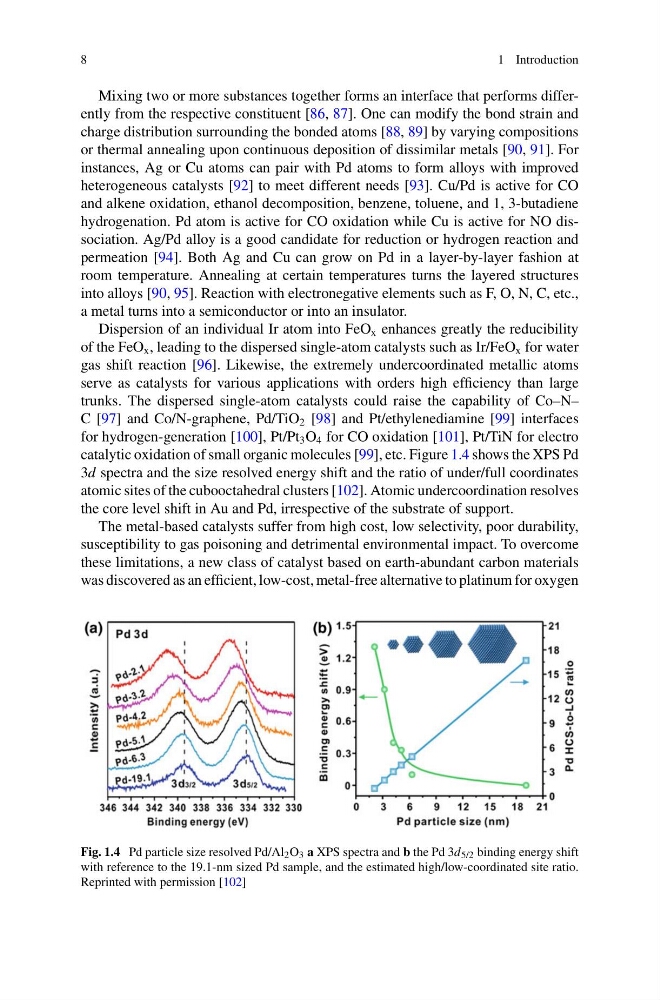
catalytic oxidation of small organic molecules [99], etc. Figure 1.4 shows the XPS Pd
3d spectra and the size resolved energy shift and the ratio of under/full coordinates
atomic sites of the cubooctahedral clusters [102]. Atomic undercoordination resolves
the core level shift in Au and Pd, irrespective of the substrate of support.
The metal-based catalysts suffer from high cost, low selectivity, poor durability,
susceptibility to gas poisoning and detrimental environmental impact. To overcome
these limitations, a new class of catalyst based on earth-abundant carbon materials
was discovered as an efficient, low-cost, metal-free alternative to platinum for oxygen
Fig. 1.4 Pd particle size resolved Pd/Al 2 O 3 a XPS spectra and b the Pd 3d 5/2 binding energy shift
with reference to the 19.1-nm sized Pd sample, and the estimated high/low-coordinated site ratio.
Reprinted with permission [102]
1 Introduction
Mixing two or more substances together forms an interface that performs differently from the respective constituent [86, 87]. One can modify the bond strain and
charge distribution surrounding the bonded atoms [88, 89] by varying compositions
or thermal annealing upon continuous deposition of dissimilar metals [90, 91]. For
instances, Ag or Cu atoms can pair with Pd atoms to form alloys with improved
heterogeneous catalysts [92] to meet different needs [93]. Cu/Pd is active for CO
and alkene oxidation, ethanol decomposition, benzene, toluene, and 1, 3-butadiene
hydrogenation. Pd atom is active for CO oxidation while Cu is active for NO dissociation. Ag/Pd alloy is a good candidate for reduction or hydrogen reaction and
permeation [94]. Both Ag and Cu can grow on Pd in a layer-by-layer fashion at
room temperature. Annealing at certain temperatures turns the layered structures
into alloys [90, 95]. Reaction with electronegative elements such as F, O, N, C, etc.,
a metal turns into a semiconductor or into an insulator.
Dispersion of an individual Ir atom into FeO x enhances greatly the reducibility
of the FeO x , leading to the dispersed single-atom catalysts such as Ir/FeO x for water
gas shift reaction [96]. Likewise, the extremely undercoordinated metallic atoms
serve as catalysts for various applications with orders high efficiency than large
trunks. The dispersed single-atom catalysts could raise the capability of Co–N–
C [97] and Co/N-graphene, Pd/TiO 2 [98] and Pt/ethylenediamine [99] interfaces
for hydrogen-generation [100], Pt/Pt 3 O 4 for CO oxidation [101], Pt/TiN for electro
catalytic oxidation of small organic molecules [99], etc. Figure 1.4 shows the XPS Pd
3d spectra and the size resolved energy shift and the ratio of under/full coordinates
atomic sites of the cubooctahedral clusters [102]. Atomic undercoordination resolves
the core level shift in Au and Pd, irrespective of the substrate of support.
The metal-based catalysts suffer from high cost, low selectivity, poor durability,
susceptibility to gas poisoning and detrimental environmental impact. To overcome
these limitations, a new class of catalyst based on earth-abundant carbon materials
was discovered as an efficient, low-cost, metal-free alternative to platinum for oxygen
Fig. 1.4 Pd particle size resolved Pd/Al 2 O 3 a XPS spectra and b the Pd 3d 5/2 binding energy shift
with reference to the 19.1-nm sized Pd sample, and the estimated high/low-coordinated site ratio.
Reprinted with permission [102]