

6
1 Introduction
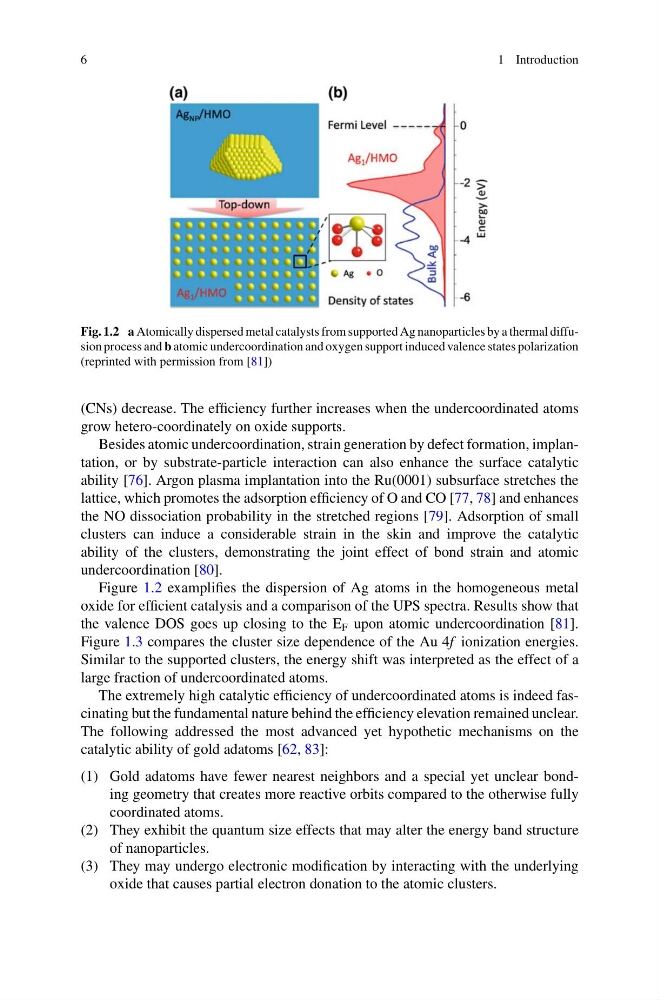
Fig. 1.2 a Atomically dispersed metal catalysts from supported Ag nanoparticles by a thermal diffusion process and b atomic undercoordination and oxygen support induced valence states polarization
(reprinted with permission from [81])
(CNs) decrease. The efficiency further increases when the undercoordinated atoms
grow hetero-coordinately on oxide supports.
Besides atomic undercoordination, strain generation by defect formation, implantation, or by substrate-particle interaction can also enhance the surface catalytic
ability [76]. Argon plasma implantation into the Ru(0001) subsurface stretches the
lattice, which promotes the adsorption efficiency of O and CO [77, 78] and enhances
the NO dissociation probability in the stretched regions [79]. Adsorption of small
clusters can induce a considerable strain in the skin and improve the catalytic
ability of the clusters, demonstrating the joint effect of bond strain and atomic
undercoordination [80].
Figure 1.2 examplifies the dispersion of Ag atoms in the homogeneous metal
oxide for efficient catalysis and a comparison of the UPS spectra. Results show that
the valence DOS goes up closing to the E F upon atomic undercoordination [81].
Figure 1.3 compares the cluster size dependence of the Au 4f ionization energies.
Similar to the supported clusters, the energy shift was interpreted as the effect of a
large fraction of undercoordinated atoms.
The extremely high catalytic efficiency of undercoordinated atoms is indeed fascinating but the fundamental nature behind the efficiency elevation remained unclear.
The following addressed the most advanced yet hypothetic mechanisms on the
catalytic ability of gold adatoms [62, 83]:
(1) Gold adatoms have fewer nearest neighbors and a special yet unclear bonding geometry that creates more reactive orbits compared to the otherwise fully
coordinated atoms.
(2) They exhibit the quantum size effects that may alter the energy band structure
of nanoparticles.
(3) They may undergo electronic modification by interacting with the underlying
oxide that causes partial electron donation to the atomic clusters.
1 Introduction
Fig. 1.2 a Atomically dispersed metal catalysts from supported Ag nanoparticles by a thermal diffusion process and b atomic undercoordination and oxygen support induced valence states polarization
(reprinted with permission from [81])
(CNs) decrease. The efficiency further increases when the undercoordinated atoms
grow hetero-coordinately on oxide supports.
Besides atomic undercoordination, strain generation by defect formation, implantation, or by substrate-particle interaction can also enhance the surface catalytic
ability [76]. Argon plasma implantation into the Ru(0001) subsurface stretches the
lattice, which promotes the adsorption efficiency of O and CO [77, 78] and enhances
the NO dissociation probability in the stretched regions [79]. Adsorption of small
clusters can induce a considerable strain in the skin and improve the catalytic
ability of the clusters, demonstrating the joint effect of bond strain and atomic
undercoordination [80].
Figure 1.2 examplifies the dispersion of Ag atoms in the homogeneous metal
oxide for efficient catalysis and a comparison of the UPS spectra. Results show that
the valence DOS goes up closing to the E F upon atomic undercoordination [81].
Figure 1.3 compares the cluster size dependence of the Au 4f ionization energies.
Similar to the supported clusters, the energy shift was interpreted as the effect of a
large fraction of undercoordinated atoms.
The extremely high catalytic efficiency of undercoordinated atoms is indeed fascinating but the fundamental nature behind the efficiency elevation remained unclear.
The following addressed the most advanced yet hypothetic mechanisms on the
catalytic ability of gold adatoms [62, 83]:
(1) Gold adatoms have fewer nearest neighbors and a special yet unclear bonding geometry that creates more reactive orbits compared to the otherwise fully
coordinated atoms.
(2) They exhibit the quantum size effects that may alter the energy band structure
of nanoparticles.
(3) They may undergo electronic modification by interacting with the underlying
oxide that causes partial electron donation to the atomic clusters.