

280
14 Principles: Bond-Band-Barrier Correlation
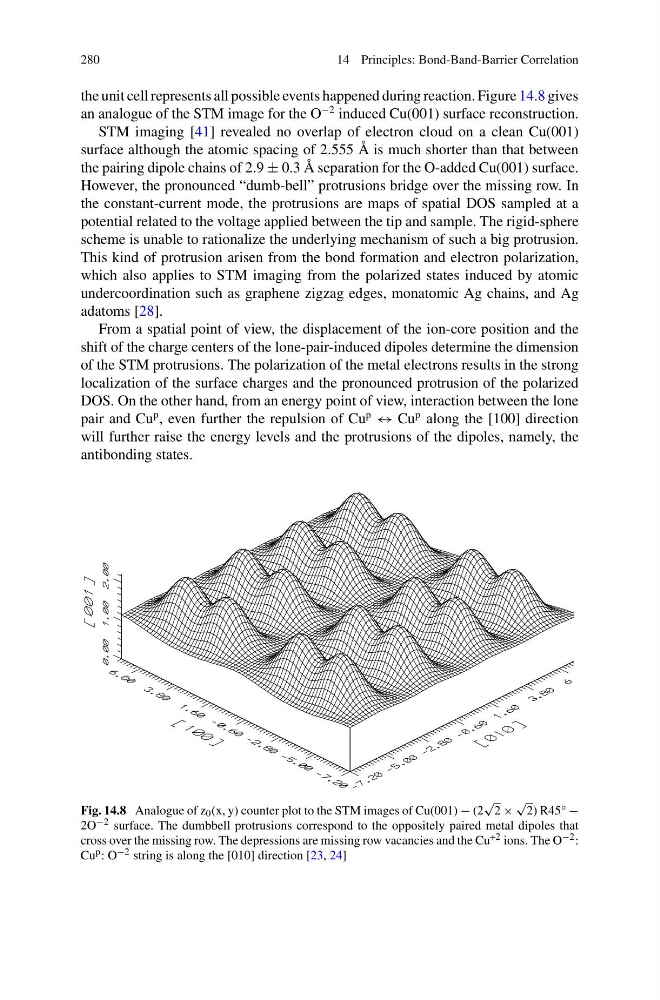
the unit cell represents all possible events happened during reaction. Figure 14.8 gives
an analogue of the STM image for the O
−2 induced Cu(001) surface reconstruction.
STM imaging [41] revealed no overlap of electron cloud on a clean Cu(001)
surface although the atomic spacing of 2.555 Å is much shorter than that between
the pairing dipole chains of 2.9 ± 0.3 Å separation for the O-added Cu(001) surface.
However, the pronounced “dumb-bell” protrusions bridge over the missing row. In
the constant-current mode, the protrusions are maps of spatial DOS sampled at a
potential related to the voltage applied between the tip and sample. The rigid-sphere
scheme is unable to rationalize the underlying mechanism of such a big protrusion.
This kind of protrusion arisen from the bond formation and electron polarization,
which also applies to STM imaging from the polarized states induced by atomic
undercoordination such as graphene zigzag edges, monatomic Ag chains, and Ag
adatoms [28].
From a spatial point of view, the displacement of the ion-core position and the
shift of the charge centers of the lone-pair-induced dipoles determine the dimension
of the STM protrusions. The polarization of the metal electrons results in the strong
localization of the surface charges and the pronounced protrusion of the polarized
DOS. On the other hand, from an energy point of view, interaction between the lone
pair and Cu
p , even further the repulsion of Cu
p
↔ Cu
p along the [100] direction
will further raise the energy levels and the protrusions of the dipoles, namely, the
antibonding states.
Fig. 14.8 Analogue of z 0 (x, y) counter plot to the STM images of Cu(001) − (2
√
2 ×
√
2) R45° −
2O −2 surface. The dumbbell protrusions correspond to the oppositely paired metal dipoles that
cross over the missing row. The depressions are missing row vacancies and the Cu +2 ions. The O −2 :
Cu p : O −2 string is along the [010] direction [23, 24]
14 Principles: Bond-Band-Barrier Correlation
the unit cell represents all possible events happened during reaction. Figure 14.8 gives
an analogue of the STM image for the O
−2 induced Cu(001) surface reconstruction.
STM imaging [41] revealed no overlap of electron cloud on a clean Cu(001)
surface although the atomic spacing of 2.555 Å is much shorter than that between
the pairing dipole chains of 2.9 ± 0.3 Å separation for the O-added Cu(001) surface.
However, the pronounced “dumb-bell” protrusions bridge over the missing row. In
the constant-current mode, the protrusions are maps of spatial DOS sampled at a
potential related to the voltage applied between the tip and sample. The rigid-sphere
scheme is unable to rationalize the underlying mechanism of such a big protrusion.
This kind of protrusion arisen from the bond formation and electron polarization,
which also applies to STM imaging from the polarized states induced by atomic
undercoordination such as graphene zigzag edges, monatomic Ag chains, and Ag
adatoms [28].
From a spatial point of view, the displacement of the ion-core position and the
shift of the charge centers of the lone-pair-induced dipoles determine the dimension
of the STM protrusions. The polarization of the metal electrons results in the strong
localization of the surface charges and the pronounced protrusion of the polarized
DOS. On the other hand, from an energy point of view, interaction between the lone
pair and Cu
p , even further the repulsion of Cu
p
↔ Cu
p along the [100] direction
will further raise the energy levels and the protrusions of the dipoles, namely, the
antibonding states.
Fig. 14.8 Analogue of z 0 (x, y) counter plot to the STM images of Cu(001) − (2
√
2 ×
√
2) R45° −
2O −2 surface. The dumbbell protrusions correspond to the oppositely paired metal dipoles that
cross over the missing row. The depressions are missing row vacancies and the Cu +2 ions. The O −2 :
Cu p : O −2 string is along the [010] direction [23, 24]