

268
14 Principles: Bond-Band-Barrier Correlation
14.2 Oxide Tetrahedron Bond Formation
14.2.1 Observations
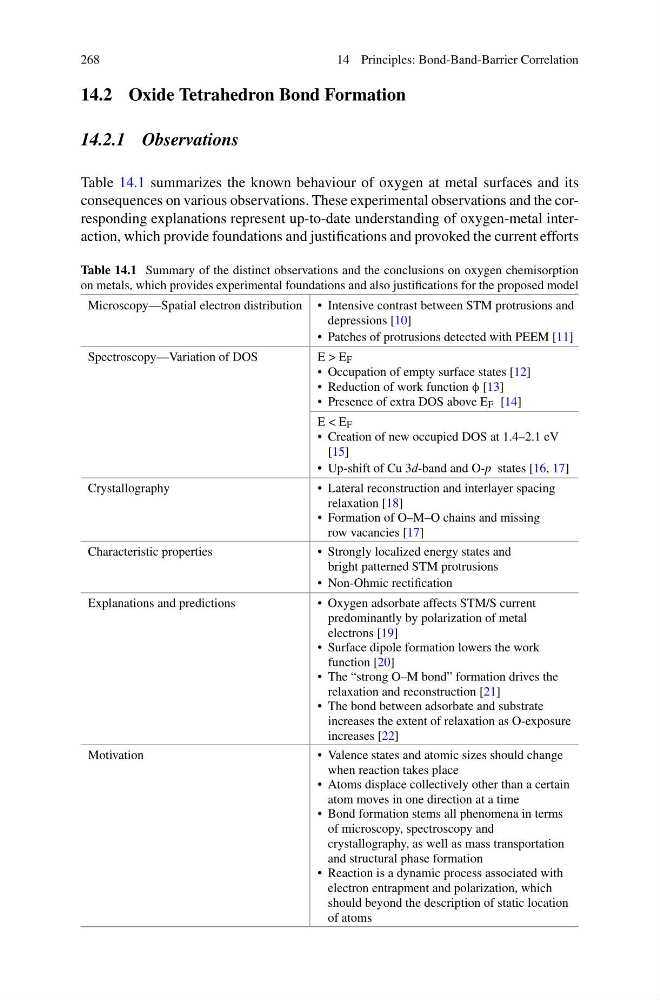
Table 14.1 summarizes the known behaviour of oxygen at metal surfaces and its
consequences on various observations. These experimental observations and the corresponding explanations represent up-to-date understanding of oxygen-metal interaction, which provide foundations and justifications and provoked the current efforts
Table 14.1 Summary of the distinct observations and the conclusions on oxygen chemisorption
on metals, which provides experimental foundations and also justifications for the proposed model
Microscopy—Spatial electron distribution • Intensive contrast between STM protrusions and
depressions [10]
• Patches of protrusions detected with PEEM [11]
Spectroscopy—Variation of DOS
E > E F
• Occupation of empty surface states [12]
• Reduction of work function φ [13]
• Presence of extra DOS above E F [14]
E < E F
• Creation of new occupied DOS at 1.4–2.1 eV
[15]
• Up-shift of Cu 3d-band and O-p states [16, 17]
Crystallography
• Lateral reconstruction and interlayer spacing
relaxation [18]
• Formation of O–M–O chains and missing
row vacancies [17]
Characteristic properties
• Strongly localized energy states and
bright patterned STM protrusions
• Non-Ohmic rectification
Explanations and predictions
• Oxygen adsorbate affects STM/S current
predominantly by polarization of metal
electrons [19]
• Surface dipole formation lowers the work
function [20]
• The “strong O–M bond” formation drives the
relaxation and reconstruction [21]
• The bond between adsorbate and substrate
increases the extent of relaxation as O-exposure
increases [22]
Motivation
• Valence states and atomic sizes should change
when reaction takes place
• Atoms displace collectively other than a certain
atom moves in one direction at a time
• Bond formation stems all phenomena in terms
of microscopy, spectroscopy and
crystallography, as well as mass transportation
and structural phase formation
• Reaction is a dynamic process associated with
electron entrapment and polarization, which
should beyond the description of static location
of atoms
14 Principles: Bond-Band-Barrier Correlation
14.2 Oxide Tetrahedron Bond Formation
14.2.1 Observations
Table 14.1 summarizes the known behaviour of oxygen at metal surfaces and its
consequences on various observations. These experimental observations and the corresponding explanations represent up-to-date understanding of oxygen-metal interaction, which provide foundations and justifications and provoked the current efforts
Table 14.1 Summary of the distinct observations and the conclusions on oxygen chemisorption
on metals, which provides experimental foundations and also justifications for the proposed model
Microscopy—Spatial electron distribution • Intensive contrast between STM protrusions and
depressions [10]
• Patches of protrusions detected with PEEM [11]
Spectroscopy—Variation of DOS
E > E F
• Occupation of empty surface states [12]
• Reduction of work function φ [13]
• Presence of extra DOS above E F [14]
E < E F
• Creation of new occupied DOS at 1.4–2.1 eV
[15]
• Up-shift of Cu 3d-band and O-p states [16, 17]
Crystallography
• Lateral reconstruction and interlayer spacing
relaxation [18]
• Formation of O–M–O chains and missing
row vacancies [17]
Characteristic properties
• Strongly localized energy states and
bright patterned STM protrusions
• Non-Ohmic rectification
Explanations and predictions
• Oxygen adsorbate affects STM/S current
predominantly by polarization of metal
electrons [19]
• Surface dipole formation lowers the work
function [20]
• The “strong O–M bond” formation drives the
relaxation and reconstruction [21]
• The bond between adsorbate and substrate
increases the extent of relaxation as O-exposure
increases [22]
Motivation
• Valence states and atomic sizes should change
when reaction takes place
• Atoms displace collectively other than a certain
atom moves in one direction at a time
• Bond formation stems all phenomena in terms
of microscopy, spectroscopy and
crystallography, as well as mass transportation
and structural phase formation
• Reaction is a dynamic process associated with
electron entrapment and polarization, which
should beyond the description of static location
of atoms