

264
14 Principles: Bond-Band-Barrier Correlation
14.1.1 Multi-Beam Diffraction
To model the substrate scattering it is assumed that the substrate forms a semiinfinite stack of atomic layers. As a representative of each atomic layer, a scattering
matrix describes how each incident beam transforms into beams leaving the bulk. The
scattering from the SPB is represented by a set of matrices describing the repeated
transmission and reflection of a set of beams by the SPB. These matrices are added to
the substrate lattice reflection matrix using the layer-doubling formalism. This model
has all possibly multiple reflections between the substrate lattice and the SPB. Thus,
the scattering amplitude from the crystal, with the SPB in place, forms a geometrical
series summing over infinite number of internal reflections [4]. Figure 14.1 illustrates
the multiple diffraction mechanism [3] for the LEED patterns and Fig. 14.2 shows
the VLEED (00) beam intensity-energy spectroscopy [5].
The scattering by the SPB is represented by a set of matrices representing the transmission and reflection of beams. These metrics are added to the substrate reflection
matrix using the layer-doubling formulism. This accounts for all possible multiple reflections between the substrate and the SPB. In the formulism, the scattered
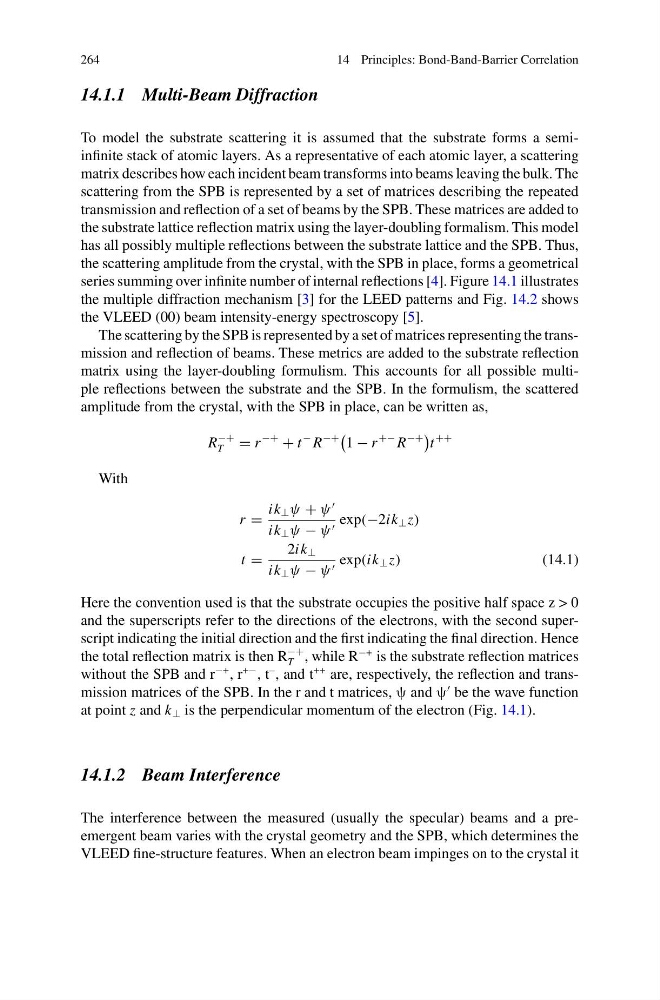
amplitude from the crystal, with the SPB in place, can be written as,
R
−+
T
= r
−+
+ t
− R
−+
1 − r
+− R
−+
t
++
With
r =
ik ⊥ ψ + ψ
ik ⊥ ψ − ψ exp(−2ik ⊥ z)
t =
2ik ⊥
ik ⊥ ψ − ψ exp(ik ⊥ z)
(14.1)
Here the convention used is that the substrate occupies the positive half space z > 0
and the superscripts refer to the directions of the electrons, with the second superscript indicating the initial direction and the first indicating the final direction. Hence
the total reflection matrix is then R
−+
T , while R
−+ is the substrate reflection matrices
without the SPB and r
−+ , r
+− , t
– , and t
++ are, respectively, the reflection and transmission matrices of the SPB. In the r and t matrices, ψ and ψ
be the wave function
at point z and k ⊥ is the perpendicular momentum of the electron (Fig. 14.1).
14.1.2 Beam Interference
The interference between the measured (usually the specular) beams and a preemergent beam varies with the crystal geometry and the SPB, which determines the
VLEED fine-structure features. When an electron beam impinges on to the crystal it
14 Principles: Bond-Band-Barrier Correlation
14.1.1 Multi-Beam Diffraction
To model the substrate scattering it is assumed that the substrate forms a semiinfinite stack of atomic layers. As a representative of each atomic layer, a scattering
matrix describes how each incident beam transforms into beams leaving the bulk. The
scattering from the SPB is represented by a set of matrices describing the repeated
transmission and reflection of a set of beams by the SPB. These matrices are added to
the substrate lattice reflection matrix using the layer-doubling formalism. This model
has all possibly multiple reflections between the substrate lattice and the SPB. Thus,
the scattering amplitude from the crystal, with the SPB in place, forms a geometrical
series summing over infinite number of internal reflections [4]. Figure 14.1 illustrates
the multiple diffraction mechanism [3] for the LEED patterns and Fig. 14.2 shows
the VLEED (00) beam intensity-energy spectroscopy [5].
The scattering by the SPB is represented by a set of matrices representing the transmission and reflection of beams. These metrics are added to the substrate reflection
matrix using the layer-doubling formulism. This accounts for all possible multiple reflections between the substrate and the SPB. In the formulism, the scattered
amplitude from the crystal, with the SPB in place, can be written as,
R
−+
T
= r
−+
+ t
− R
−+
1 − r
+− R
−+
t
++
With
r =
ik ⊥ ψ + ψ
ik ⊥ ψ − ψ exp(−2ik ⊥ z)
t =
2ik ⊥
ik ⊥ ψ − ψ exp(ik ⊥ z)
(14.1)
Here the convention used is that the substrate occupies the positive half space z > 0
and the superscripts refer to the directions of the electrons, with the second superscript indicating the initial direction and the first indicating the final direction. Hence
the total reflection matrix is then R
−+
T , while R
−+ is the substrate reflection matrices
without the SPB and r
−+ , r
+− , t
– , and t
++ are, respectively, the reflection and transmission matrices of the SPB. In the r and t matrices, ψ and ψ
be the wave function
at point z and k ⊥ is the perpendicular momentum of the electron (Fig. 14.1).
14.1.2 Beam Interference
The interference between the measured (usually the specular) beams and a preemergent beam varies with the crystal geometry and the SPB, which determines the
VLEED fine-structure features. When an electron beam impinges on to the crystal it