

256
13 Introduction
Most researchers agreed on the missing-row (MR) type Cu(001)-(2
√
2 ×
√
2)R45°-O reconstruction first proposed by Zeng and Mitchell in 1990 [42]. A
combination of STM observations [43, 44] and VLEED computations [7, 8, 19] confirmed that an off-centered pyramid Cu(001)-c(2 × 2)-O
−1 forms first, at oxygen
exposure lower than 25 L, and then the MR (2
√
2 ×
√
2)R45°-2O
−2 superstructure
follows.
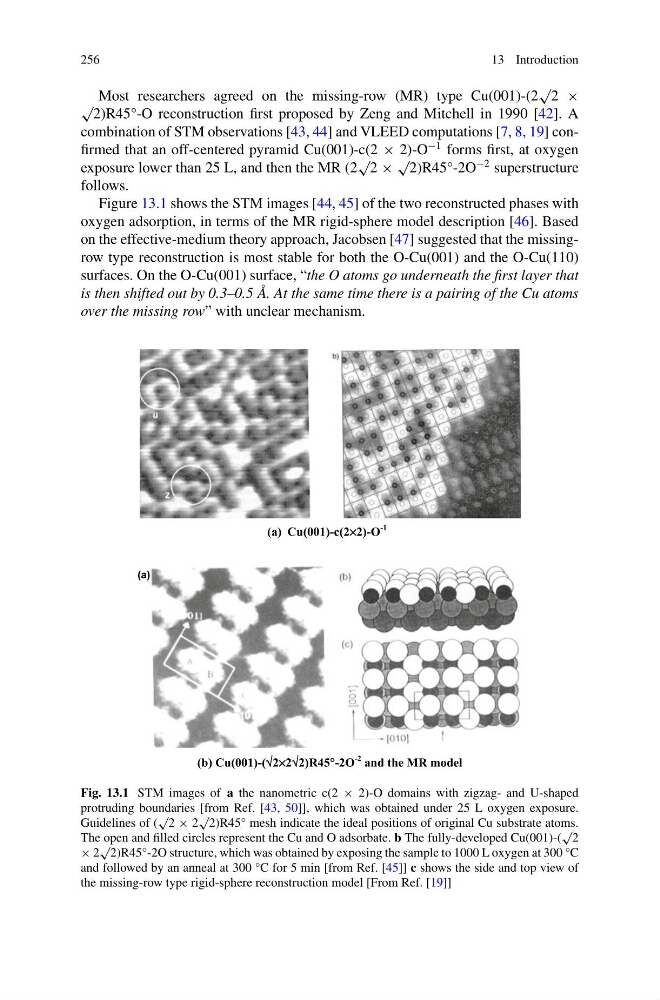
Figure 13.1 shows the STM images [44, 45] of the two reconstructed phases with
oxygen adsorption, in terms of the MR rigid-sphere model description [46]. Based
on the effective-medium theory approach, Jacobsen [47] suggested that the missingrow type reconstruction is most stable for both the O-Cu(001) and the O-Cu(110)
surfaces. On the O-Cu(001) surface, “the O atoms go underneath the first layer that
is then shifted out by 0.3–0.5 Å. At the same time there is a pairing of the Cu atoms
over the missing row” with unclear mechanism.
(a) Cu(001)-c(2× ×2)-O
-1
(a)
(b) Cu(001)-(√2×2√2)R45°-2O
-2 and the MR model
Fig. 13.1 STM images of a the nanometric c(2 × 2)-O domains with zigzag- and U-shaped
protruding boundaries [from Ref. [43, 50]], which was obtained under 25 L oxygen exposure.
Guidelines of (
√
2 × 2
√
2)R45° mesh indicate the ideal positions of original Cu substrate atoms.
The open and filled circles represent the Cu and O adsorbate. b The fully-developed Cu(001)-(
√
2
× 2
√
2)R45°-2O structure, which was obtained by exposing the sample to 1000 L oxygen at 300 °C
and followed by an anneal at 300 °C for 5 min [from Ref. [45]] c shows the side and top view of
the missing-row type rigid-sphere reconstruction model [From Ref. [19]]
13 Introduction
Most researchers agreed on the missing-row (MR) type Cu(001)-(2
√
2 ×
√
2)R45°-O reconstruction first proposed by Zeng and Mitchell in 1990 [42]. A
combination of STM observations [43, 44] and VLEED computations [7, 8, 19] confirmed that an off-centered pyramid Cu(001)-c(2 × 2)-O
−1 forms first, at oxygen
exposure lower than 25 L, and then the MR (2
√
2 ×
√
2)R45°-2O
−2 superstructure
follows.
Figure 13.1 shows the STM images [44, 45] of the two reconstructed phases with
oxygen adsorption, in terms of the MR rigid-sphere model description [46]. Based
on the effective-medium theory approach, Jacobsen [47] suggested that the missingrow type reconstruction is most stable for both the O-Cu(001) and the O-Cu(110)
surfaces. On the O-Cu(001) surface, “the O atoms go underneath the first layer that
is then shifted out by 0.3–0.5 Å. At the same time there is a pairing of the Cu atoms
over the missing row” with unclear mechanism.
(a) Cu(001)-c(2× ×2)-O
-1
(a)
(b) Cu(001)-(√2×2√2)R45°-2O
-2 and the MR model
Fig. 13.1 STM images of a the nanometric c(2 × 2)-O domains with zigzag- and U-shaped
protruding boundaries [from Ref. [43, 50]], which was obtained under 25 L oxygen exposure.
Guidelines of (
√
2 × 2
√
2)R45° mesh indicate the ideal positions of original Cu substrate atoms.
The open and filled circles represent the Cu and O adsorbate. b The fully-developed Cu(001)-(
√
2
× 2
√
2)R45°-2O structure, which was obtained by exposing the sample to 1000 L oxygen at 300 °C
and followed by an anneal at 300 °C for 5 min [from Ref. [45]] c shows the side and top view of
the missing-row type rigid-sphere reconstruction model [From Ref. [19]]