

11.3 Supersolidity and Quasisolidity
223
secures the contacting interface repulsivity, resulting in the slipperiness of ice [69],
nanobubble endurability [68], and the toughest water skin [70]. It is the supersolid
skin’s lower density that raises the skin thermal diffusivity for the heat transport in
the Mpemba effect [71].
Salt solvation derives cations and anions dispersed in the solution [33]. Each of
the ions serves as a source center of electric field that aligns, clusters, stretches and
polarizes the neighboring O:H–O bonds, resulting the same supersolidity within the
hydration shell whose size is subject to the screening of the hydrating H 2 O dipoles
and the ionic charge quantity and volume size.
11.3.2 Supercooling of Supersolid Phase
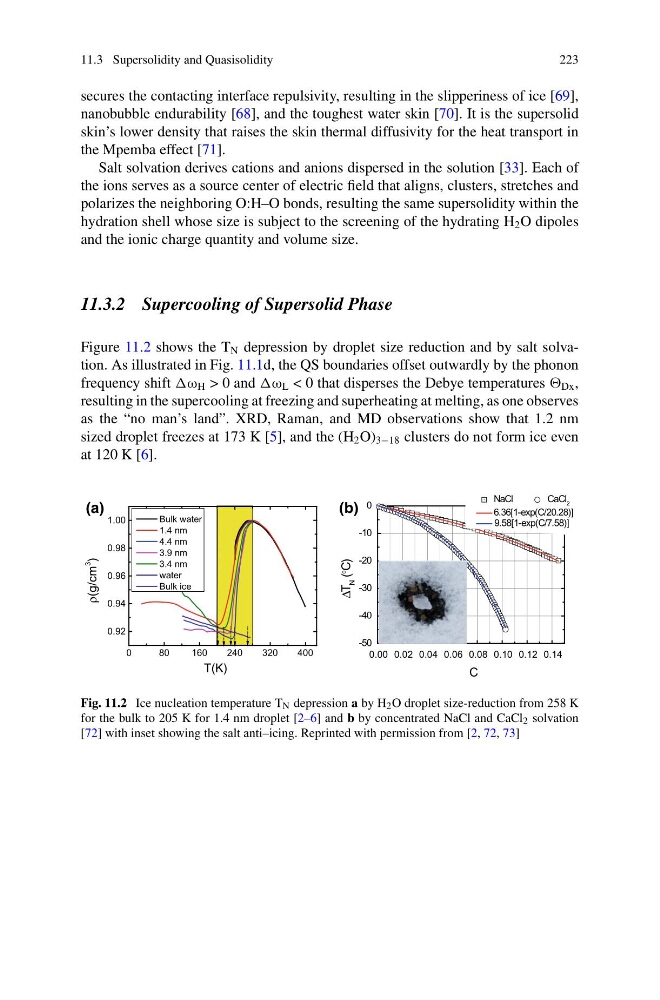
Figure 11.2 shows the T N depression by droplet size reduction and by salt solvation. As illustrated in Fig. 11.1d, the QS boundaries offset outwardly by the phonon
frequency shift H > 0 and L < 0 that disperses the Debye temperatures Dx ,
resulting in the supercooling at freezing and superheating at melting, as one observes
as the “no man’s land”. XRD, Raman, and MD observations show that 1.2 nm
sized droplet freezes at 173 K [5], and the (H 2 O) 3−18 clusters do not form ice even
at 120 K [6].
0
80
160
240
320
400
0.92
0.94
0.96
0.98
1.00
ρ(g/cm
3
)
T(K)
Bulk water
1.4 nm
4.4 nm
3.9 nm
3.4 nm
water
Bulk ice
(a)
(b)
0.00 0.02 0.04 0.06 0.08 0.10 0.12 0.14
-50
-40
-30
-20
-10
0
ΔT
N
(
o
C)
C
NaCl
CaCl 2
6.36[1-exp(C/20.28)]
9.58[1-exp(C/7.58)]
Fig. 11.2 Ice nucleation temperature T N depression a by H 2 O droplet size-reduction from 258 K
for the bulk to 205 K for 1.4 nm droplet [2–6] and b by concentrated NaCl and CaCl 2 solvation
[72] with inset showing the salt anti–icing. Reprinted with permission from [2, 72, 73]
223
secures the contacting interface repulsivity, resulting in the slipperiness of ice [69],
nanobubble endurability [68], and the toughest water skin [70]. It is the supersolid
skin’s lower density that raises the skin thermal diffusivity for the heat transport in
the Mpemba effect [71].
Salt solvation derives cations and anions dispersed in the solution [33]. Each of
the ions serves as a source center of electric field that aligns, clusters, stretches and
polarizes the neighboring O:H–O bonds, resulting the same supersolidity within the
hydration shell whose size is subject to the screening of the hydrating H 2 O dipoles
and the ionic charge quantity and volume size.
11.3.2 Supercooling of Supersolid Phase
Figure 11.2 shows the T N depression by droplet size reduction and by salt solvation. As illustrated in Fig. 11.1d, the QS boundaries offset outwardly by the phonon
frequency shift H > 0 and L < 0 that disperses the Debye temperatures Dx ,
resulting in the supercooling at freezing and superheating at melting, as one observes
as the “no man’s land”. XRD, Raman, and MD observations show that 1.2 nm
sized droplet freezes at 173 K [5], and the (H 2 O) 3−18 clusters do not form ice even
at 120 K [6].
0
80
160
240
320
400
0.92
0.94
0.96
0.98
1.00
ρ(g/cm
3
)
T(K)
Bulk water
1.4 nm
4.4 nm
3.9 nm
3.4 nm
water
Bulk ice
(a)
(b)
0.00 0.02 0.04 0.06 0.08 0.10 0.12 0.14
-50
-40
-30
-20
-10
0
ΔT
N
(
o
C)
C
NaCl
CaCl 2
6.36[1-exp(C/20.28)]
9.58[1-exp(C/7.58)]
Fig. 11.2 Ice nucleation temperature T N depression a by H 2 O droplet size-reduction from 258 K
for the bulk to 205 K for 1.4 nm droplet [2–6] and b by concentrated NaCl and CaCl 2 solvation
[72] with inset showing the salt anti–icing. Reprinted with permission from [2, 72, 73]