

5.1 Observations
83
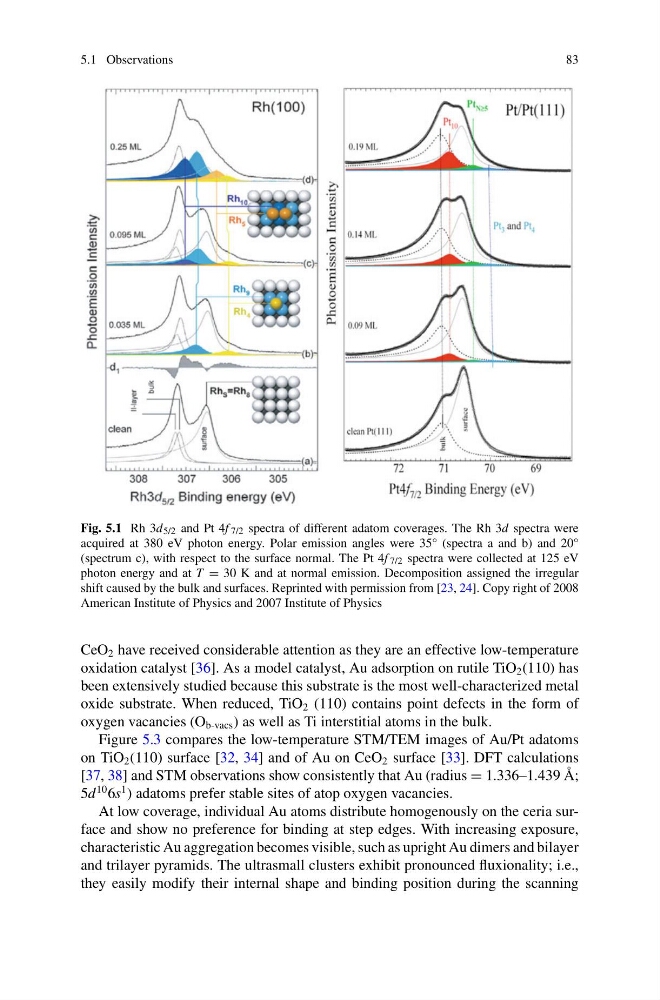
Fig. 5.1 Rh 3d 5/2 and Pt 4f 7/2 spectra of different adatom coverages. The Rh 3d spectra were
acquired at 380 eV photon energy. Polar emission angles were 35° (spectra a and b) and 20°
(spectrum c), with respect to the surface normal. The Pt 4f 7/2 spectra were collected at 125 eV
photon energy and at T = 30 K and at normal emission. Decomposition assigned the irregular
shift caused by the bulk and surfaces. Reprinted with permission from [23, 24]. Copy right of 2008
American Institute of Physics and 2007 Institute of Physics
CeO 2 have received considerable attention as they are an effective low-temperature
oxidation catalyst [36]. As a model catalyst, Au adsorption on rutile TiO 2 (110) has
been extensively studied because this substrate is the most well-characterized metal
oxide substrate. When reduced, TiO 2 (110) contains point defects in the form of
oxygen vacancies (O b-vacs ) as well as Ti interstitial atoms in the bulk.
Figure 5.3 compares the low-temperature STM/TEM images of Au/Pt adatoms
on TiO 2 (110) surface [32, 34] and of Au on CeO 2 surface [33]. DFT calculations
[37, 38] and STM observations show consistently that Au (radius = 1.336–1.439 Å;
5d
10 6s
1 ) adatoms prefer stable sites of atop oxygen vacancies.
At low coverage, individual Au atoms distribute homogenously on the ceria surface and show no preference for binding at step edges. With increasing exposure,
characteristic Au aggregation becomes visible, such as upright Au dimers and bilayer
and trilayer pyramids. The ultrasmall clusters exhibit pronounced fluxionality; i.e.,
they easily modify their internal shape and binding position during the scanning
83
Fig. 5.1 Rh 3d 5/2 and Pt 4f 7/2 spectra of different adatom coverages. The Rh 3d spectra were
acquired at 380 eV photon energy. Polar emission angles were 35° (spectra a and b) and 20°
(spectrum c), with respect to the surface normal. The Pt 4f 7/2 spectra were collected at 125 eV
photon energy and at T = 30 K and at normal emission. Decomposition assigned the irregular
shift caused by the bulk and surfaces. Reprinted with permission from [23, 24]. Copy right of 2008
American Institute of Physics and 2007 Institute of Physics
CeO 2 have received considerable attention as they are an effective low-temperature
oxidation catalyst [36]. As a model catalyst, Au adsorption on rutile TiO 2 (110) has
been extensively studied because this substrate is the most well-characterized metal
oxide substrate. When reduced, TiO 2 (110) contains point defects in the form of
oxygen vacancies (O b-vacs ) as well as Ti interstitial atoms in the bulk.
Figure 5.3 compares the low-temperature STM/TEM images of Au/Pt adatoms
on TiO 2 (110) surface [32, 34] and of Au on CeO 2 surface [33]. DFT calculations
[37, 38] and STM observations show consistently that Au (radius = 1.336–1.439 Å;
5d
10 6s
1 ) adatoms prefer stable sites of atop oxygen vacancies.
At low coverage, individual Au atoms distribute homogenously on the ceria surface and show no preference for binding at step edges. With increasing exposure,
characteristic Au aggregation becomes visible, such as upright Au dimers and bilayer
and trilayer pyramids. The ultrasmall clusters exhibit pronounced fluxionality; i.e.,
they easily modify their internal shape and binding position during the scanning