

Considering that interlocking the experimental hutch would take a minimum of
30 s and that crystal selection and mounting will take longer still, a good proportion
of allocated beamtime would not be spent actually collecting data! This is clearly a
waste of a precious resource, and again, the MX community has the answer – sample
mounting robots. Crystals are pre-mounted, frozen and placed in a dewar for the
robot to take and place on the diffractometer. The crystal is centred remotely by
mouse-clicking on the centre of the crystal, which is then driven to a predetermined
point in space. This now allows the whole experimental process to be run without the
user being at the beamline – they mount their crystals in the comfort of their own
labs, freeze and ship them to the synchrotron. With the crystals loaded into the dewar
at the synchrotron by beamline staff, the experiment can be run by the users
remotely. During the experiment the users will centre the crystal; assess the quality
and intensity for the diffraction pattern; change attenuation or counting time as
necessary; see how well it indexes; assess the data resolution; and determine the
quality of the structure solution and refinement. I19 at Diamond Light Source
(UK) is the first small molecule beamline to offer this capability to their users.
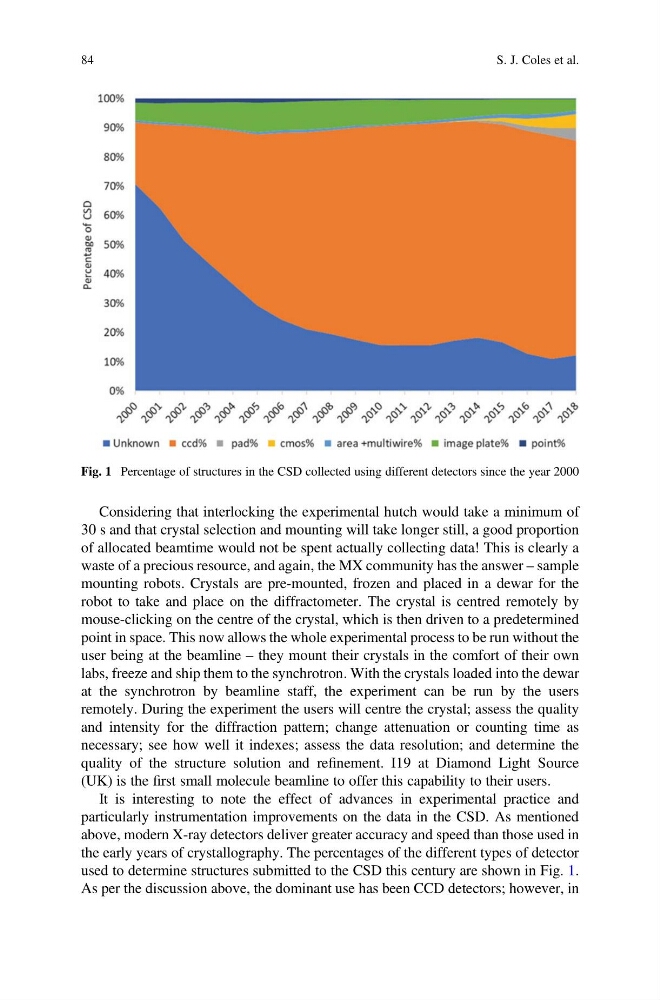
It is interesting to note the effect of advances in experimental practice and
particularly instrumentation improvements on the data in the CSD. As mentioned
above, modern X-ray detectors deliver greater accuracy and speed than those used in
the early years of crystallography. The percentages of the different types of detector
used to determine structures submitted to the CSD this century are shown in Fig. 1.
As per the discussion above, the dominant use has been CCD detectors; however, in
Fig. 1 Percentage of structures in the CSD collected using different detectors since the year 2000
84
S. J. Coles et al.
30 s and that crystal selection and mounting will take longer still, a good proportion
of allocated beamtime would not be spent actually collecting data! This is clearly a
waste of a precious resource, and again, the MX community has the answer – sample
mounting robots. Crystals are pre-mounted, frozen and placed in a dewar for the
robot to take and place on the diffractometer. The crystal is centred remotely by
mouse-clicking on the centre of the crystal, which is then driven to a predetermined
point in space. This now allows the whole experimental process to be run without the
user being at the beamline – they mount their crystals in the comfort of their own
labs, freeze and ship them to the synchrotron. With the crystals loaded into the dewar
at the synchrotron by beamline staff, the experiment can be run by the users
remotely. During the experiment the users will centre the crystal; assess the quality
and intensity for the diffraction pattern; change attenuation or counting time as
necessary; see how well it indexes; assess the data resolution; and determine the
quality of the structure solution and refinement. I19 at Diamond Light Source
(UK) is the first small molecule beamline to offer this capability to their users.
It is interesting to note the effect of advances in experimental practice and
particularly instrumentation improvements on the data in the CSD. As mentioned
above, modern X-ray detectors deliver greater accuracy and speed than those used in
the early years of crystallography. The percentages of the different types of detector
used to determine structures submitted to the CSD this century are shown in Fig. 1.
As per the discussion above, the dominant use has been CCD detectors; however, in
Fig. 1 Percentage of structures in the CSD collected using different detectors since the year 2000
84
S. J. Coles et al.