

1985 J. Karle and H.A. Hauptman were awarded the Nobel Prize for developing
these direct methods for solving crystals structures.
Another powerful solution technique is the multi-wavelength anomalous dispersion (MAD) method [64]. In this technique, atoms’ inner electrons absorb X-rays of
particular wavelengths and reemit the X-rays after a delay, inducing a phase shift in
all of the reflections, known as the anomalous dispersion effect. Analysis of this
phase shift (which may be different for individual reflections) results in a solution for
the phases. Since X-ray fluorescence techniques (like this one) require excitation at
very specific wavelengths, it is necessary to use synchrotron radiation when using
the MAD method. Other methods of experimental phase determination include
multiple isomorphous replacement (MIR), where heavy atoms are inserted into
structure (usually by synthesising proteins with analogues or by soaking), molecular
replacement (MR) and single-wavelength anomalous dispersion (SAD).
The phenomenon of anomalous dispersion also had an important role in showing
how X-ray crystallography could be used to determine the absolute configurations of
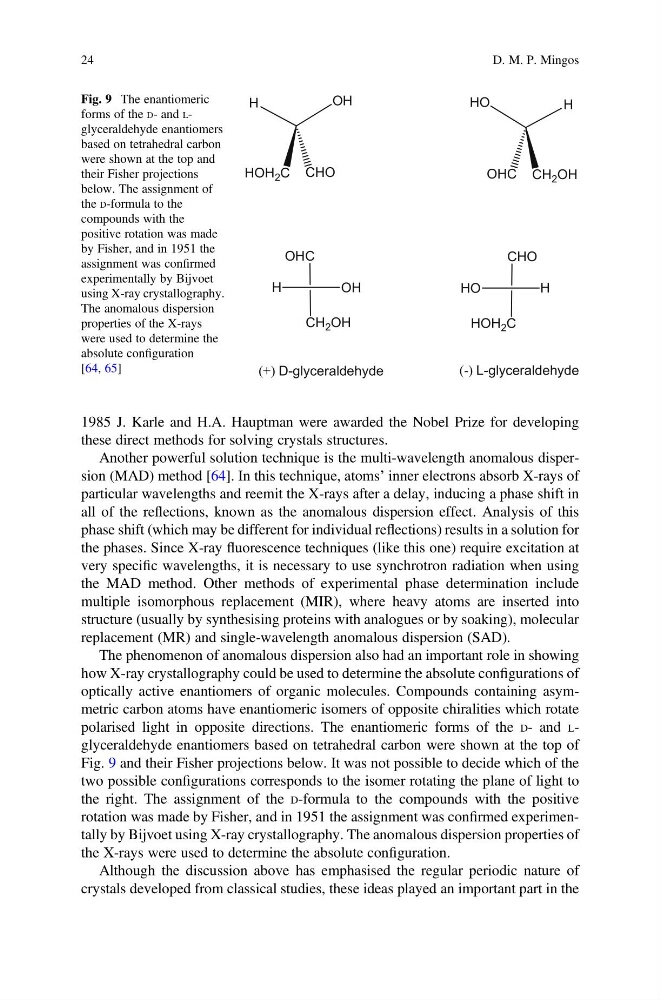
optically active enantiomers of organic molecules. Compounds containing asymmetric carbon atoms have enantiomeric isomers of opposite chiralities which rotate
polarised light in opposite directions. The enantiomeric forms of the D- and Lglyceraldehyde enantiomers based on tetrahedral carbon were shown at the top of
Fig. 9 and their Fisher projections below. It was not possible to decide which of the
two possible configurations corresponds to the isomer rotating the plane of light to
the right. The assignment of the D-formula to the compounds with the positive
rotation was made by Fisher, and in 1951 the assignment was confirmed experimentally by Bijvoet using X-ray crystallography. The anomalous dispersion properties of
the X-rays were used to determine the absolute configuration.
Although the discussion above has emphasised the regular periodic nature of
crystals developed from classical studies, these ideas played an important part in the
OHC
CH 2 OH
H
OH
CHO
HOH 2 C
H
HO
(+) D-glyceraldehyde
(-) L-glyceraldehyde
OH
H
HOH 2 C CHO
HO
H
CH 2 OH
OHC
Fig. 9 The enantiomeric
forms of the D- and Lglyceraldehyde enantiomers
based on tetrahedral carbon
were shown at the top and
their Fisher projections
below. The assignment of
the D-formula to the
compounds with the
positive rotation was made
by Fisher, and in 1951 the
assignment was confirmed
experimentally by Bijvoet
using X-ray crystallography.
The anomalous dispersion
properties of the X-rays
were used to determine the
absolute configuration
[64, 65]
24
D. M. P. Mingos
these direct methods for solving crystals structures.
Another powerful solution technique is the multi-wavelength anomalous dispersion (MAD) method [64]. In this technique, atoms’ inner electrons absorb X-rays of
particular wavelengths and reemit the X-rays after a delay, inducing a phase shift in
all of the reflections, known as the anomalous dispersion effect. Analysis of this
phase shift (which may be different for individual reflections) results in a solution for
the phases. Since X-ray fluorescence techniques (like this one) require excitation at
very specific wavelengths, it is necessary to use synchrotron radiation when using
the MAD method. Other methods of experimental phase determination include
multiple isomorphous replacement (MIR), where heavy atoms are inserted into
structure (usually by synthesising proteins with analogues or by soaking), molecular
replacement (MR) and single-wavelength anomalous dispersion (SAD).
The phenomenon of anomalous dispersion also had an important role in showing
how X-ray crystallography could be used to determine the absolute configurations of
optically active enantiomers of organic molecules. Compounds containing asymmetric carbon atoms have enantiomeric isomers of opposite chiralities which rotate
polarised light in opposite directions. The enantiomeric forms of the D- and Lglyceraldehyde enantiomers based on tetrahedral carbon were shown at the top of
Fig. 9 and their Fisher projections below. It was not possible to decide which of the
two possible configurations corresponds to the isomer rotating the plane of light to
the right. The assignment of the D-formula to the compounds with the positive
rotation was made by Fisher, and in 1951 the assignment was confirmed experimentally by Bijvoet using X-ray crystallography. The anomalous dispersion properties of
the X-rays were used to determine the absolute configuration.
Although the discussion above has emphasised the regular periodic nature of
crystals developed from classical studies, these ideas played an important part in the
OHC
CH 2 OH
H
OH
CHO
HOH 2 C
H
HO
(+) D-glyceraldehyde
(-) L-glyceraldehyde
OH
H
HOH 2 C CHO
HO
H
CH 2 OH
OHC
Fig. 9 The enantiomeric
forms of the D- and Lglyceraldehyde enantiomers
based on tetrahedral carbon
were shown at the top and
their Fisher projections
below. The assignment of
the D-formula to the
compounds with the
positive rotation was made
by Fisher, and in 1951 the
assignment was confirmed
experimentally by Bijvoet
using X-ray crystallography.
The anomalous dispersion
properties of the X-rays
were used to determine the
absolute configuration
[64, 65]
24
D. M. P. Mingos