

reported. Currently more than one million structures have been determined, and the
instrumental and computing advances which have made this possible are discussed
in subsequent chapters. As early as 1930, it was recognised that the increase in
structural information was going to create archival and accession problems for future
generations. R.W.G. Wyckoff made important contributions to addressing these
issues and providing mechanisms for efficiently disseminating structural information. I shall return to this point later in subsequent chapter.
The Bragg’s structural determinations of diamond which showed that all the
carbon atoms had tetrahedral geometries confirmed the valency proposed initially
by Kekulé and supported by van’t Hoff and Lebel’s geometric interpretation of
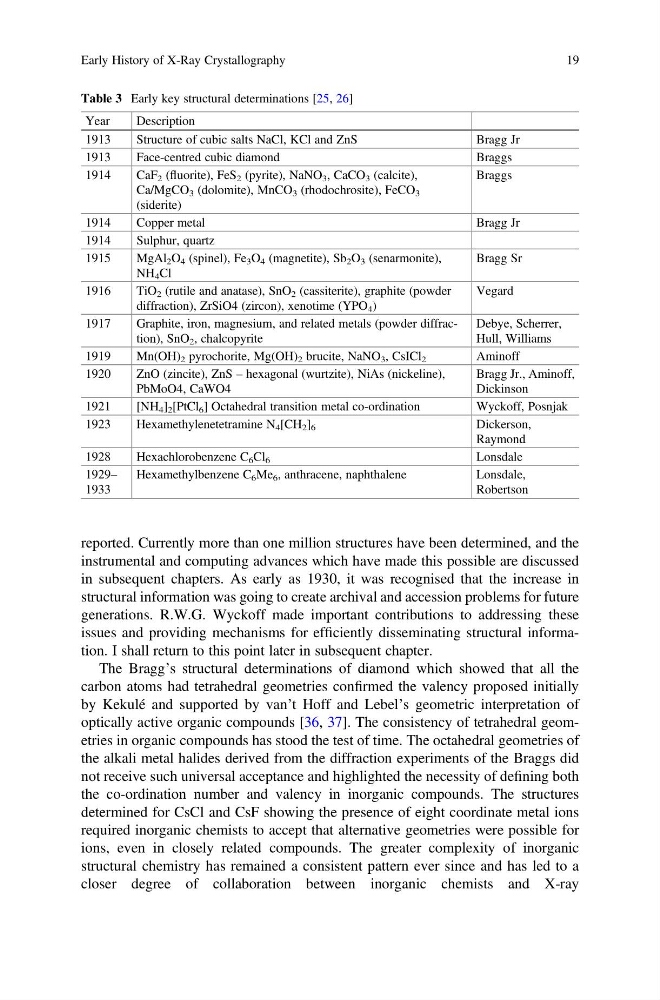
optically active organic compounds [36, 37]. The consistency of tetrahedral geometries in organic compounds has stood the test of time. The octahedral geometries of
the alkali metal halides derived from the diffraction experiments of the Braggs did
not receive such universal acceptance and highlighted the necessity of defining both
the co-ordination number and valency in inorganic compounds. The structures
determined for CsCl and CsF showing the presence of eight coordinate metal ions
required inorganic chemists to accept that alternative geometries were possible for
ions, even in closely related compounds. The greater complexity of inorganic
structural chemistry has remained a consistent pattern ever since and has led to a
closer degree of collaboration between inorganic chemists and X-ray
Table 3 Early key structural determinations [25, 26]
Year
Description
1913
Structure of cubic salts NaCl, KCl and ZnS
Bragg Jr
1913
Face-centred cubic diamond
Braggs
1914
CaF 2 (fluorite), FeS 2 (pyrite), NaNO 3 , CaCO 3 (calcite),
Ca/MgCO 3 (dolomite), MnCO 3 (rhodochrosite), FeCO 3
(siderite)
Braggs
1914
Copper metal
Bragg Jr
1914
Sulphur, quartz
1915
MgAl 2 O 4 (spinel), Fe 3 O 4 (magnetite), Sb 2 O 3 (senarmonite),
NH 4 Cl
Bragg Sr
1916
TiO 2 (rutile and anatase), SnO 2 (cassiterite), graphite (powder
diffraction), ZrSiO4 (zircon), xenotime (YPO 4 )
Vegard
1917
Graphite, iron, magnesium, and related metals (powder diffraction), SnO 2 , chalcopyrite
Debye, Scherrer,
Hull, Williams
1919
Mn(OH) 2 pyrochorite, Mg(OH) 2 brucite, NaNO 3 , CsICl 2
Aminoff
1920
ZnO (zincite), ZnS – hexagonal (wurtzite), NiAs (nickeline),
PbMoO4, CaWO4
Bragg Jr., Aminoff,
Dickinson
1921
[NH 4 ] 2 [PtCl 6 ] Octahedral transition metal co-ordination
Wyckoff, Posnjak
1923
Hexamethylenetetramine N 4 [CH 2 ] 6
Dickerson,
Raymond
1928
Hexachlorobenzene C 6 Cl 6
Lonsdale
1929–
1933
Hexamethylbenzene C 6 Me 6 , anthracene, naphthalene
Lonsdale,
Robertson
Early History of X-Ray Crystallography
19
instrumental and computing advances which have made this possible are discussed
in subsequent chapters. As early as 1930, it was recognised that the increase in
structural information was going to create archival and accession problems for future
generations. R.W.G. Wyckoff made important contributions to addressing these
issues and providing mechanisms for efficiently disseminating structural information. I shall return to this point later in subsequent chapter.
The Bragg’s structural determinations of diamond which showed that all the
carbon atoms had tetrahedral geometries confirmed the valency proposed initially
by Kekulé and supported by van’t Hoff and Lebel’s geometric interpretation of
optically active organic compounds [36, 37]. The consistency of tetrahedral geometries in organic compounds has stood the test of time. The octahedral geometries of
the alkali metal halides derived from the diffraction experiments of the Braggs did
not receive such universal acceptance and highlighted the necessity of defining both
the co-ordination number and valency in inorganic compounds. The structures
determined for CsCl and CsF showing the presence of eight coordinate metal ions
required inorganic chemists to accept that alternative geometries were possible for
ions, even in closely related compounds. The greater complexity of inorganic
structural chemistry has remained a consistent pattern ever since and has led to a
closer degree of collaboration between inorganic chemists and X-ray
Table 3 Early key structural determinations [25, 26]
Year
Description
1913
Structure of cubic salts NaCl, KCl and ZnS
Bragg Jr
1913
Face-centred cubic diamond
Braggs
1914
CaF 2 (fluorite), FeS 2 (pyrite), NaNO 3 , CaCO 3 (calcite),
Ca/MgCO 3 (dolomite), MnCO 3 (rhodochrosite), FeCO 3
(siderite)
Braggs
1914
Copper metal
Bragg Jr
1914
Sulphur, quartz
1915
MgAl 2 O 4 (spinel), Fe 3 O 4 (magnetite), Sb 2 O 3 (senarmonite),
NH 4 Cl
Bragg Sr
1916
TiO 2 (rutile and anatase), SnO 2 (cassiterite), graphite (powder
diffraction), ZrSiO4 (zircon), xenotime (YPO 4 )
Vegard
1917
Graphite, iron, magnesium, and related metals (powder diffraction), SnO 2 , chalcopyrite
Debye, Scherrer,
Hull, Williams
1919
Mn(OH) 2 pyrochorite, Mg(OH) 2 brucite, NaNO 3 , CsICl 2
Aminoff
1920
ZnO (zincite), ZnS – hexagonal (wurtzite), NiAs (nickeline),
PbMoO4, CaWO4
Bragg Jr., Aminoff,
Dickinson
1921
[NH 4 ] 2 [PtCl 6 ] Octahedral transition metal co-ordination
Wyckoff, Posnjak
1923
Hexamethylenetetramine N 4 [CH 2 ] 6
Dickerson,
Raymond
1928
Hexachlorobenzene C 6 Cl 6
Lonsdale
1929–
1933
Hexamethylbenzene C 6 Me 6 , anthracene, naphthalene
Lonsdale,
Robertson
Early History of X-Ray Crystallography
19