

photocrystallographic studies became established in the late 1990s and early 2000s,
transition metal nitrite systems have played a key role in furthering our understanding of linkage isomerism in the single crystal.
Much of the work on solid-state nitrite linkage isomers to date has aimed to
maximise the nitro ! nitrito photoconversion level by engineering a “reaction
cavity” around the switchable ligand to allow the isomerisation to proceed with
minimal steric influence from the surrounding crystal environment. This strategy
follows from the topochemical postulate proposed by Schmidt and Cohen in the
1960s, which states that single-crystal reactions must follow the minimum-energy
pathway involving the least amount of atomic rearrangement in order to preserve
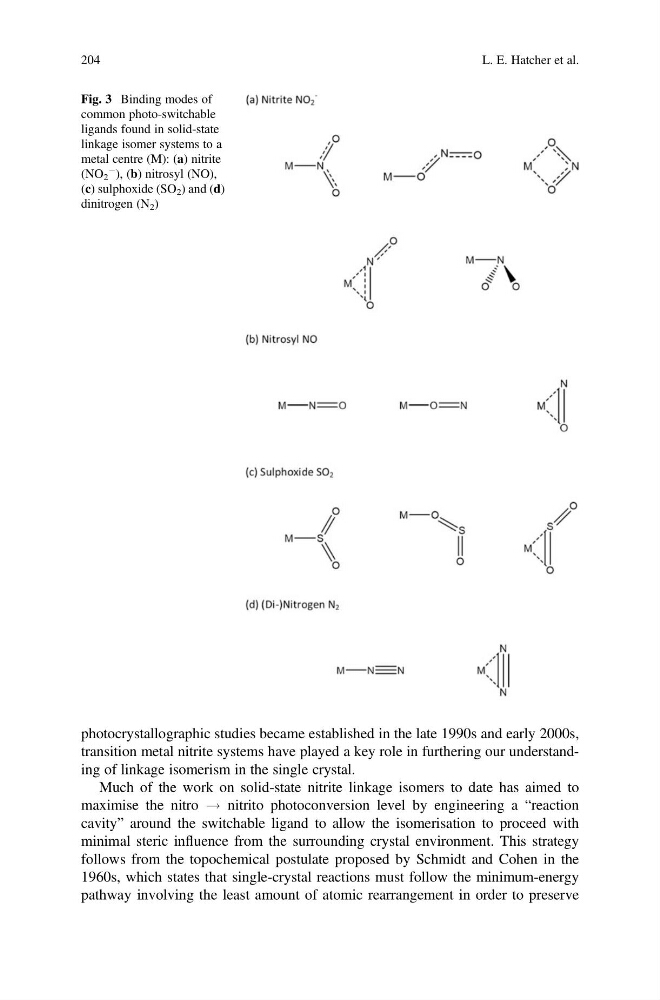
Fig. 3 Binding modes of
common photo-switchable
ligands found in solid-state
linkage isomer systems to a
metal centre (M): (a) nitrite
(NO 2
À
), (b) nitrosyl (NO),
(c) sulphoxide (SO 2 ) and (d)
dinitrogen (N 2 )
204
L. E. Hatcher et al.
transition metal nitrite systems have played a key role in furthering our understanding of linkage isomerism in the single crystal.
Much of the work on solid-state nitrite linkage isomers to date has aimed to
maximise the nitro ! nitrito photoconversion level by engineering a “reaction
cavity” around the switchable ligand to allow the isomerisation to proceed with
minimal steric influence from the surrounding crystal environment. This strategy
follows from the topochemical postulate proposed by Schmidt and Cohen in the
1960s, which states that single-crystal reactions must follow the minimum-energy
pathway involving the least amount of atomic rearrangement in order to preserve
Fig. 3 Binding modes of
common photo-switchable
ligands found in solid-state
linkage isomer systems to a
metal centre (M): (a) nitrite
(NO 2
À
), (b) nitrosyl (NO),
(c) sulphoxide (SO 2 ) and (d)
dinitrogen (N 2 )
204
L. E. Hatcher et al.