

isomerism date back to the early 1900s, when the existence of yellow and red forms
of the coordination complex [Co(NH 3 ) 5 (NO 2 )]Cl 2 was explained by the nitrite
(NO 2
À ) ligand coordinating through N or O to produce two complexes with distinct
crystal field splitting (Fig. 1). In 1956, it was shown using infrared (IR) spectroscopy
that the O-bound nitrito form converts to the more stable N-bound nitro form over
time in the solid state [3]. Solution
18 O labelling experiments further demonstrated
that the NO 2 ligand does not exchange with solvent and thus that the isomerisation is
an intramolecular process [4].
A breakthrough in this field came in 1997 when Carducci et al. reported SCXRD
experiments on sodium nitroprusside (Na 2 [Fe(CN) 5 (NO)].2H 2 O; SNP), in which
single crystals were photoexcited in situ using a laser [1]. Previous studies using
Mössbauer spectroscopy and calorimetry showed that light irradiation at low temperature produced two long-lived metastable intermediates that can co-exist in the
same crystal. The crystallography experiments confirmed the existence of three
distinct isomers corresponding to different binding modes of the NO ligand, viz. a
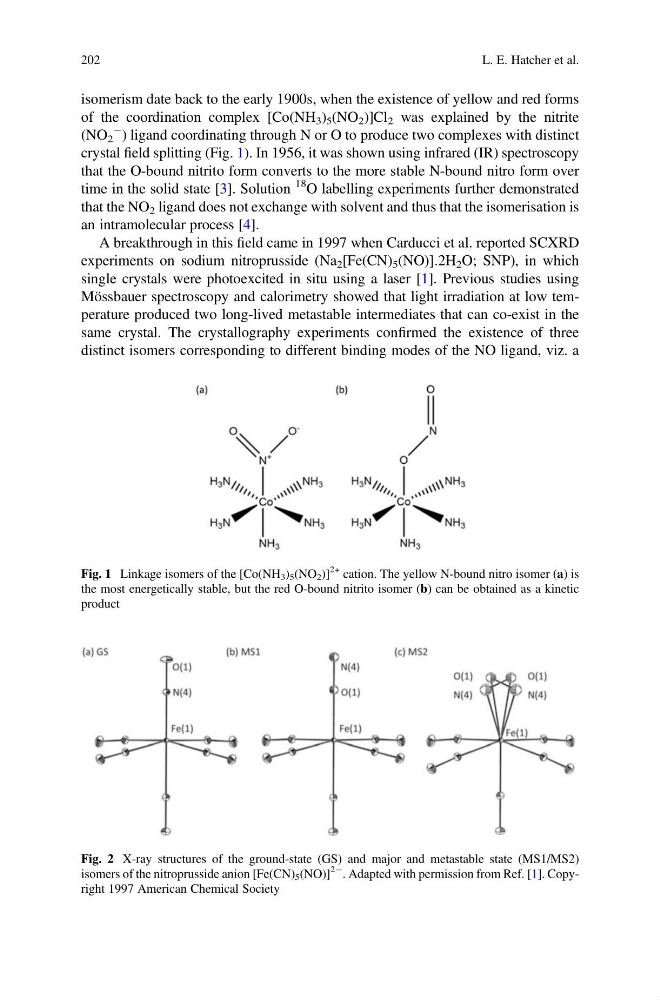
Fig. 1 Linkage isomers of the [Co(NH 3 ) 5 (NO 2 )]
2+ cation. The yellow N-bound nitro isomer (a) is
the most energetically stable, but the red O-bound nitrito isomer (b) can be obtained as a kinetic
product
Fig. 2 X-ray structures of the ground-state (GS) and major and metastable state (MS1/MS2)
isomers of the nitroprusside anion [Fe(CN) 5 (NO)]
2À
. Adapted with permission from Ref. [1]. Copyright 1997 American Chemical Society
202
L. E. Hatcher et al.
of the coordination complex [Co(NH 3 ) 5 (NO 2 )]Cl 2 was explained by the nitrite
(NO 2
À ) ligand coordinating through N or O to produce two complexes with distinct
crystal field splitting (Fig. 1). In 1956, it was shown using infrared (IR) spectroscopy
that the O-bound nitrito form converts to the more stable N-bound nitro form over
time in the solid state [3]. Solution
18 O labelling experiments further demonstrated
that the NO 2 ligand does not exchange with solvent and thus that the isomerisation is
an intramolecular process [4].
A breakthrough in this field came in 1997 when Carducci et al. reported SCXRD
experiments on sodium nitroprusside (Na 2 [Fe(CN) 5 (NO)].2H 2 O; SNP), in which
single crystals were photoexcited in situ using a laser [1]. Previous studies using
Mössbauer spectroscopy and calorimetry showed that light irradiation at low temperature produced two long-lived metastable intermediates that can co-exist in the
same crystal. The crystallography experiments confirmed the existence of three
distinct isomers corresponding to different binding modes of the NO ligand, viz. a
Fig. 1 Linkage isomers of the [Co(NH 3 ) 5 (NO 2 )]
2+ cation. The yellow N-bound nitro isomer (a) is
the most energetically stable, but the red O-bound nitrito isomer (b) can be obtained as a kinetic
product
Fig. 2 X-ray structures of the ground-state (GS) and major and metastable state (MS1/MS2)
isomers of the nitroprusside anion [Fe(CN) 5 (NO)]
2À
. Adapted with permission from Ref. [1]. Copyright 1997 American Chemical Society
202
L. E. Hatcher et al.