

and reabsorbed on decompression. The net result in the magnetic properties is the
conversion of the complex from a fast-relaxing to slow-relaxing species on increasing pressure to 1.44 GPa. Jahn-Teller switching was also observed in the previously
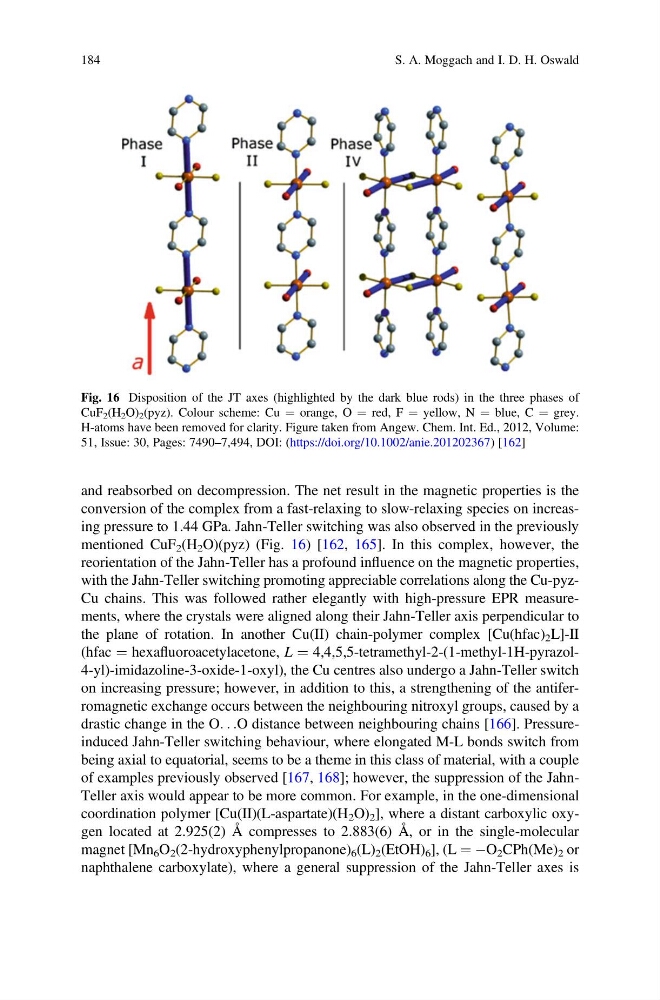
mentioned CuF 2 (H 2 O)(pyz) (Fig. 16) [162, 165]. In this complex, however, the
reorientation of the Jahn-Teller has a profound influence on the magnetic properties,
with the Jahn-Teller switching promoting appreciable correlations along the Cu-pyzCu chains. This was followed rather elegantly with high-pressure EPR measurements, where the crystals were aligned along their Jahn-Teller axis perpendicular to
the plane of rotation. In another Cu(II) chain-polymer complex [Cu(hfac) 2 L]-II
(hfac ¼ hexafluoroacetylacetone, L ¼ 4,4,5,5-tetramethyl-2-(1-methyl-1H-pyrazol4-yl)-imidazoline-3-oxide-1-oxyl), the Cu centres also undergo a Jahn-Teller switch
on increasing pressure; however, in addition to this, a strengthening of the antiferromagnetic exchange occurs between the neighbouring nitroxyl groups, caused by a
drastic change in the O. . .O distance between neighbouring chains [166]. Pressureinduced Jahn-Teller switching behaviour, where elongated M-L bonds switch from
being axial to equatorial, seems to be a theme in this class of material, with a couple
of examples previously observed [167, 168]; however, the suppression of the JahnTeller axis would appear to be more common. For example, in the one-dimensional
coordination polymer [Cu(II)(L-aspartate)(H 2 O) 2 ], where a distant carboxylic oxygen located at 2.925(2) Å compresses to 2.883(6) Å, or in the single-molecular
magnet [Mn 6 O 2 (2-hydroxyphenylpropanone) 6 (L) 2 (EtOH) 6 ], (L ¼ ÀO 2 CPh(Me) 2 or
naphthalene carboxylate), where a general suppression of the Jahn-Teller axes is
Fig. 16 Disposition of the JT axes (highlighted by the dark blue rods) in the three phases of
CuF 2 (H 2 O) 2 (pyz). Colour scheme: Cu ¼ orange, O ¼ red, F ¼ yellow, N ¼ blue, C ¼ grey.
H-atoms have been removed for clarity. Figure taken from Angew. Chem. Int. Ed., 2012, Volume:
51, Issue: 30, Pages: 7490–7,494, DOI: (https://doi.org/10.1002/anie.201202367) [162]
184
S. A. Moggach and I. D. H. Oswald
conversion of the complex from a fast-relaxing to slow-relaxing species on increasing pressure to 1.44 GPa. Jahn-Teller switching was also observed in the previously
mentioned CuF 2 (H 2 O)(pyz) (Fig. 16) [162, 165]. In this complex, however, the
reorientation of the Jahn-Teller has a profound influence on the magnetic properties,
with the Jahn-Teller switching promoting appreciable correlations along the Cu-pyzCu chains. This was followed rather elegantly with high-pressure EPR measurements, where the crystals were aligned along their Jahn-Teller axis perpendicular to
the plane of rotation. In another Cu(II) chain-polymer complex [Cu(hfac) 2 L]-II
(hfac ¼ hexafluoroacetylacetone, L ¼ 4,4,5,5-tetramethyl-2-(1-methyl-1H-pyrazol4-yl)-imidazoline-3-oxide-1-oxyl), the Cu centres also undergo a Jahn-Teller switch
on increasing pressure; however, in addition to this, a strengthening of the antiferromagnetic exchange occurs between the neighbouring nitroxyl groups, caused by a
drastic change in the O. . .O distance between neighbouring chains [166]. Pressureinduced Jahn-Teller switching behaviour, where elongated M-L bonds switch from
being axial to equatorial, seems to be a theme in this class of material, with a couple
of examples previously observed [167, 168]; however, the suppression of the JahnTeller axis would appear to be more common. For example, in the one-dimensional
coordination polymer [Cu(II)(L-aspartate)(H 2 O) 2 ], where a distant carboxylic oxygen located at 2.925(2) Å compresses to 2.883(6) Å, or in the single-molecular
magnet [Mn 6 O 2 (2-hydroxyphenylpropanone) 6 (L) 2 (EtOH) 6 ], (L ¼ ÀO 2 CPh(Me) 2 or
naphthalene carboxylate), where a general suppression of the Jahn-Teller axes is
Fig. 16 Disposition of the JT axes (highlighted by the dark blue rods) in the three phases of
CuF 2 (H 2 O) 2 (pyz). Colour scheme: Cu ¼ orange, O ¼ red, F ¼ yellow, N ¼ blue, C ¼ grey.
H-atoms have been removed for clarity. Figure taken from Angew. Chem. Int. Ed., 2012, Volume:
51, Issue: 30, Pages: 7490–7,494, DOI: (https://doi.org/10.1002/anie.201202367) [162]
184
S. A. Moggach and I. D. H. Oswald