

complex were studied to 9 GPa. The β-phase was found to undergo a pressureinduced phase transition at 6.8 GPa (designated β’), giving rise to a rearrangement of
the macrocycle to give a disordered structure, with each of the three independent
molecules in the β’ phase showing whole-molecule disorder. This is somewhat
unusual, in that disorder is induced on increasing pressure, as often the opposite is
observed, with smaller anisotropic displacement parameters and less disorder in a
material favouring a reduction in volume [158]. Nevertheless, it is not unheard of,
especially in solid-state materials, such as spinels [159].
4.3 Pressure-Induced Bond Formation and Breaking
Although the compression of M-M and M-L bonds is generally observed in metalcontaining compounds, examples of bond breaking and bond making are not nearly
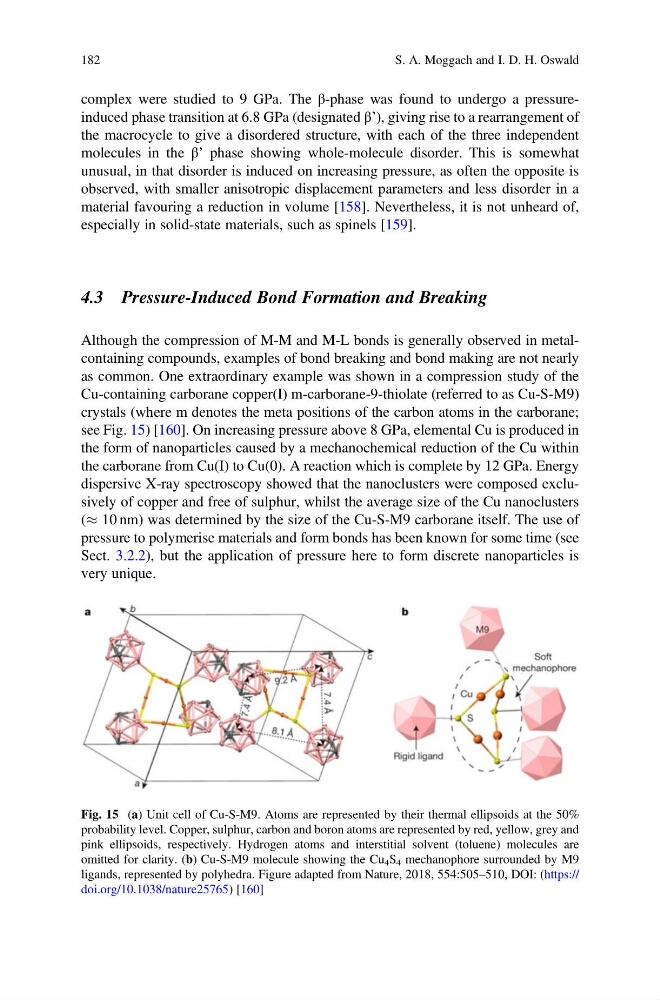
as common. One extraordinary example was shown in a compression study of the
Cu-containing carborane copper(I) m-carborane-9-thiolate (referred to as Cu-S-M9)
crystals (where m denotes the meta positions of the carbon atoms in the carborane;
see Fig. 15) [160]. On increasing pressure above 8 GPa, elemental Cu is produced in
the form of nanoparticles caused by a mechanochemical reduction of the Cu within
the carborane from Cu(I) to Cu(0). A reaction which is complete by 12 GPa. Energy
dispersive X-ray spectroscopy showed that the nanoclusters were composed exclusively of copper and free of sulphur, whilst the average size of the Cu nanoclusters
(% 10 nm) was determined by the size of the Cu-S-M9 carborane itself. The use of
pressure to polymerise materials and form bonds has been known for some time (see
Sect. 3.2.2), but the application of pressure here to form discrete nanoparticles is
very unique.
Fig. 15 (a) Unit cell of Cu-S-M9. Atoms are represented by their thermal ellipsoids at the 50%
probability level. Copper, sulphur, carbon and boron atoms are represented by red, yellow, grey and
pink ellipsoids, respectively. Hydrogen atoms and interstitial solvent (toluene) molecules are
omitted for clarity. (b) Cu-S-M9 molecule showing the Cu 4 S 4 mechanophore surrounded by M9
ligands, represented by polyhedra. Figure adapted from Nature, 2018, 554:505–510, DOI: (https://
doi.org/10.1038/nature25765) [160]
182
S. A. Moggach and I. D. H. Oswald
the macrocycle to give a disordered structure, with each of the three independent
molecules in the β’ phase showing whole-molecule disorder. This is somewhat
unusual, in that disorder is induced on increasing pressure, as often the opposite is
observed, with smaller anisotropic displacement parameters and less disorder in a
material favouring a reduction in volume [158]. Nevertheless, it is not unheard of,
especially in solid-state materials, such as spinels [159].
4.3 Pressure-Induced Bond Formation and Breaking
Although the compression of M-M and M-L bonds is generally observed in metalcontaining compounds, examples of bond breaking and bond making are not nearly
as common. One extraordinary example was shown in a compression study of the
Cu-containing carborane copper(I) m-carborane-9-thiolate (referred to as Cu-S-M9)
crystals (where m denotes the meta positions of the carbon atoms in the carborane;
see Fig. 15) [160]. On increasing pressure above 8 GPa, elemental Cu is produced in
the form of nanoparticles caused by a mechanochemical reduction of the Cu within
the carborane from Cu(I) to Cu(0). A reaction which is complete by 12 GPa. Energy
dispersive X-ray spectroscopy showed that the nanoclusters were composed exclusively of copper and free of sulphur, whilst the average size of the Cu nanoclusters
(% 10 nm) was determined by the size of the Cu-S-M9 carborane itself. The use of
pressure to polymerise materials and form bonds has been known for some time (see
Sect. 3.2.2), but the application of pressure here to form discrete nanoparticles is
very unique.
Fig. 15 (a) Unit cell of Cu-S-M9. Atoms are represented by their thermal ellipsoids at the 50%
probability level. Copper, sulphur, carbon and boron atoms are represented by red, yellow, grey and
pink ellipsoids, respectively. Hydrogen atoms and interstitial solvent (toluene) molecules are
omitted for clarity. (b) Cu-S-M9 molecule showing the Cu 4 S 4 mechanophore surrounded by M9
ligands, represented by polyhedra. Figure adapted from Nature, 2018, 554:505–510, DOI: (https://
doi.org/10.1038/nature25765) [160]
182
S. A. Moggach and I. D. H. Oswald