

Co-crystals of paracetamol (VIII) have also been investigated at pressure. The
paracetamol/piperazine system was used as an exemplar to demonstrate the potential
to isolate new forms of co-crystals at high pressure. In this study we were able to use
the recrystallisation technique to isolate a new ethanol solvate of paracetamol/
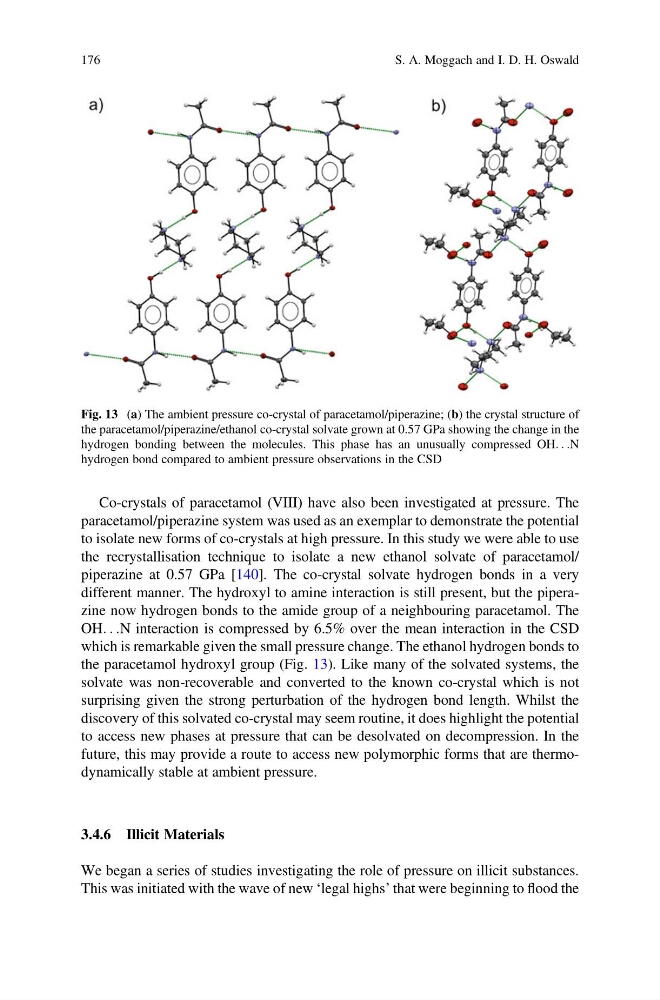
piperazine at 0.57 GPa [140]. The co-crystal solvate hydrogen bonds in a very
different manner. The hydroxyl to amine interaction is still present, but the piperazine now hydrogen bonds to the amide group of a neighbouring paracetamol. The
OH. . .N interaction is compressed by 6.5% over the mean interaction in the CSD
which is remarkable given the small pressure change. The ethanol hydrogen bonds to
the paracetamol hydroxyl group (Fig. 13). Like many of the solvated systems, the
solvate was non-recoverable and converted to the known co-crystal which is not
surprising given the strong perturbation of the hydrogen bond length. Whilst the
discovery of this solvated co-crystal may seem routine, it does highlight the potential
to access new phases at pressure that can be desolvated on decompression. In the
future, this may provide a route to access new polymorphic forms that are thermodynamically stable at ambient pressure.
3.4.6 Illicit Materials
We began a series of studies investigating the role of pressure on illicit substances.
This was initiated with the wave of new ‘legal highs’ that were beginning to flood the
Fig. 13 (a) The ambient pressure co-crystal of paracetamol/piperazine; (b) the crystal structure of
the paracetamol/piperazine/ethanol co-crystal solvate grown at 0.57 GPa showing the change in the
hydrogen bonding between the molecules. This phase has an unusually compressed OH. . .N
hydrogen bond compared to ambient pressure observations in the CSD
176
S. A. Moggach and I. D. H. Oswald
paracetamol/piperazine system was used as an exemplar to demonstrate the potential
to isolate new forms of co-crystals at high pressure. In this study we were able to use
the recrystallisation technique to isolate a new ethanol solvate of paracetamol/
piperazine at 0.57 GPa [140]. The co-crystal solvate hydrogen bonds in a very
different manner. The hydroxyl to amine interaction is still present, but the piperazine now hydrogen bonds to the amide group of a neighbouring paracetamol. The
OH. . .N interaction is compressed by 6.5% over the mean interaction in the CSD
which is remarkable given the small pressure change. The ethanol hydrogen bonds to
the paracetamol hydroxyl group (Fig. 13). Like many of the solvated systems, the
solvate was non-recoverable and converted to the known co-crystal which is not
surprising given the strong perturbation of the hydrogen bond length. Whilst the
discovery of this solvated co-crystal may seem routine, it does highlight the potential
to access new phases at pressure that can be desolvated on decompression. In the
future, this may provide a route to access new polymorphic forms that are thermodynamically stable at ambient pressure.
3.4.6 Illicit Materials
We began a series of studies investigating the role of pressure on illicit substances.
This was initiated with the wave of new ‘legal highs’ that were beginning to flood the
Fig. 13 (a) The ambient pressure co-crystal of paracetamol/piperazine; (b) the crystal structure of
the paracetamol/piperazine/ethanol co-crystal solvate grown at 0.57 GPa showing the change in the
hydrogen bonding between the molecules. This phase has an unusually compressed OH. . .N
hydrogen bond compared to ambient pressure observations in the CSD
176
S. A. Moggach and I. D. H. Oswald