

biological systems. Specifically, John Bernal and William Astbury were encouraged
to study the diffraction patterns of proteins. Sumner established in 1946 that
enzymes produced diffraction patterns, and in subsequent years, the majority of
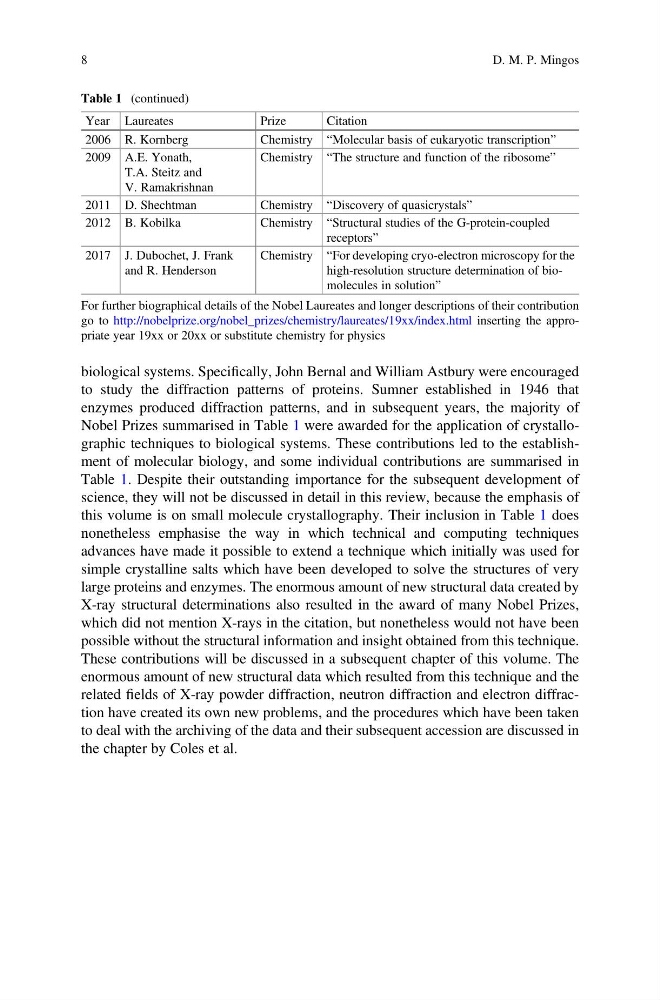
Nobel Prizes summarised in Table 1 were awarded for the application of crystallographic techniques to biological systems. These contributions led to the establishment of molecular biology, and some individual contributions are summarised in
Table 1. Despite their outstanding importance for the subsequent development of
science, they will not be discussed in detail in this review, because the emphasis of
this volume is on small molecule crystallography. Their inclusion in Table 1 does
nonetheless emphasise the way in which technical and computing techniques
advances have made it possible to extend a technique which initially was used for
simple crystalline salts which have been developed to solve the structures of very
large proteins and enzymes. The enormous amount of new structural data created by
X-ray structural determinations also resulted in the award of many Nobel Prizes,
which did not mention X-rays in the citation, but nonetheless would not have been
possible without the structural information and insight obtained from this technique.
These contributions will be discussed in a subsequent chapter of this volume. The
enormous amount of new structural data which resulted from this technique and the
related fields of X-ray powder diffraction, neutron diffraction and electron diffraction have created its own new problems, and the procedures which have been taken
to deal with the archiving of the data and their subsequent accession are discussed in
the chapter by Coles et al.
Table 1 (continued)
Year Laureates
Prize
Citation
2006 R. Kornberg
Chemistry “Molecular basis of eukaryotic transcription”
2009 A.E. Yonath,
T.A. Steitz and
V. Ramakrishnan
Chemistry “The structure and function of the ribosome”
2011 D. Shechtman
Chemistry “Discovery of quasicrystals”
2012 B. Kobilka
Chemistry “Structural studies of the G-protein-coupled
receptors”
2017 J. Dubochet, J. Frank
and R. Henderson
Chemistry “For developing cryo-electron microscopy for the
high-resolution structure determination of biomolecules in solution”
For further biographical details of the Nobel Laureates and longer descriptions of their contribution
go to http://nobelprize.org/nobel_prizes/chemistry/laureates/19xx/index.html inserting the appropriate year 19xx or 20xx or substitute chemistry for physics
8
D. M. P. Mingos
to study the diffraction patterns of proteins. Sumner established in 1946 that
enzymes produced diffraction patterns, and in subsequent years, the majority of
Nobel Prizes summarised in Table 1 were awarded for the application of crystallographic techniques to biological systems. These contributions led to the establishment of molecular biology, and some individual contributions are summarised in
Table 1. Despite their outstanding importance for the subsequent development of
science, they will not be discussed in detail in this review, because the emphasis of
this volume is on small molecule crystallography. Their inclusion in Table 1 does
nonetheless emphasise the way in which technical and computing techniques
advances have made it possible to extend a technique which initially was used for
simple crystalline salts which have been developed to solve the structures of very
large proteins and enzymes. The enormous amount of new structural data created by
X-ray structural determinations also resulted in the award of many Nobel Prizes,
which did not mention X-rays in the citation, but nonetheless would not have been
possible without the structural information and insight obtained from this technique.
These contributions will be discussed in a subsequent chapter of this volume. The
enormous amount of new structural data which resulted from this technique and the
related fields of X-ray powder diffraction, neutron diffraction and electron diffraction have created its own new problems, and the procedures which have been taken
to deal with the archiving of the data and their subsequent accession are discussed in
the chapter by Coles et al.
Table 1 (continued)
Year Laureates
Prize
Citation
2006 R. Kornberg
Chemistry “Molecular basis of eukaryotic transcription”
2009 A.E. Yonath,
T.A. Steitz and
V. Ramakrishnan
Chemistry “The structure and function of the ribosome”
2011 D. Shechtman
Chemistry “Discovery of quasicrystals”
2012 B. Kobilka
Chemistry “Structural studies of the G-protein-coupled
receptors”
2017 J. Dubochet, J. Frank
and R. Henderson
Chemistry “For developing cryo-electron microscopy for the
high-resolution structure determination of biomolecules in solution”
For further biographical details of the Nobel Laureates and longer descriptions of their contribution
go to http://nobelprize.org/nobel_prizes/chemistry/laureates/19xx/index.html inserting the appropriate year 19xx or 20xx or substitute chemistry for physics
8
D. M. P. Mingos