

investigated are chloroform and its bromo- and iodo-analogues. At high pressure all
three systems are isostructural with one another crystallising in P6 3 /m with the only
difference being the pressure at which the high-pressure polymorph is observed.
β-Chloroform is observed between 0.62 and 0.75 GPa [13], whilst δ-bromoform [13]
crystallises at much lower pressure of 0.2 GPa and iodoform transforms at 0.85 GPa
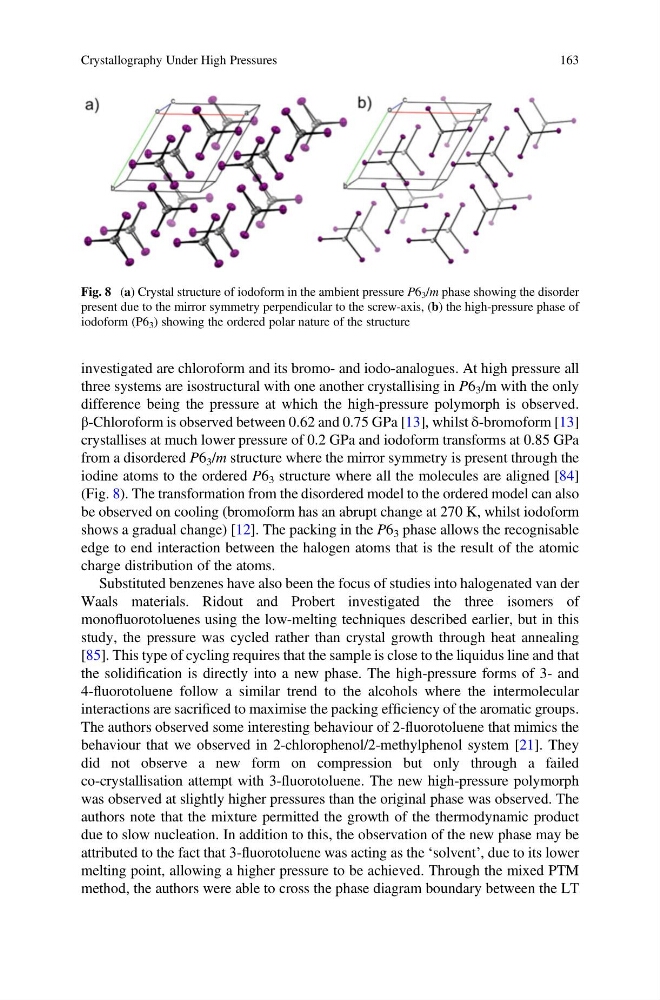
from a disordered P6 3 /m structure where the mirror symmetry is present through the
iodine atoms to the ordered P6 3 structure where all the molecules are aligned [84]
(Fig. 8). The transformation from the disordered model to the ordered model can also
be observed on cooling (bromoform has an abrupt change at 270 K, whilst iodoform
shows a gradual change) [12]. The packing in the P6 3 phase allows the recognisable
edge to end interaction between the halogen atoms that is the result of the atomic
charge distribution of the atoms.
Substituted benzenes have also been the focus of studies into halogenated van der
Waals materials. Ridout and Probert investigated the three isomers of
monofluorotoluenes using the low-melting techniques described earlier, but in this
study, the pressure was cycled rather than crystal growth through heat annealing
[85]. This type of cycling requires that the sample is close to the liquidus line and that
the solidification is directly into a new phase. The high-pressure forms of 3- and
4-fluorotoluene follow a similar trend to the alcohols where the intermolecular
interactions are sacrificed to maximise the packing efficiency of the aromatic groups.
The authors observed some interesting behaviour of 2-fluorotoluene that mimics the
behaviour that we observed in 2-chlorophenol/2-methylphenol system [21]. They
did not observe a new form on compression but only through a failed
co-crystallisation attempt with 3-fluorotoluene. The new high-pressure polymorph
was observed at slightly higher pressures than the original phase was observed. The
authors note that the mixture permitted the growth of the thermodynamic product
due to slow nucleation. In addition to this, the observation of the new phase may be
attributed to the fact that 3-fluorotoluene was acting as the ‘solvent’, due to its lower
melting point, allowing a higher pressure to be achieved. Through the mixed PTM
method, the authors were able to cross the phase diagram boundary between the LT
Fig. 8 (a) Crystal structure of iodoform in the ambient pressure P6 3 /m phase showing the disorder
present due to the mirror symmetry perpendicular to the screw-axis, (b) the high-pressure phase of
iodoform (P6 3 ) showing the ordered polar nature of the structure
Crystallography Under High Pressures
163
three systems are isostructural with one another crystallising in P6 3 /m with the only
difference being the pressure at which the high-pressure polymorph is observed.
β-Chloroform is observed between 0.62 and 0.75 GPa [13], whilst δ-bromoform [13]
crystallises at much lower pressure of 0.2 GPa and iodoform transforms at 0.85 GPa
from a disordered P6 3 /m structure where the mirror symmetry is present through the
iodine atoms to the ordered P6 3 structure where all the molecules are aligned [84]
(Fig. 8). The transformation from the disordered model to the ordered model can also
be observed on cooling (bromoform has an abrupt change at 270 K, whilst iodoform
shows a gradual change) [12]. The packing in the P6 3 phase allows the recognisable
edge to end interaction between the halogen atoms that is the result of the atomic
charge distribution of the atoms.
Substituted benzenes have also been the focus of studies into halogenated van der
Waals materials. Ridout and Probert investigated the three isomers of
monofluorotoluenes using the low-melting techniques described earlier, but in this
study, the pressure was cycled rather than crystal growth through heat annealing
[85]. This type of cycling requires that the sample is close to the liquidus line and that
the solidification is directly into a new phase. The high-pressure forms of 3- and
4-fluorotoluene follow a similar trend to the alcohols where the intermolecular
interactions are sacrificed to maximise the packing efficiency of the aromatic groups.
The authors observed some interesting behaviour of 2-fluorotoluene that mimics the
behaviour that we observed in 2-chlorophenol/2-methylphenol system [21]. They
did not observe a new form on compression but only through a failed
co-crystallisation attempt with 3-fluorotoluene. The new high-pressure polymorph
was observed at slightly higher pressures than the original phase was observed. The
authors note that the mixture permitted the growth of the thermodynamic product
due to slow nucleation. In addition to this, the observation of the new phase may be
attributed to the fact that 3-fluorotoluene was acting as the ‘solvent’, due to its lower
melting point, allowing a higher pressure to be achieved. Through the mixed PTM
method, the authors were able to cross the phase diagram boundary between the LT
Fig. 8 (a) Crystal structure of iodoform in the ambient pressure P6 3 /m phase showing the disorder
present due to the mirror symmetry perpendicular to the screw-axis, (b) the high-pressure phase of
iodoform (P6 3 ) showing the ordered polar nature of the structure
Crystallography Under High Pressures
163